
SILENT WITNESS

HALIFAX, Nova Scotia, April 11, 2026 – If they want to believe it’s love, let them: It’s all they have. We know it isn’t God’s Love, but we’re blessed to be able to receive God’s Love, so the least we can do, being so blessed, is to let them believe what they want, even if it’s a lie.
Especially if it’s a lie.
One of the great mercies we can afford as children of God is to let people believe what they want to believe. If that’s all they want, that’s all they’ll get. It would be wrong of us to take away that small comfort of a lie told to them so many times it’s become truth to them. We should never take away their lie. It’s not ours to take.
Paul writes about people so far gone—so lost in sin—that God just lets them be. He doesn’t send Paul to preach to them; he just lets them be.
Some people, not sent from God, argue that we should urgently witness to these souls, and the louder the better – that we should invade their claimed spaces and subject them to the spiritual equivalent of waterboarding. But these preachers have been sent on a fool’s errand that will only end in loathing and rage on both sides. You cannot override what God has decreed, and if God has decreed them lost (like the people written about by Paul, or the people just before the flood, or the people in Sodom just before it rained fire and brimstone), then lost they’ll be. You don’t want to fight against God’s decrees because to do so would be to deny God’s justice and to fight against God himself. We can’t do those things and still call ourselves God’s children. Let the worldly church fight the fight not blessed by God, if that’s what they want to do. But we, like Paul, must stand back and stand down because to do anything else would be to defy God.
It was not easy for Paul to see the level of sin he saw and remain silent. It’s not easy for us, either. In these cases, we must change our tactics, knowing that nothing we say will persuade them to change. So we say nothing. We treat them with the same courtesy that we would want to be treated with (as commanded by Jesus), but we say nothing about their sin. We don’t involve ourselves in their sin; we don’t celebrate their sin; we don’t question their sin; we don’t even acknowledge their sin: Taking our cue from Paul, we separate ourselves from their sin, speaking of it only among ourselves, if necessary, but otherwise remaining silent.
We are silent not out of fear of them but out of fear of God.
Our silence is witness enough.
ELDAD AND MEDAD, AND US

HALIFAX, Nova Scotia, April 11, 2026 – Eldad and Medad have their 15 milliseconds of Biblical fame buried deep within Numbers. If you rush through the book, you might miss it. Still, Eldad and Medad rank as prophets, because scripture tells us that God’s Spirit spoke through them. They are a prototype of us bornagain believers, a forerunner of what God had in store for his people, so long as they are God’s people.
Eldad and Medad were not among the 70 elders officially designated by Moses to receive a share of God’s Spirit. They had remained behind in the camp when the summoned chosen dutifully filed into the tabernacle to be tapped. And yet God chose the two men to receive his Spirit outside the tabernacle, having seen something in those two that Moses initially missed.
However, as soon as the Spirit fell upon Eldad and Medad and they started prophesying, a boy who heard them ran to tell Joshua, who then rushed to tell Moses, expecting him to immediately silence them. To Joshua’s way of thinking, because Eldad and Medad were not of the 70 chosen elders, their prophesying was undercutting Moses’ authority.
But Moses didn’t see it that way. He knew the two men were prophesying by God’s Holy Spirit, by direct appointment of God. And so instead of commending Joshua for his loyalty, Moses reprimanded him, saying:
Enviest thou for my sake? would God that all the Lord’s people were prophets, and that the Lord would put his spirit upon them!
(Numbers 11:29)
As Moses’ protégé, Joshua got schooled and schooled hard in that exchange. But he obviously also learned from it, because later he himself would be guided and emboldened by God’s Holy Spirit, becoming not only a great leader but also one of only two of the original 600,000+ men who left Egypt who ultimately made it to the promised land.
Moses and Joshua’s exchange reminds me of the New Testament passage where the people are shouting “Hosanna in the highest!” during Jesus’ procession into Jerusalem. The Pharisees command Jesus to silence them, to which Jesus replies that if he did silence them, the very rocks beneath their feet would cry out instead. The lesson here is that you can’t interfere with Spirit-led prophesying, as it comes directly from God. Attempting to do so only makes disciples and prophets even of rocks and mountains and trees, which will then proclaim the glory of God everywhere and unfettered.
Moses’ wish that “all the Lord’s people were prophets” finally came true when Jesus founded his Church nearly a millennium and a half later. Everyone in that Church is born again, each with a unique measure of God’s Spirit according to God’s grace. Like Eldad and Medad, all of us bornagain believers are God’s prophets, whether we are recognized by the world (and the worldly church) as such or not. You cannot have God’s Spirit in you and not be a prophet of God, as having God’s Spirit is the very definition of a prophet: “The testimony of Jesus is the spirit of prophecy”.
We all remember the instant when God first put his Spirit in us – how suddenly we “saw” and how easily we prophesied! Nothing could have silenced us in those early days of our rebirth any more than the disciples could have been silenced at Pentecost: The force of God’s Spirit was overwhelming. I can imagine that Eldad and Medad experienced much the same thing, though with them it wasn’t spiritual rebirth: It was more a visitation of God’s Spirit, like it was for all prophets of God prior to Jesus founding his Church. Still, like us at our rebirth, Eldad and Medad were unstoppable in their prophesying, which Moses in his God-given wisdom recognized for what it was. There was a place and a purpose for Eldad and Medad, just as there was a place and a purpose for Moses and his 70 chosen elders, just as there’s a place and a purpose for us, God’s saints, during the prophesied falling away.
And yet despite the force of God’s Spirit when it first enters us, none of us are fully spiritually formed at that time, not even Jesus. We begin with a bang at our rebirth and grow from there. Jesus had a head start on all of us, being conceived of the Holy Spirit, but he still had to go through his paces, he still had to make his mistakes and learn from them, he still had to bide his time and patiently wait. Part of the waiting was for his sake and part for the sake of others, so that God could strengthen Jesus for his appointed tasks while also getting all his ducks in a row. God likewise has us wait at times. When that happens, it may seem like we’re spinning our spiritual wheels, going nowhere, but that’s just God’s way of preparing us by letting us steep, like tea: the longer we steep, the stronger we get.
We just need to be careful not to grow cold and bitter while we steep.
FORTY SACRED DAYS: THE TRANSITION

HALIFAX, Nova Scotia, April 6, 2026 – The Jesus who rose from the dead looked nothing like the rabbi Jesus. In fact, he looked so different, it’s likely his own mother didn’t recognize him. Certainly, his disciples didn’t, and they’d been with him for three whole years, night and day, talking to him, listening to him, memorizing every curve and angle of his face, the way you soak in every last detail of a loved one. And yet even they—his chosen few—thought he was just another stranger, and an ill-informed one at that, when they first came upon him on the road to Emmaus. They didn’t have a clue they were talking to their risen Lord until he outed himself at dinner.
I would have loved to have been a fly on the wall during that encounter! I bet Jesus could barely hold back a smile at their fumbling earnestness. Did God supernaturally withhold Jesus’ identity from them? Scripture says he did. It was probably another test of sorts, the way we’re tested when God withholds the identity of angels from us. He wants to see how we’ll interact with strangers when we don’t know we’re being watched. I never know I’ve had an angelic encounter until the angel is long gone. Still, there’s something about them even as I’m talking to them that triggers something inside me. Something that nags at me the way something nagged at the disciples on the road to Emmaus. They described it as their hearts burning within them, a knowing without knowing what it was they knew. The same thing happens when we encounter God’s holy angels here on Earth and, to a lesser degree, when we encounter other genuine bornagain believers in person.
We can only wonder where Jesus went and what he did in the 40 days leading up to his ascension. We know he spent several hours with his disciples and other followers, but that time accounts for only a small portion of the nearly six weeks. Was he here on Earth the whole time, or did he do some day trips and maybe even a few overnighters in Heaven? He told the “good thief” on the neighboring cross that he’d be with him that day in Paradise, so we can assume from this scripture that Jesus did have physical as well as spiritual access to the heavenly realms prior to his publicly witnessed ascension. How much access, we don’t know. (Maybe we don’t need to know.) It’s still fascinating to think about how he slipped back and forth between Heaven and Earth not only “in the spirit” but physically, like the holy angels do, all decked out in his shiny new but unrecognizable-to-those-who’d-known-him-before body that was being upgraded to heavenly standards day by day.
In contrast to the wide reach of Jesus’ ministry during the preceding three years, very few on Earth got to see the risen Jesus before he ascended. And even of those who did get to see him, some still doubted it was him because he looked and sounded and moved so different from the Jesus they knew. It might have seemed to them that it was Jesus but not Jesus, because it actually was Jesus but not Jesus, the way we’ll be us but not us if we make it to Heaven – same soul, but different body, different voice, different movement.
Different memories.
Jesus has never stopped teaching us, not from the moment Moses first mentioned him all the way up until now. But in those 40 sacred days between his resurrection and ascension, Jesus taught us something very special: He gave us a glimpse into what awaits us if we make it Home. And what did he teach us? That we’ll look entirely different from what we do now, and that our bodies will have entirely different capabilities. For instance, we’ll be able to appear and disappear at will. Among humans, we’ll appear human, though not recognizable (people who knew us before won’t know who we are). We’ll be able to eat food (yay! lol). We’ll be able to move between the heavenly and earthly realms with the same ease as God’s holy angels. And we’ll continue to help and teach much in the same way as we help and teach now, only with greater authority: We’ll command attention without demanding it, and our words will have impact, due to the fulness of God’s Holy Spirit that will be in us.
When all is said and done, this is what I’m waiting for – that glorious transition from here to there, from the earthly to the heavenly, spiritually and physically. I thank God for giving Jesus the grace of time to show us what that transition looks like.
“AS THE DAYS OF NOAH”: NO MORE CONVERSIONS
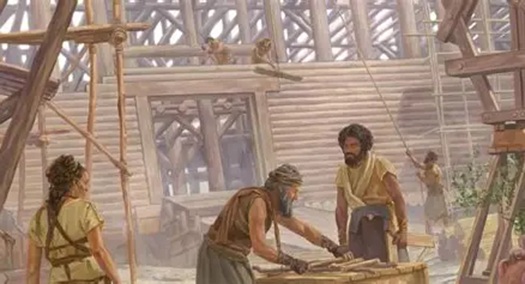
HALIFAX, Nova Scotia, April 2, 2026 – In describing the final stages of the end times, Jesus likened them to “the days of Noah”. But what did he mean by that? The book of Genesis tells us that those days were unimaginably evil, and that the evil was not just confined to people but had manifested in all the animals as well. We also know from the Gospels that the people in Noah’s age appeared to be blissfully unaware of the horror that was about to be unleashed on them and that they went about their daily lives as if God and his judgement didn’t exist.
Sound familiar? Jesus could well have been describing our own age.
Noah, as we know from scripture, was the only one who “found grace” in God’s eyes. Not his wife, not his three sons or their wives, only Noah. Still, Noah’s grace was sufficient to spiritually cover his family and a certain number of animals, and so they, too, were spared from the watery grave that would claim everyone and and everything else. But it was only Noah who was righteous and had found grace in God’s eyes. This point is important.
When God commanded Noah to build the ark, giving him the exact design specifications as well as the reason for building it, Noah obeyed God to the letter. He didn’t argue with God about the seemingly impossible construction timeline (according to the book of Jubilees, just over one year) or about excluding everyone but his immediate family from the ark. He didn’t beg God to spare his village or at least the children in it. He didn’t rail at God for not giving anyone else a chance. He simply put his head down, nose to the grindstone, and did as God commanded.
There were no more conversions to God’s way of righteousness after Noah received his instructions. We know there were no more conversions because God implicitly states in scripture that only Noah found grace in his eyes. Once God had decided enough was enough and that judgement was due, the line was drawn separating Noah from everyone else. No-one else squeaked through even at the eleventh hour because no-one else was given the chance to squeak through.
As a bornagain believer, you are likely well acquainted with the anguish of praying for people who are deep in sin, only to have God gently chide you not to pray for them anymore. I remember the first time that happened to me; I witnessed a different side of God’s mercy. Paul describes it as God giving people over to their sins: If they choose evil, God lets them have evil. He positions us as witnesses (silent or otherwise) to his Truth, but he lets the sinners be, and he tells us likewise to let them be.
I believe that Noah was tunnel-visioned after he received his ark-building instructions from God. I don’t believe, as some Bible commentators have proposed, that Noah frantically preached to his unrepentant evil generation. I believe that he just let them be in their sins and focused instead on doing God’s will, which in this case was to build the ark and prepare for the flood. I believe this because over and over again, scripture informs us that after a certain point, God washes his hands of sinners. He no longer tries to correct them or to send anyone to try to correct them; he just lets them be.
We see this in the days of Noah, we see this in the days leading up to the destruction of Sodom, and we see this in the days leading up to the fall of Jerusalem prior to the Babylonian exile. Conversions to righteousness don’t happen, not after a certain point. We read in Ezekiel 9 how none are spared but those who are already righteous in God’s eyes. Even little children are not spared. We need to stare this fact directly in the face and see it for what it is. We dare not look away; we dare not pretend it isn’t so; else, we’ll waste precious time doing what we shouldn’t be doing by praying and preaching to the already lost, and in so doing disobeying God.
And still the sinners will sneer: “Where then is your precious God’s mercy?”, to which the only reply can be: “In letting you live the life you choose, in letting you sin freely, since you’ve shown that’s all you want. In allowing you to reject God—to disbelieve he even exists—while still giving you what you want: That’s God’s mercy.”
When Jesus says the final stages of the end times will be like the days of Noah, he means, among other things, there’ll be no more conversions. He means the line will already have been drawn separating the righteous from the unrighteous, from those who have found grace in God’s eyes and those who have not. The book of Revelation underscores this truth in showing that, after the sealings that take place prior to the opening of the seventh seal, there are no more conversions. Not a one.
In the past, I have stupidly—that is, without God’s guidance— prayed for people who were already lost. When God finally intervened and told me not to pray for them anymore, he explained that he doesn’t want them to be hounded. He loves them even though they’ve rejected him, and he wants them to have whatever little bit of happiness they can eke out from whatever time they have left. He tells me: “This is all they have. This time here, now – this is all they have. Let them be.”
And so I let them be. I put my nose to the spiritual grindstone, and I let them be.
You must do the same.
He that is unjust, let him be unjust still: and he which is filthy, let him be filthy still….
Revelation 22:11

