
GREATER THAN MONEY

HALIFAX, Nova Scotia, August 31, 2026 – Prior to starting his ministry, Jesus worked as a carpenter. By “worked”, I mean he offered his services in exchange for payment. Jesus either accepted money or bartered for the amount he’d negotiated for his carpentry services. There’s nothing in scripture that would indicate he’d done otherwise.
But when he started his ministry, his payment terms changed drastically. He no longer negotiated or demanded any payment at all for the ministry services he offered, whether healing, teaching, preaching, or just performing random miracles along the way. He did everything for free. There’s nothing in scripture that would indicate he did otherwise.
Still, Jesus needed money for his daily needs. We all need money for our daily needs. But what we don’t need is to charge a fee in exchange for our ministry services.
I’ve already stated here in this blog and elsewhere that anyone who charges a fee to preach is not bornagain. Ditto for people who charge a fee for praying, healing, teaching about the Kingdom, or otherwise providing information on spiritual development, including counseling. “Pay for pray” is a worldly (i.e., unregenerated) church phenomenon, as is demanding and accepting payment for preaching. The worldly church gets paid for this kind of work and does so with God’s permission (as Jesus said, they have their reward).
But we, as bornagain believers, must never request payment for doing God’s work because it’s not us doing the work: it’s God, by his Spirit, working through us. We must never ask for donations. We must never ask for an honorarium. We must never ask for payment for preaching and teaching the Word. Never. Not once. Not under any circumstance.
Don’t you dare.
Because if you ask for money for doing what you’ve received from God for free, God will take it from you in other ways, and with interest. You’ll end up much poorer financially and spiritually than you would have been had you not demanded payment. The worldly church, yes, gets paid in worldly ways, but God arranges for his children to be paid in different ways, and always more than enough.
You won’t have to ask; it will be offered.
Consider Jesus. He never charged anything for his ministry services, and yet he always had more than enough for his needs. People donated their money and resources without him having to ask. And on the rare occasion when his needs unexpectedly exceeded the norm and it appeared that he was going to come up short, God would provide a timely miracle, like placing the gold coin in the fish’s mouth so that Jesus could pay the tribute tax (with money to spare), or multiplying a handful of loaves and fishes so that Jesus could feed a multitude (with basketsful to spare).
I know, without your having to tell me, that God has provided you with more than one timely miracle since your rebirth. I know, because he’s done it for me, too. He does it for all his children, even without them having to ask him for help. In fact, the most substantial financial and other gifts I’ve received since my rebirth came out of the blue from sources I either didn’t previously know or didn’t suspect would want to help me. This is how God works, and it is an enormous blessing for us but even more so for the people who provide for us at God’s (usually anonymous) prompting.
Money is a worldly construct. As such, it has no place in God’s Kingdom. No genuine bornagain believers will accept payment for preaching and teaching the Word. If they did so in error, they’ll still suffer for it and will hopefully learn from their suffering not to do it again, knowing that the worst kind of suffering is separation from God. If you’re genuinely bornagain, demanding payment for doing God’s work will very swiftly separate you from God in the same way as purposely sinning will, and none of us want that. None of us want to be even a handsbreadth away from our heavenly Father. For us, separation from God is the worst state imaginable, much worse than an empty purse or a gnawing stomach. And if after doing God’s work we still end up broke and starving, it will only be to test us and will soon pass.
We know from the example set by Jesus that God provides for his children. From the start of his ministry, Jesus did his Father’s work diligently and for free, and so must we. No exceptions. As Jesus reminds us, you cannot serve God and mammon. The God we serve is greater than money. We don’t honor him by refusing to accept unsolicited donations (we must always accept those; never let pride stop you, as unsolicited donations are God-prompted and will bless the donor more than us). We honor God by refusing to demand payment for ministry services. In this as in all things, Jesus—not the worldly church—is our example.
The God we serve is greater than money.
The Good Lord provides.
ON HELPING THE UNHELPABLE

HALIFAX, Nova Scotia, August 25, 2026 –As bornagain believers, we sometimes can’t help ourselves from helping. But God doesn’t always want us to help. Sometimes our desire to help gets in the way of God’s justice. This is a hard spiritual truth that most of us had to learn the hard way. Peter learned it the hard way when he declared that he’d die rather than let Jesus be killed, and Jesus called him Satan for his efforts. We definitely don’t want to be called Satan by Jesus. And we definitely don’t want to get in the way of God’s justice.
There are many reasons why God shut Noah and his family into the ark. It wasn’t just because it was time for them to be shut in. It wasn’t just because God didn’t want them to be traumatized by witnessing the flood. And it wasn’t just because God didn’t want them to try to rescue those who were not supposed to be rescued. But this last reason—preventing Noah and his family from rescuing those who were not meant to be rescued—is likely the main one. Because after they were shut into the ark and the waters were unleashed, Noah and his family would have heard the terrified screams of people crying out for help; they would have heard people pounding on the side of the ark, begging to be let in; they would have heard the pitiable and haunting moans of children and animals just before they drowned. They would have heard all these things, and being the kind souls they were, Noah and his family have wanted to help. (I would wager that Noah’s wife would especially have wanted to help). But God didn’t want them to help, so he not only shut them into the ark before the waters rose, he supernaturally sealed the door so that they couldn’t leave, so that they couldn’t try to help the unhelpable.
The ark’s design also prevented anyone from scaling the vessel to gain unlawful entry.
(God thinks of everything!)
In the past, I have been guilty of attempting to help the unhelpable. Of course, my efforts failed spectacularly, which is a very painful way to learn what must be learned. So now when I see people who look like they could use some help, I ask God first whether or not I should help, and if God says “Yes”, I do, but if God says “No”, I don’t. I don’t quibble and I don’t argue. I don’t try to wheel and deal. I accept God’s word as final and get on with my day.
When people choose evil and earn the rewards of their choice, you not only have to respect their right to choose, you also have to respect their due reward for having chosen evil. You especially have to respect their due reward, because if you don’t respect it and try to override it with misdirected “help”, you’ll learn the hard way that you should not have tried to interfere with God’s justice. The people you’re trying to help will not be helped in any real way, and you’ll suffer the consequences of going against God. In so doing, you’ll essentially become the “Satan” that Jesus accused Peter of being.
Helping people can be a spiritual minefield. The only way to safely negotiate it is to ask God’s guidance whenever you feel the urge to lend a helping hand. Not everyone is on God’s list to be helped, and not everyone is on God’s list to be helped by you. You can learn this the hard way (not recommended), or you can save yourself the suffering and wait for God’s go-ahead.
In this, as in everything else, be like Jesus, who only ever did what God showed him to do. Many people today are beyond our help and many more are trending that way. We need to respect people’s right to choose evil, if that’s what they want, just as we’re to respect their due rewards for having chosen evil.
You can’t pray away God’s justice. Pray instead for God’s guidance and for God’s will to be done.
ON GIVING CHARITY
Ye said also, Behold, what a weariness is it… and ye brought that which was torn, and the lame, and the sick; thus ye brought an offering: should I accept this of your hand? saith the Lord.
But cursed be the deceiver, which hath in his flock a male, and voweth, and sacrificeth unto the Lord a corrupt thing: for I am a great King, saith the Lord of hosts, and my name is dreadful among the heathen.
Malachi 1:13-14
HALIFAX, Nova Scotia, August 22, 2026 – Giving alms or charity is like offering a sacrifice to God. I mention the connection between charity and sacrifice because it’s important for us on a spiritual level to give charity. And because it’s important, we should know how to do it, not so that it makes us feel good about ourselves, but so that it will be received by God as an acceptable and valuable sacrifice in the spiritual realm, which is the only realm that matters.
“Charity” has been mainstreamed in Western society to mean donating money or goods to a cause. In most cases, the funds or items donated do not in any real way affect the finances of the donor. The donation is made from superfluous wealth or what Jesus calls “abundance” (spare change, old clothes, used furniture, low-cost or nearly expired food, etc.) and is often done in exchange for value-in-kind, like a tax receipt. Charity given from abundance and that does not affect the core finances or wealth of the giver is not worth much in God’s eyes. He sees the gesture, but he doesn’t perceive any real value in the item sacrificed. The value of the sacrifice is crucially important to God: For a sacrifice, God demands a healthy male, unspotted and unblemished, not a weak and sickly thing that would not have survived into adulthood.
Considering the above, what kind of charity do you give? Does it affect your core finances or is it taken from your abundance? Do you request a tax receipt, essentially demanding to get back what you put out, or do you (as Jesus advised) give your alms without fanfare and anonymously, expecting nothing in return (not even a “thank you”)? Do you offer the best of what you have at any given moment, or do you merely cast off what you no longer need?
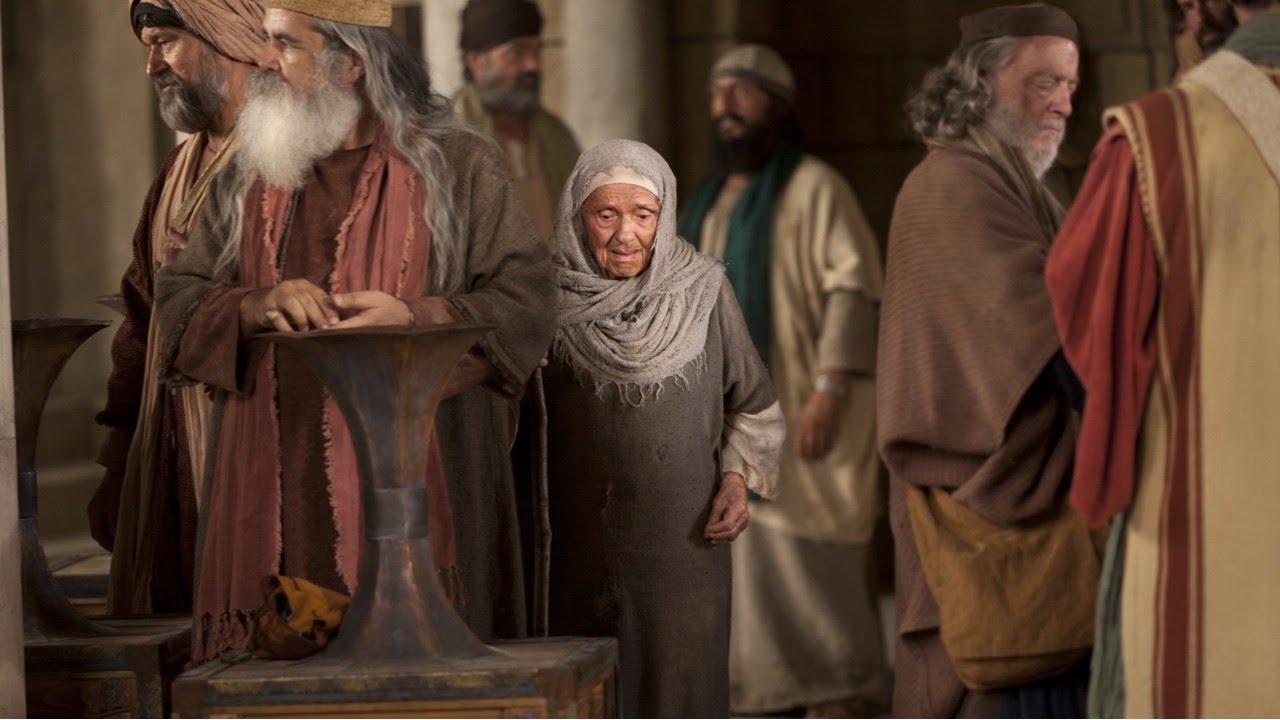
Recall the example of the old widow in the temple who gave everything she had to live on. Even though her ‘everything’ was but a pittance compared to the donations given by the wealthier donors, Jesus said that what the widow gave was in God’s eyes worth more than all the other donations combined. This is because she gave from her core resources while the others gave from their excess.
Please be advised that this is not an exhortation to immediately sell everything you have and give the proceeds to the poor (though God might in fact ask you to do that some day). Giving charity is an essential feature of being bornagain, but like everything else it needs to be guided by God, which means it needs to be done in his time and in his way. The heartstring-tugging ads showcasing starving African children who can be fed for just 10 dollars a day are not meant for us, knowing that nearly 100% of the donated funds are swallowed up in administrative and advertising costs. When God invites us to give charity, it’s both a test of our obedience and an opportunity to bless someone in a targeted and meaningful way. And being a test, God lets us know not only precisely what we should give, but when and how we should give it.
In a church service a few years ago, I witnessed a young usher pocketing money from the collections plate. I knew that he was new to the congregation (and new to the country), and I was surprised that he’d been asked to collect the donations, as that task usually fell to older, trustworthy church members. I glanced up at the pastor sitting at the altar, but he seemed unaware of the theft. Or if he was aware of it, he didn’t show it. I thought to tell him after the service what I’d seen, but God advised me not to. What I’d witnessed was a test both of the usher and of the pastor and so had nothing to do with me. What it did teach me, though, was not to contribute to the collections plate at that or any other church unless God specifically directs me to.
When we give charity in ways that are not directed by God—that is, as a performative gesture or a social obligation, to be seen and approved by others—we essentially give in vain. Our only reward is the pat we give ourselves on our own back. But when we give alms under God’s direction, our charity bears fruit. No-one but God needs to know what we’ve given, since God is the one who evaluates our gift, allocates who should receive it, and blesses us accordingly. The spiritual value of our charitable sacrifice is not the value the world sets on it. In the spiritual realm, the value of our donation is based on our ready willingness to give what God specifically asks of us, and to give it in God’s way.
Pray to God to guide you in giving charity, knowing that if you give it as directed, you’ll be bountifully blessed.
ON NOT READING THE BIBLE

HALIFAX, Nova Scotia, August 20, 2026 – I was offered the opportunity a few years back to learn Biblical (ancient) Hebrew so that I could read the Old Testament in the original script. I considered the opportunity, discussed it with God, and then respectfully declined. The same opportunity arose again recently, and again I respectfully declined. I’m not against learning Biblical Hebrew or against reading a text in its original language. Both of those things have their merits. I just don’t need to learn Biblical Hebrew in order to read the Bible. In fact, I don’t need to read the Bible at all, and I’ve learned from God that it’s best not to read it.
Let me explain.
The Bible is not a book in the sense that other books are, well, mere books. Unlike mere books, the Bible is a living instrument that God uses to teach us about himself, his Kingdom, and whatever it is we need to learn at any given moment. You can read the Bible, if you want to, in much the same way as you can read a mere book, but your reward in reading the Bible this way is that you’ll get from it as much as you would a mere book. That is to say, you won’t get nothing out of it, but you also won’t get much.
The Bible isn’t meant to be read by us: It’s meant to be read to us by God through his Holy Spirit. If we try to read the Bible under our own initiative and by our own understanding—if we pore over it like the temple elders pored over their scrolls, searching in vain for evidence that the Messiah should or should not come from Nazareth—we’ll learn about people who lived in different places at times, about what these people did (or didn’t do), and about how they died. In learning these things, we’ll form a rough idea of the characters named throughout the Bible, but that’s about it. In other words, we’ll get from the Bible the same depth of information we’d get from any other book, any other mere book.
But if we let God read the Bible to us through his Holy Spirit (the same Holy Spirit that lives in each one of us), something entirely different happens. We see beyond the words on the page, be they ancient or modern Hebrew, Greek, English, etc. In fact, we don’t even need words when God reads us the Bible. The day I was reborn, God spoke to me not in words but in ideas and images. The same thing happens when God reads us the Bible, which is why the language on the page in front of us doesn’t matter. God will help us understand what we need to understand and to see what we need to see supernaturally. Even the version of the Bible (King James vs English Standard vs New Revised Standard, etc.) is ultimately irrelevant: If changes were made to the original text that God didn’t approve, he’ll skip right over them, and we won’t even know they’re there.
We don’t need to approach the Bible as experts in ancient languages: We just need to ask God to read it to us, and he will. And when we open his book (we still need to open it!) to the chapters and verses he wants us to focus on, he’ll open our understanding in ways that can never happen if we read the Bible on our own. He’ll teach us not through the words on the page but through his Word and by the power of his Holy Spirit.
So don’t bother reading the Bible; let God read it to you.
IS THE BIBLE HOLY?

HALIFAX, Nova Scotia, August 17, 2026 – Is the Bible holy? Every Bible cover asserts it. Most Christians unquestioningly agree. But what precisely (if anything) is “holy” about the Bible?
As I’ve mentioned previously in this blog, I came to belief relatively late in life. I wasn’t “raised in the faith”; I was unexpectedly and instantaneously reborn on a lonely stretch of beach in South Australia. During that miraculous process, my belief was delivered to me on a silver platter before I even knew I believed. In other words, I knew what I believed before I knew I believed it. I was taught of God by God. I still am.
Prior to my rebirth, the Bible was one of those things I could not stand being around. I found the Old Testament boring and the New Testament gobbledygook. The New Testament particularly irked me, as the letters of the words all ran together to form a language that was incomprehensible to me. Even if I’d wanted to read the words of Jesus in my unbeliever days, I wouldn’t have been able to. They were like reading a foreign language I had no knowledge of. Still, within an hour of my rebirth, there I was, sitting at my kitchen table reading (devouring!) the New Testament of our Lord and Saviour Jesus Christ. I haven’t stopped reading it since.
Over the years, the Bible has become my constant companion. Or better said, Bibles have become my constant companions. When one wears out—when the cover falls off and/or the pages fall out—I get another one. And because I can’t bring myself to throw out my “used” Bibles, I’m surrounded by Bibles in varying stages of disintegration. I have one on my pillow, one next to my bed, one on my desk, one on my kitchen table, a few on my fireplace mantle, and one in the oversized canvas bag I haul around with me wherever I go. Far from being the symbol of loathing it once was to me, the Bible has become a cornerstone of my life.
But is it holy?
I discussed in an earlier article the essence of holiness and what makes a person holy. Holiness is one of God’s characteristics that God can confer on whoever he wills through his aptly named Holy Spirit. In other words, where the Holy Spirit is, there is holiness; where the Holy Spirit is not, there is no holiness. Holiness is given by God through his Spirit and controlled by God through his Spirit. Therefore, a thing or person in and of themselves cannot be holy without the will of God and the presence of God’s Holy Spirit.
A Bible is a book. I am under no delusion that the Holy Spirit hovers over the well-worn pages of my dog-eared Bibles. However, because a measure of God’s Holy Spirit is within me (which he gave to me at my rebirth), I know with God-inspired certainty that within the Bible’s pages are certain thoughts and words that were inspired by God through his Holy Spirit. Not the entire book—not every word that’s written in it—but certain thoughts and words.
But is that enough to make the Bible itself holy?
From my perspective, the “Holy Bible” emblazoned on the cover of every Bible refers not to the entire book but to those words and thoughts within it that are holy, that come from God. The holy words and thoughts are sandwiched in between words and thoughts that are not necessarily holy (not having been inspired by God) but are still supportive and reflective of the holiness. Think of it like a diamond ring that is not made exclusively of diamonds but still contains diamonds as its central feature, the rest of the ring being made of gold or silver or some other metal that supports and showcases the diamonds and enables the ring to be worn. We don’t call it a “diamond and gold ring” or a “diamond and silver ring”, just simply a diamond ring. In the same way, we don’t call it the “Holy and Holy-adjacent Bible” but simply the Holy Bible, understanding that the holiness is set within and shines among the supportive (though not in themselves holy) words.
So yes, my fellow bornagain believers, the Bible is holy. Not every word in it but enough to justify the exalted title. I do not deify the Bible or worship it as a holy relic to be held aloft and paraded in processions (as some denominations do), but I do love and unquestioningly believe in those parts that come directly from God. When I hug and kiss my poor tattered Bibles, it’s the holiness of God’s thoughts and words that I’m embracing, a holiness that has its source in God and is as close as I’ll get to hugging and kissing God—my Heavenly Father!— until I get Home.
 A BORN-AGAIN BELIEVER