
Home » Uncategorized (Page 2)
Category Archives: Uncategorized
DOUBLE VISION
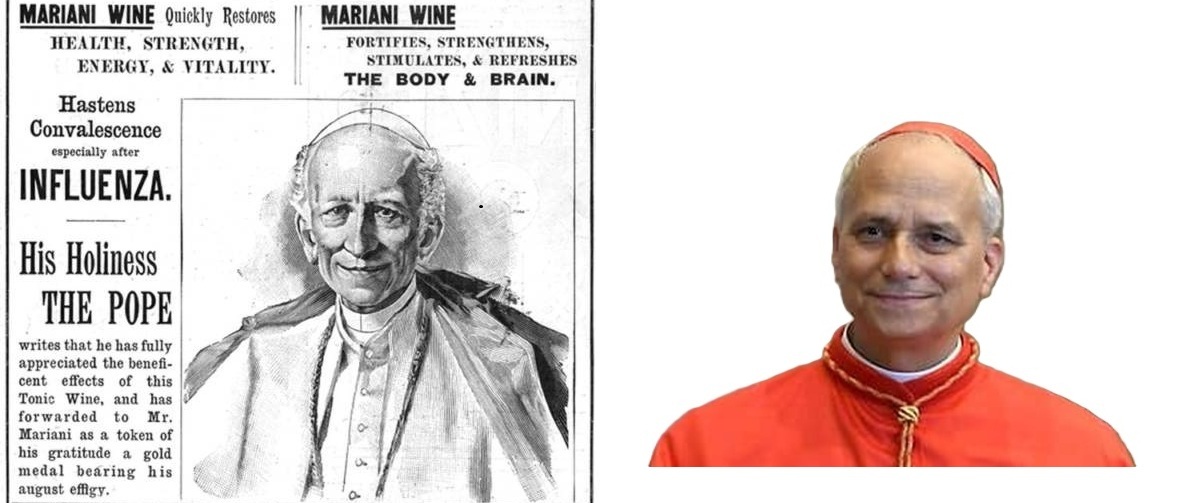
HALIFAX, Nova Scotia, May 25, 2025 – “Vin Mariani” was a sweet alcoholic medicinal concoction popular in Europe in the mid-to-late 1800s. It’s main claim to fame was the addition of coca to the brew, an ingredient which allegedly cured everything from fatigue to muscle weakness to melancholy. Many famous people swore by the efficacy of this elixir, including the reigning pope at the time. In fact, Leo the 13th was so enamored with the stuff, he declared it his favorite drink and bestowed upon its inventor the Vatican’s golden seal of approval.
Sadly, Vin Mariani is no longer with us, but its non-alcoholic offspring—Coca-Cola™—very much is. Did you know that Coca-Cola was inspired by Vin Mariani? And guess who swears by Coca-Cola as his all-time favorite drink? Our very own Pope Leo the 14th, who, by the way, bears an uncanny physical resemblance to Pope Leo the 13th (see pics above). Just look at the noses and the set of the lips! Just look at those eyes!
And did you know that the separated-at-birth Leos the 13th and 14th both ascended the papal throne at age 69? Or that #13 holds the record for being the oldest pope ever, reigning until his death at age 93? (Maybe they should have added longevity to Vin Mariani’s list of attributes!) Will our Coca-Cola-fueled #14 give #13 a run for his money and set a new all-time papal age record? We might want to hope so, considering what various prophecies claim is in store for the end of Pope Leo the 14th’s reign.
Along with being renowned for his tippling of Vin Mariani and his record-setting papal age, Leo the 13th is also famous for a vision he allegedly had while celebrating mass at the Vatican chapel in 1884. Just as he was about to leave the altar, the heavens opened and the pope was privy to a conversation between God and Satan. No-one else attending the mass could see or hear the conversation, but several eye-witnesses claim that Leo the 13th fell into a trance-like state and remained motionless for about 10 minutes, his face upturned and ashen. (Sounds like ol’ Leo could have used a swig of Vin Mariani!) When he regained movement, the pope hastily left the chapel and retreated to his office, where he likely did have a swig or two of the Vin (or something stronger), and likely also wrote the vision down.
While a full and official account of what Leo the 13th saw and heard in the chapel that day was never made public, snippets of the vision’s contents have trickled out over the years via the ecclesiastical rumor mill. From what can be pieced together so far, the alleged conversation between God and Satan concerned the destruction of the church, with Satan requesting the power and a specific amount of time to destroy Catholicism. God granted him both. The specific amount of time was 75 to 100 years.
A few decades later, a Portuguese girl who later became a nun would allegedly be given a similar vision of the destruction of Catholicism and Rome in what has since become known as the the third secret of Fatima. That vision was written down, sealed, and given to the Vatican for safe-keeping until it was unsealed and made public in the year 2000. And we’re all now very much aware (or should be) of Malachy’s prophecy of the final pope—Petrus Romanus—presiding over the destruction of the church and Rome. We’ve also determined that Leo the 14th, with his Roman (Italian) heritage and his surname of Prevost, which is an anagram of Petrus (Peter), is in fact the prophesied Petrus Romanus, or Peter the Roman, hidden in plain view.
So now we have a Coca-Cola-swigging pope, Leo the 14th, who’s nearly the spitting image of his immediate predecessor namesake pope, Leo the 13th, who also happened to swig a drink that was the immediate predecessor of Coca-Cola, with both popes having ascended the papal throne at age 69 and both being directly connected to a series of visions concerning the destruction of Catholicism and Rome. Are these all just coincidences and “woo-woos” that mean nothing? Let’s hope so. Let’s sincerely hope so. As much as I have issues with Catholicism (“issues” being a polite term), the destruction of the worldly church is not good for anyone, including us born-again believers. Yes, our own beloved Church, being safely tucked away in the spiritual realm, will continue strong and undefiled until Jesus comes back in glory to take the last of us Home, but the death of the worldly church will signal the start of a very bad time here on Earth, culminating in the institutionalization of luciferianism as the sole acceptable belief system, or what John in the book of Revelation describes as the reign of the beasts.
The timing, according to all the above-mentioned prophecies, appears to be set and permission granted. Demonic elements within the worldly church are organizing the destruction from within. This is not an attack from without but from within, and a diabolically well-organized one at that. As much as we want to forestall the destruction of the worldly church, especially in consideration of what its end signifies, the forces of evil embedded within it are longing for its annihilation and laboring tirelessly towards that end. And we appear to have a timeframe for the destruction: no later than the end of the reign of Leo the 14th, a.k.a. Petrus Romanus—Peter the Roman—the current pope, aged 69, who may or may not live past the all-time papal age record of 93. If the prophecies are accurate, we can’t stop what’s coming, but we can make good use of whatever time we have left.
So, be bold, my fellow born-again believers! Be true to your mission! Be brave! Do whatever you can to get God’s Word out while there’s still time. And if you find that your energy is lagging—that your spirit is willing, but your flesh is weak—have a coke.
HABEMUS PAPAM: POPE PETER THE ROMAN

HALIFAX, Nova Scotia, May 8, 2025 – So, we have our Pope Peter the Roman after all, hidden (as they say) in plain sight.
“Prevost” is an anagram of “Petros V”, and “petros” is the Greek form of “Peter”.
Definition auto-compiled from two websites (one, two):
Petros is a name of Greek origin that means “rock”. It is an alternate form of Peter. The name derives from Latin “petra” (Petrus), from the Ancient Greek “petra” / “Petros”, from the Aramaic word “kephas”, which in turn derives from the Syriac “kefa”, all words meaning “stone, rock”.
“Kephas”, of course, is what Jesus surnamed his disciple Simon, the one we know as Peter and allegedly the first pope.
Pope Petros, who is of Italian heritage, will now sit in Rome, satisfying the prophecy for “Peter the Roman” in every conceivable way.
In case you’re new to this game, here is the last verse of Malachy’s prophecy, translated into English:
“In the final persecution of the Holy Roman Church, there will sit Peter the Roman, who will pasture his sheep in many tribulations, and when these things are finished, the city of seven hills will be destroyed, and the dreadful judge will judge his people. The End.”
So again, there we have it. They done did it. They followed the script to the letter, and now, I guess, we’re doomed.
Pope Petros is 69. I give him 20-25 years at most, which gives the rest of us about 20-25 years before the “S” really Hits The Fan.
Remember – this is a script they’re following. It’s not a prophecy; it’s a script.
Malachy might have intended it as a prophecy, but they’re following it as a script.
As my grandmother would say (if she spoke Latin): Deus adiuvet nos omnes.
WHO’S DIRECTING YOUR PLANS?

HALIFAX, Nova Scotia, May 2, 2025 – We all have plans. Lots of them. From the time we wake up in the morning until the time we go to sleep at night, we’re making plans: Work plans. Meal plans. Shopping plans. Travel plans. Sometimes we even make plans to make time to make plans.
And yet, with all our planning, who’s directing us? Are we inspired by God’s Spirit or by our own will and impulse? Do we do what we do because we think we should do it (because someone has told us we should do it)? Or do we do what we do because God has advised us, one on one, to do it?
Who exactly is directing our plans?
The day I was born-again, I started reading the Bible. Better said, I started eating and drinking and absorbing God’s Word. I was spiritually ravenous. Like a newborn at the teat, I sucked and slurped and couldn’t get enough. And yet, there were some parts of God’s Word that were hard to swallow at the time. They stuck with me because they seemed to stick out. And every time I would read through the Bible, I would trip over them.
One of those parts is in James’ letter:
“Go to now, ye that say, Today or tomorrow we will go into such a city, and continue there a year, and buy and sell, and get gain:
Whereas ye know not what shall be on the morrow. For what is your life? It is even a vapour, that appeareth for a little time, and then vanisheth away.
For that ye ought to say, If the Lord will, we shall live, and do this, or that.
But now ye rejoice in your boastings: all such rejoicing is evil.
Therefore to him that knoweth to do good, and doeth it not, to him it is sin.” (James: 4:13-17)
It seemed to me at the time that James was being a stickler. What did it matter if we prefaced our plans with “If the Lord will”? Surely God would support all our efforts to do good in his name and that of his precious son? Surely nothing that we did in his or Jesus’ name would go to waste? Surely everything we did with our heart in the right place would be duly noted and weighed in our favor? Surely it couldn’t be considered “evil” or “sin” if we did what we did with good intentions?
You would think. At least that’s what the world tells us: “His heart was in the right place”, “he had good intentions”, “he meant right”. I mean, wasn’t it James himself who told Jesus to get out there and do things to prove to the world that he was the Messiah (only to be knocked back by Jesus with that very same advice James would later give to us in his letter)? The world’s way of doing things is to do something because it seems like it should be done, or to jump in head-first and worry about the details later. Duty and compulsion. That’s the world’s way.
But is it God’s way?
Scripture very plainly says we’re to be patient and wait for God’s directive and timing. We’re always to be patient and wait for God’s directive and timing. We can’t assume tomorrow, let alone next year: We can’t even assume the rest of today. We always need to be patient and wait for God’s directive and timing.
Years ago, I tried to start a Bible study. I did everything I thought I needed to do to prepare for it, but no-one showed up. Day after day I waited in the appointed meeting room at the appointed time, but no-one showed up. Even the people who’d contacted me to tell me they were coming were no-shows. Eventually I gave up and realized that God didn’t want me to do the Bible study, at least not at that time. It was a very humbling experience for me, but also a profound teaching moment.
If God isn’t in it, it has no value. If God isn’t personally directing your steps, you’re better off standing still and remaining silent. How many of us make wild and empty gestures thinking we’re doing the right thing – “the Christian thing” – but how many of us will instead end up like King Saul, who also thought he was doing the right thing by sparing the choicest livestock for later sacrifice, even though God had specifically told him to kill everyone and everything and take nothing with him?
Make sure your offers of sacrifice are God-directed and not self-directed. There is no such thing as “a Christian thing to do”: There is only what God wills and what he doesn’t will. All our plans, whether directly in service to God or in our more mundane daily rounds, need to be inspired and directed by God. If they’re not, they’re not worth doing, and they might (like Saul) even get us condemned.
James was absolutely right in saying that we need to defer to God in making our plans. He wasn’t being a stickler; he was stating the scripture-based obvious. Some of us just take a little longer than others to get it.
SEED

HALIFAX, Nova Scotia, April 24, 2025 – They dream of us, the kind of dreams you don’t tell your spouse or your significant other or even your therapist. (And never your mentor.) Dreams so raw, they rush in a fever as soon as they wake to look us up. But we have nothing to do with those dreams; they aren’t from us. We aren’t responsible for them. We haven’t sent them. God uses us as we’ve given him permission to use us, in some cases begged him to use us, and so he makes use of us. Some of our best work for the Kingdom is done entirely without our knowledge and solely because we begged God to use us.
After the first dreams comes the obsession. Not for all, but for some. Flashbacks that progress to a slow reaching out and then a quick pulling back when they find who we’ve become. Then the headshaking and sneering and dismissal, but still the thoughts. Always the thoughts. Back of the mind, front of the mind. Seed planted. And, for some, more dreams.
The first heart-pounding contact tests the waters. They don’t tell their spouse or significant other or therapist about that, either. Sometimes we engage and sometimes we don’t, depending on what God advises. Sometimes it’s best just to stay out of it completely and let God use us as we’ve given him permission to use us. God knows exactly what to do at precisely the right time, when and where to plant seed. We don’t. We’ll likely only make a mess of it.
Did you know that we’re being tested by those dreams, too? Not just the dreamers – we dreamees are also being tested. We’re being tested in how we respond. Which is why we need to defer to God and not take matters into our own hands. We must never forge ahead thinking we’ll wing it and that we can handle it and that we have everything under control, because we can’t handle it and don’t have anything under control. The forces working against us, though nowhere near as strong as God, are still degrees of magnitude more powerful than us. We cannot deal with them on our own, and to believe that we can is a trap.
I’ve been caught in that trap, many a time, and had to learn not to take the bait. I had to learn to defer to God, always defer to God. We’ve not sent the dreams, but they’ll come looking for us. How we handle them is a testament to who we’ve become.
Some of our best work is done entirely without us.
DRILL SERGEANT JESUS

HALIFAX, Nova Scotia, February 18, 2025 – When it starts, it will happen so suddenly, you won’t realize it’s started until after you catch your breath. You won’t want to be caught then with your spiritual pants down around your ankles, because the odds will not be in your favor if that happens. Which is why Jesus warned us always to watch and always to keep our loins girded. He means we should always be spiritually ready. If we’re spiritually ready, we won’t be caught with our pants down.
And we’ve all had that, as a teaser, as a tester, being caught unawares, in a moment of slackness, resting on our lees, taking our ease with our pants down around our ankles, and it wasn’t pretty. God puts us through our paces so we can experience how horrible that feels and learn to do whatever it takes not to let that happen again. Some of us had to go through those paces a few times and then a few times again before we finally learned what we needed to learn to God’s satisfaction. Because I guarantee you, you will not know when it starts that it has actually started, but you’ll still, by default – by training – need to respond at the top of your game.
When Jesus began his ministry work, he was like a kindergarten teacher corralling wayward children and trying his best to hold their attention with miracles and breathless stories. He handed out cures like lollipops and exorcisms like gold stars, and everyone who wanted one, got one. As his ministry progressed, he became more like a high school teacher, entrusting his best students with a small portion of his duties, sending them out two by two with strict instructions, all while keeping a close eye on the slackers lounging at the back cracking jokes. By the end of his ministry, Jesus had morphed into a full-blown drill sergeant. Even his finest recruits didn’t escape his wrath when it was called for. He needed them to fully internalize the blunt brutal seriousness of the work they were called to do, that it was an all-or-nothing situation, and that if they weren’t willing to give it their all, they had no place in his Kingdom.
We are now in the age of drill sergeant Jesus. The time for kindergarten Jesus and high school teacher Jesus is over. This is war we’re preparing for. We’ve already endured a few initial skirmishes, but the trumpet has yet to blow. We can still pray not to be here when the trumpet blows. But if it does and we’re here, we need to be ready, not just somewhat ready or good-enough ready or (my personal favorite) Jesus-will-take-care-of-everything ready, but special-ops-trained and loins-girded ready. Anything less, and we won’t make it.
You can’t run with your pants down around your ankles, and you’ll be doing lots of running in this war. You’ll be running towards the enemy as much as you’ll be running away, but there will be running. So you might as well settle in your mind now to be ready to run not at a moment’s notice, but at a millisecond’s.
ATTENNNNNN-CHUNN!
Chin up!
Chest out!
Gut in!
I said GUT IN!
Weapons ready!
Loins girded!
WATCH!
BE RIGHTEOUS STILL

HALIFAX, Nova Scotia, January 3, 2025 – In the instant before my rebirth, when I was still an atheist, God offered me the choice of two options and showed me a vision of two possible outcomes. In the first part of the vision, he showed me the outcome that would result if I chose to forgive, and in the second part, he showed me the outcome that would result if I chose not to forgive. Specifically, I was shown that if I chose to forgive, all my pain would disappear, and if I chose not to forgive, my pain would not only continue but worsen.
God offered me the choice and showed me the outcomes visually as well as by understanding. No words were spoken.
This vision has remained with me as a guide to this day.
**********
I mention the above because God gave me a choice that involved two options and their respective outcomes, and one of those outcomes was not good. Yet even though it wasn’t good, it also wasn’t immediate horrific death. God didn’t say: Choose this, and you’ll live forever, or choose that, and you’ll die immediately and horribly. Even with the bad outcome, I was offered the possibility of continuing my life on Earth, though in a progressively ever-worsening spiritual state and with the understanding that the opportunity I was being afforded at that time would not come around again.
Thank God I chose to forgive, but still, choosing not to forgive was also an option. I wasn’t forced to make the choice to forgive; I wasn’t threatened with immediate death if I chose not to forgive: I was simply shown the outcomes of each choice, urged to choose the option that would resolve my pain, and left to make the decision for myself.
I mention the ever-worsening spiritual state that results from choosing unforgiveness because many who have been given the same offer as I was given have chosen not to forgive, have chosen revenge. When you choose revenge over mercy, your life reflects that choice. When you take matters into your own hands, you suffer the consequences, with an emphasis on suffer. The suffering that comes to you after you exact what you think is your rightful revenge is of your own doing. In other words, you’ve brought your suffering on yourself and have no-one but yourself to blame.
Even worse, if you choose this course of action after rejecting the option that would free you of your pain, God himself can’t help you anymore. You might be mollified temporarily by earthly mollifications (booze, drugs, wealth, career success, deviant sex, and other diversions), you might even be shielded from further consequences for a time by making a deal with the devil, but your pain will never be purged like it would have been had you chosen mercy when you had the chance.
Geopolitically, nations undergo the same process as individuals, as nations are made up of individuals whose characters collectively determine the course of that nation. When the measure of righteous individuals in a nation is surpassed by the unrighteous, that nation begins an unstoppable decline into hell. Daniel writes of nations that had their dominions taken away and yet continued for thousands of years, though in a progressively humbled state. Examples include Iraq, Iran, Egypt, Ethiopia, Lebanon, and Syria. Their glory days are long behind them as they limp through the millennia, sinking deeper and deeper into poverty and chaos despite countless efforts at reform. Fast on the heels of the historically declined nations are the newly declining ones of former Christendom (Canada, US, UK, etc.). As with individuals, once the definitive decline begins, it cannot be reversed; it can be slowed, but not reversed.
Not one nation today is on the spiritual ascendent, and we can expect this trend to continue. There is a misguided notion of a future global messianic or Golden Age, a sort of Heaven on Earth, but nothing could be farther from the truth. Since the coming of Jesus, Heaven is as close to Earth as it will ever be. The Zion foretold in scripture is here and now, in the spiritual realm of God’s Kingdom on Earth. Scriptural Zion will only ever be in the spiritual realm, which is why Jesus pointedly stated that his Kingdom is not of this world.
Every choice we make during our time on Earth has consequences. At a pivotal point in our lives, God presents each of us with the opportunity to choose righteousness over revenge. The choice we make at that time cannot be undone and will determine our place in eternity, with few exceptions. If you’re genuinely reborn, you’ve chosen righteousness. Your job now is to keep on choosing righteousness, even if it means immediate and horrific death.
[H]e that is righteous, let him be righteous still; and he that is holy, let him be holy still.
And in the days of these kings shall the God of heaven set up a kingdom, which shall never be destroyed…. As concerning the rest, they had their dominion taken away: yet their lives were prolonged for a season and time.
VOTE EARLY AND VOTE OFTEN!

HALIFAX, Nova Scotia, November 5, 2024 – Just a reminder that God’s justice is perfect. Whichever new leader America ends up with today, America deserves, whether for good or for evil. You can’t override God’s justice by voting this way or that (or not at all) in an election, any more than you can override God’s justice by committing voter fraud, because the fact is that you vote every single day, all day, in everything you do.
Your entire life is one big vote.
So, if the pain you feel is the pain you’ve earned and the measure you mete is the measure you receive, and you want better leaders – be better people.
THE ONLY WAY FORWARD

HALIFAX, Nova Scotia, November 2, 2024 – Becoming more like Jesus doesn’t mean we have to grow our hair long and wear sandals. It means we make the same choices he did and embrace the same values he did, not because we’re trying to mimic him for the sake of mimicking him, but because he did things right.
If you’re genuinely born-again, you want to do things right. The desire to do things right is your default position in everything you do. You don’t consciously make it your default position; it becomes your default position at rebirth.
I was born-again from atheism, so I don’t share the mindset of people who are happy to remain in churchianity. When I say I don’t share their mindset, I mean I don’t understand it. I’ve never experienced it. For me, it’s been either zero belief or 100% belief. For me, there was never anything in between, by which I mean that in-between place where most people in churchianity dwell who say they believe but don’t live their belief.
When Jesus raised Jairus’s daughter from the dead, he took only three of his disciples and the dead girl’s parents into the girl’s room. There is a reason why Jesus did this and why it was meticulously recorded in the Gospels. Outside were crowds of people who mocked Jesus for saying the girl was not dead, just sleeping, but also outside and far far away were the rest of Jesus’ disciples whose faith wasn’t as strong as Peter’s and James’s and John’s. I wonder how they felt when Jesus looked past them and chose instead those three disciples to accompany him for the miracle. Was it a wake-up call for them, an incentive to grow their faith? Or did it shame them? Hurt them? (Maybe even get them a little angry?) All the disciples had been called at the same time to follow Jesus, but some had become much stronger in their faith than others. Why was that? Why did some grow fast and deep in faith, while others lagged behind?
We know it wasn’t for lack of opportunity that some of the disciples progressed more slowly than others. I mean, they were all living and working with Jesus. I can’t imagine a better opportunity to become more like Jesus than by watching him and hearing him and interacting with him day after day. So what makes people drag their heels in their faith journey? What side-tracks them? What makes them draw the belief line this far and no further?
Jesus gives us the answer:
If any man come to me and hate not his father, and mother, and wife, and children, and brethren, and sisters, yea, and his own life also, he cannot be my disciple.
And whosoever doth not bear his cross, and come after me, cannot be my disciple.
Whosoever he be of you that forsaketh not all that he hath, he cannot be my disciple.
This is not the first or the only time that Jesus tells people they have to leave their old life behind if they want to be his follower. It’s a theme that runs through the gospels from start to finish. But Jesus didn’t tell people to leave their families, quit their jobs, and give up all their possessions for his sake. Jesus wasn’t gaining anything from having them do these things. It wasn’t for his benefit that Jesus had them walk away from their old lives – it was for their own benefit. They were the ones who would gain from it.
And what would they gain? A closer relationship with God and everything that goes with having a close relationship with God. And how would they gain it? By relying more and more on God than on people and possessions. By leaving their minds undistracted and unburdened by “the cares of this world”, they’d be free to focus fully on the task at hand, as directed by Jesus.
The call to walk away from your old life is as loud and clear as it was when Jesus chose his first disciples. The call has not changed, even though some claim it was only for the early church, not for us today. But I disagree. Clinging to your old life lies at the root of weak and superficial faith, and weak and superficial faith explains why so many people who say they believe end up spinning their wheels in churchianity. Not making God their priority, they can’t receive what God wants to give them. Sure, they’ll have their family, but at what cost? Sure, they’ll keep their job and their possessions, but at what price and for how long?
Rebirth is like a birth: you arrive with nothing and are given everything you need to survive. But imagine a newborn refusing to let go of its placenta and umbilical cord. Imagine a newborn refusing to use its lungs to breathe. Imagine a newborn refusing to suck on a breast but instead crying for the blood transference that fed it in the womb. That newborn wouldn’t survive very long.
Yet that newborn is not unlike a Christian who refuses to let go of his old life.
Becoming more and more like Jesus is a call we need to answer every day. We do this by making the same choices Jesus did and for no other reason than that they were and are the right choices. If Jesus unequivocally says we’re to leave everything behind, we leave everything behind, and we do so not for Jesus’ sake, but for ours. We can’t claim to have a close relationship with God if we’re hanging onto the world’s umbilical cord. Letting go of our old life – giving it all up for God – is not only the best way forward for genuine believers, it’s the only way forward.
NOAH’S NEIGHBOURS AND THE ELEPHANTS IN THE ROOM

HALIFAX, Nova Scotia, August 7, 2024 – During the long slow decline of Judaism, in the years between the rebuilding of Jerusalem after the Babylonian exile and the coming of Jesus the Christ, the enemies of the children of Israel would get elephants drunk, poke their feet with sticks to enrage them, and then send them rampaging into Jewish towns and villages, trailed by enemy soldiers. These “war elephants” were styled after those used by Hannibal in his battles against the Romans and were considered a superweapon for their sheer size and weight alone. Not meaning to kill, the otherwise docile giants couldn’t help but cause death and destruction in their drunken fury. Tolkien’s mumakils are based on these beasts.
The human capacity to twist the natural use of God’s creation into unnatural and evil purposes seemingly has no bounds, which is why God on occasion issues a Time Out. These may take the form of a flood or world-wide war or genocidal event whose intent is to reset human desire back to basic survival mode. Ravaged by destructive forces, the blood-thirsty quickly devolve into the just plain thirsty who spend their days looking for potable water and scraps of food rather than plotting revenge. The famished, sick, and freezing, as both Hannibal and Hitler found out too late, make for poor soldiers.
If the current level of excessive twisting of God’s creation is any indication, we’re long overdue for a Time Out. Perhaps we’re already in the midst of one, but instead of a flood of water, it’s a flood of euphemistically labeled “newcomers” pouring over the borders of former Christian nations; instead of a declared war, it’s an invasion of military-aged males with military-grade experience masquerading as asylum seekers.
But have no doubt, we’ve earned these interlopers. They’re a reward, not a test or imposition: a reward. We collectively had them coming after we consistently, resolutely, and proudly turned away from God and embraced the ungodly. Given free reign to choose, we showed by our choices that we wanted a world without God, and he’s now in the process of giving it to us.
There are now so many drunken rampaging elephants in the room, it’s impossible to ignore them let alone avoid them. We see them coming but are warned to unsee them; we try to unsee them but succeed only at seeing them all the more. We are by turns drowning and being trampled, with no safe haven but under the shadow of God’s Hand.
And so we scurry under here and crouch, panting and wounded. We dare not venture beyond these confines, even after our breathing has calmed and our bleeding has stopped. Here is where we need to stay, aware of the carnage happening all around us but just as aware that we can do nothing to stop it. Earned rewards cannot be stopped, though they can be mitigated while there’s still time.
Is there still time? Can the floods be rerouted and the elephants made docile again? Can we lure these great beasts out of the room and back into the jungles where they belong? Is there still time to mitigate the damage and recalculate our rewards, or is it already too late?
How much time did Sodom have?
How much time did Noah’s neighbours have?
Is this a Time Out or a Time’s Up?
**********
I see and am commanded (not by God) to unsee, but I only take my Commands from God.
**********
A PALE HORSE

What the world says:
The rider emerged from the river on a dappled grey horse at the Trocadero at the base of the iconic and resplendent Eiffel Tower. A parade of flag bearers from all countries assembled behind the rider as they walked together through the streets of Paris to raise the Olympic flag and sing the Olympic anthem.
It was magnificent and humbling.
What the Bible says:
And I looked, and behold a pale horse: and his name that sat on him was Death, and Hell followed with him.
 A BORN-AGAIN BELIEVER