
Home » Posts tagged 'born-again believer' (Page 2)
Tag Archives: born-again believer
WE NEED A PANDEMIC

HALIFAX, Nova Scotia, February 17, 2026 – We pray wrong. We see a drought and pray for rain. We see a broken nation and pray for healing. We see ungodly people doing ungodly things, and we pray for God to forgive them. But what we should be praying for is an outbreak of righteousness, an epidemic of doing good, a pandemic of people choosing what’s right in God’s eyes, even when it flies in the face of what the world thinks is right. At the same time, we need to pray for God to strengthen us to levels he hasn’t strengthened us before, so that we can persistently and under every circumstance model godliness, model godliness, model godliness, until it spreads like a holy contagion to everyone around us.
We need a pandemic of godliness.
You can’t change God’s justice. You can’t call for a review of God’s terms just because you don’t like them. God sent Jonah to warn the Ninevites that their city would be destroyed in 40 days. When the King of Nineveh heard Jonah, he didn’t ignore him or mock him. He didn’t try to silence him. He didn’t threaten to arrest him for hate speech or for creating a public disturbance. No, the King responded by instituting a nation-wide emergency. All Ninevites were to drop whatever they were doing and immediately sit in sackcloth and ashes, including their animals. And they were to fast until the king told them to stop. No arguments and no exceptions. They couldn’t even drink water. The King believed that if Nineveh did this, God might change his mind about destroying them.
Note that the King didn’t simply pray to God to forgive the Ninevites’ sins. Nor did he curse God for the threatened destruction. He instead took the most drastic godly action possible and used his authority to make sure that everyone else did. “But, Charlotte”, you might be thinking, “People today aren’t going to this. They’re not going to stop whatever they’re doing and go along with whatever the government or other authority tells them to do.” You might be surprised. During the last “pandemic”, whole populations stopped whatever they were doing and donned masks. Whole populations obediently stood six feet apart. Entire industries were shut down, schools and businesses were shuttered, people self-isolated at home – some welded in from the outside – until they were given permission to leave. Whole populations complied with the most drastic of decrees without question. And they did all this for months – even years – because they were afraid to catch a cold. You’d be surprised at what people can be persuaded to do under the right authority.
When God saw the Ninevites’ collective show of repentance, he called off the planned destruction. Note that God’s justice didn’t change; the Ninevites changed, and in changing their behavior, they changed their due reward.
All nations today are on the fast-track to destruction. We need a pandemic of godly behavior to stop the destruction or at the very least to delay it. Praying for God to forgive us and save us is not going to cut it this time. Like Nineveh, it’s too late and we’re too far gone. We need instead to pray for people to make godly choices – to choose what’s right in God’s eyes. And we need to pray this prayer while making godly choices ourselves, every day, all day, without exception. Our prayers will only have authority if we ourselves model what we’re praying for.
We urgently need a pandemic of godliness. It begins with localized outbreaks of making good choices.
Let’s get that pandemic started now!
So the people of Nineveh believed God, and proclaimed a fast, and put on sackcloth, from the greatest of them even to the least of them. For word came unto the king of Nineveh, and he arose from his throne, and he laid his robe from him, and covered him with sackcloth, and sat in ashes. And he caused it to be proclaimed and published through Nineveh by the decree of the king and his nobles, saying, Let neither man nor beast, herd nor flock, taste any thing: let them not feed, nor drink water: But let man and beast be covered with sackcloth, and cry mightily unto God: yea, let them turn every one from his evil way, and from the violence that is in their hands. Who can tell if God will turn and repent, and turn away from his fierce anger, that we perish not? And God saw their works, that they turned from their evil way; and God repented of the evil, that he had said that he would do unto them; and he did it not.
(Jonah 3:5-10)
THE ANSWER TO MY PRAYER
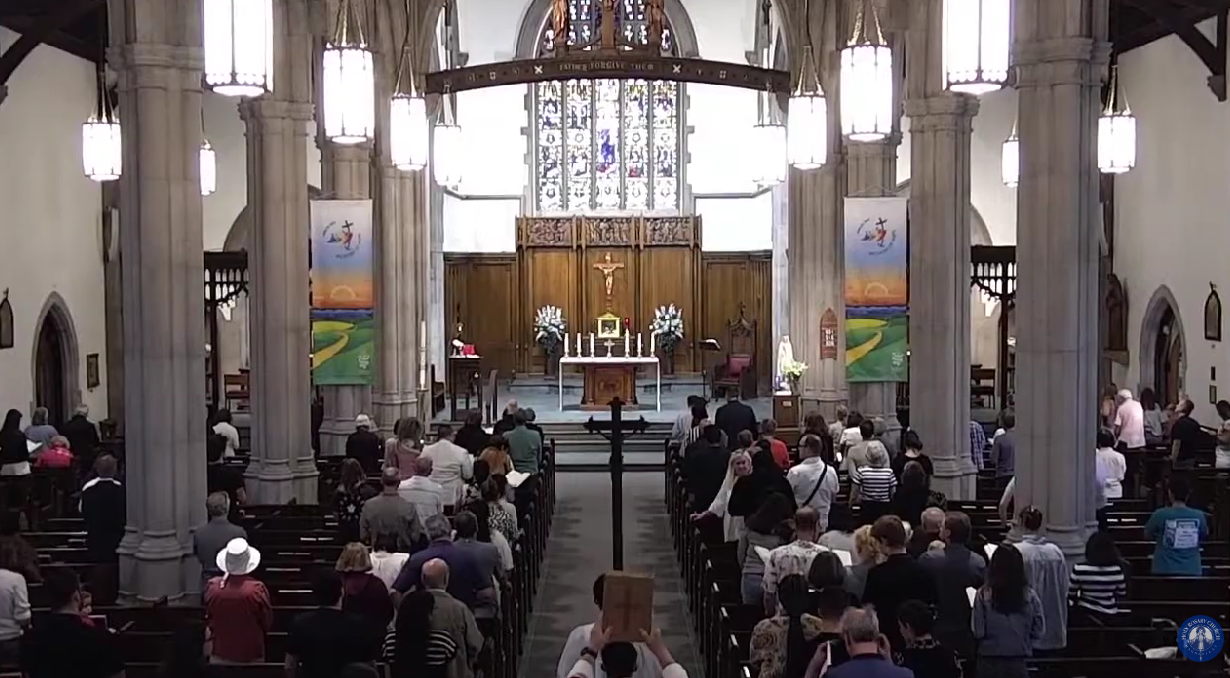
HALIFAX, Nova Scotia, February 14, 2026 – Because I came to belief as an adult rather than as a child, my faith evolved differently than most believers. Still, even as an adult, I was as docile as a child when I first believed. Having been infant-baptized into the Roman Catholic church and so believing that’s where I belonged, I started attending Catholic masses shortly after I was reborn. Sometimes I’d go twice a day (noon and five p.m.) and on Sundays I’d go three times. I couldn’t get enough of God, who (as I was told by the priests) lived in a box at the side of the altar. I’d always sit in the front pew so I could get as close to him as possible.
As I matured in my faith, I started having doubts about what the priests were telling me. I started not being able to say some of the responses during mass because I knew they were wrong. I started reading with horror about the various Inquisitions and other crimes, past and present, of the papacy. I also (and this for me was by far the worst) started to feel a distance developing between me and God. The joy that had been my constant companion in the early days and months of my rebirth began to retreat. In its place was a sense of duty (attending mass, praying the rosary, following all prayer and fasting directives issued by the pope, decorating my place with crucifixes, pictures of saints, prayer candles, etc.) that seemed to be taking me farther and farther away from God.
Three-and-a-half years into my rebirth, I was heavily involved in Catholicism. Along with attending mass daily, I sat on several committees, was appointed lector, taught a Bible class, and was even entrusted with a key to the church building, I was there so often. I also rented the church basement for my employment-related events. My life revolved around “the church”, so what happened on January 12th that year upended everything.
It was a Sunday. I was sitting in my pew after the service, reveling in my usual post-mass bliss and enjoying the smell of the just-extinguished altar candles. I loved that smell because it reminded me of birthday candles (and so birthday cake!). Other than for a few people milling around some statues of saints, lighting candles and bowing down in prayer before them, I was alone in the church’s main room. As I sat there in a haze of spiritual warm ‘n’ fuzzies, God suddenly opened my eyes. I say “opened my eyes”, but it was more like something fell from my eyes and I could see what I hadn’t seen before. And what I saw horrified me.
I was in a pagan temple. I wasn’t in a God-worshiping church, I was in a pagan temple, and the people bowing down before the statues were bowing down before effigies of demons. Even worse was the abomination of the mangled corpse that hung, larger than life, over the altar. It was a reenactment of Jesus on the cross that was supposed to represent God’s great love for us, but all I could see (and all I still see, whenever I see a crucifix) was Jesus’ tormented and humiliated body. This is not how God shows us his love.
While I sat there in shock at what was being revealed to me, the priest slipped through one of the back doors behind the altar, smiled at me, and asked me if I’d be attending the Christmas party in the church basement at noon. I managed to squeak out a “we’ll see”, to which he nodded and disappeared back through the door. Then the deacon bustled up the aisle behind me to prepare the altar for the next mass. Seeing me sitting there, he also asked me if I was attending the party, to which I managed another weak “we’ll see”. He murmured a few more pleasantries while performing his housekeeping duties and then disappeared through the same back door as the priest.
I took this as my cue to leave.
Carefully, deliberately, I stood up and put on my shoes. For three and half years, I’d removed my shoes whenever I passed the threshold of the church, believing the place to be holy ground. For me to put on my shoes while I was still at the church pew was an act of revolution. Likely no-one else noticed me putting on my shoes at the pew, but I did and God did. And then, firmly shod, I made my way to the back of the church, out the doors, and onto the street, never to return.
In showing me the truth about the church building I’d just exited, God didn’t say to leave it. He gave me no directive or command in that regard: He simply revealed to me what manner of place I was in and then left it up to me to decide what to do. But having seen what I just saw, there was no way I could stay there. And not being able to stay there (or in other places like it), I could no longer be a Catholic.
When I got back to my apartment, I immediately tore down all the crucifixes and pictures of saints adorning my walls and threw them into a box. Into a second box went my rosary beads, chaplets, prayer cards, and every other piece of Catholic paraphernalia I’d collected (at great expense) over the years, including my Catholic Bible, hymn books, and catechism. I then closed the two boxes and shoved them under a table out of sight.
I half expected to be struck by lightning through my skylight while I was doing this, but nothing happened other than that the room appeared much brighter and cleaner after the purge. Then I sat down at my kitchen table and opened a second-hand Bible I’d bought on impulse a few years earlier but hadn’t used (because it wasn’t Catholic) and started reading the Old Testament for the first time in my life. I’d been reading the New Testament every day since my rebirth, but I hadn’t yet touched the Old Testament. I’d been relying instead on the carefully selected and sanitized OT snippets that were doled out during mass. But in reading the older books for myself, I soon realized why those snippets had been so carefully selected.
The OT clearly showed that Catholicism is not Christianity. Many of the rites and rituals taught to Catholics are expressly forbidden and even outright condemned in the Old Testament. Tellingly, those verses are never included in the OT morsels spoon-fed to us during mass.
From that day forward, I removed myself entirely from the church and all its activities without telling anyone there why. God had me remain silent, as I wasn’t yet strong enough to combat their arguments. I let them draw their own conclusions as to why I’d left. Occasionally, I’d pass a congregant on the street, but they’d avert their eyes and ignore my greeting. The priest stopped me once and asked me “Charlotte, what happened?…”, but I could only mumble some vague excuse that I no longer recall and that didn’t resolve the confusion in his eyes.
The priest was a kindly man. He’d consistently supported me in everything I did at the church, appointing me as lector at noon mass and even agreeing to let me teach a Bible study, which at that time was unheard of in a Catholic church. He knew my conversion was real and that I was different from most if not all the other congregants. I could see the hurt in his eyes that day on the street, hurt and concern underlying his confusion, but God had me remain silent beyond my mumbled excuse. It wasn’t my time to explain.
The revelation God showed me on January 12th that year was an answer to a prayer I’d prayed on my face in tears on a milestone birthday nine days earlier. In that prayer, I’d begged God to take out of my life everything that was keeping me from doing his holy will, to take me back spiritually to how I was when I was first reborn. My prayer was awkward and stilted (I was repeating a phrase I’d heard from a televangelist), but my tears were real and my agony was real and my desire to reconnect with God—to be close with him again like we were at the beginning—was a cry from the heart, pure, raw, and unfeigned.
And God heard my prayer.
And he answered it.
In his time and in his way, he answered it, showing me that what was keeping me from doing his will was Catholicism and all its trappings. He didn’t tell me to leave Catholicism; he showed me what it was – first, by revealing the true nature of the place I’d been worshiping in, and second by revealing to me in scripture how Catholicism violated his commands and how I’d been replacing him with Catholicism, faith with religion. What I chose to do with that knowledge was up to me.
I know I made the right choice in walking away from the Catholic organization. Although my life was temporarily upended and I became an outcast in that community, the reward was a closer relationship with God. My prayer was answered in the best possible way. I’ve never once regretted leaving Catholicism and I have no plans to return. But in rejecting the church, I didn’t reject the people I’d met there; most of them were kind-hearted and well-meaning, just spiritually confused. It wasn’t Catholics I was rejecting, it was Catholic doctrines, Catholic creeds, Catholic paraphernalia, and the whole rotting edifice of the papacy. It’s all spiritual garbage, but it does have a worldly purpose, and so I let it be. Catholicism is not my concern.
I’m glad I experienced the worldly church firsthand, but I’m also glad it was “one and done”. I might have been infant-baptized into Roman Catholicism, but I was reborn into God’s Kingdom. I know now, as a mature bornagain believer, that my worship center is the Kingdom established by Jesus, and my fellow worshipers are bornagain believers. This is my Church. These are my people. This is where I belong. No buildings. No creeds. No recitations. No props. Faith, not religion. Just us living in constant spiritual communion with each other and with God and Jesus, through God’s Holy Spirit.
This is all I want and this is all I need until I get Home.
ON SABBATICAL

HALIFAX, Nova Scotia, October 19, 2025 – I’ll be on sabbatical until next year (2026). During that time, I won’t be posting any new articles, but feel free to dive into the 1000 or so already posted here. Just pick a topic (e.g., forgive) and plug it into the site search bar in the upper right corner.
See ya’ll when I get back!
ON MARTYRDOM
HALIFAX, Nova Scotia, October 4, 2025 – I saw a video yesterday featuring a middle-aged woman bragging about her children being martyred. In her view, because the children had purposely been put in harm’s way in a war zone and had been killed as a result, Paradise was their guaranteed reward. The woman also mentioned that she hoped her two newly born grandchildren would likewise soon be killed. I’ve seen other videos with other women boasting the same thing. I find them deeply disturbing and can only wonder what Child Protective Services would have to say about this parenting style.
Martyrdom is baked into religious zealotry. Killing for your beliefs and dying for your beliefs (often both at the same time) are hallmarks of a deep-seated faith, but not all faiths are God-seeking, not all faiths are good. Moreover, there’s a difference between actively seeking martyrdom and submitting to it when it’s thrust on you. People who actively seek to be martyred (or actively seek for their children to be martyred) are not well people. This statement needs no explanation. Likewise, a belief system that encourages martyrdom either through killing or suicide (or both simultaneously) is not a healthy belief system. This statement also needs no explanation.
Actively and publicly pursuing martyrdom and expecting a heavenly reward for it is like the man who stood praying at the front of the temple, boasting loudly about his sacrifices so that everyone would see and hear him. Jesus says that man already has his reward (worldly attention and accolades) and God won’t be adding to it.
There was once a Christian theologian who taught that every believer should pray to be martyred. He exhorted his adherents not only to train for certain death but to actively engage in pursuits that would lead to their martyrdom. This is not an accurate take on the Gospel message. In the end, the theologian died at home not from being martyred but from ill-health brought on by an earlier stint in jail.
To my mind, preaching the pursuit of martyrdom is preaching another Gospel. God doesn’t ask us to purposely pursue martyrdom. Nowhere in scripture does Jesus say we should actively seek to be killed to fast-track our way Home. He says it may be necessary to endure persecution and imprisonment, but he never tells us to seek out persecution or purposely do things to be arrested and imprisoned. He himself only put himself in the position to be arrested and imprisoned (and tortured and killed) because it was “his time” and God had specifically directed him to do so. This scenario is entirely different from people who encourage and actively pursue martyrdom as a way of life.
God will never ask you to kill for your beliefs, though he may ask you to die for them. Like your court defence (should you ever need one), martyrdom is not something you should plan in advance. If it comes on you as a test, God will direct you at the time while also strengthening you to “endure to the end”. This is what Jesus taught us and so this is how we should approach martyrdom. We do not train for martyrdom, we do not actively seek out martyrdom, we do not encourage others to actively seek out martyrdom, and we do not pray to be martyred. The theologian who died at home of ill-health rather than being “gloriously martyred” (as he’d hoped and prayed) is a cautionary tale.
Again – God would never ask us to kill for him, though he may one day ask us to die for him. That we should be prepared to die for our belief is part and parcel of what it means to be a born-again follower of Jesus. We shouldn’t romanticize martyrdom, but we should be aware of its possibility, if only to know that, if and when it happens, we should continue to lean entirely on God.
But actively pursuing martyrdom? That’s not God’s Way. Human sacrifice is the domain of the Father of Lies, and he has zero jurisdiction over the allotment of heavenly rewards. Which means that while the devil may well sell you a ticket to Paradise, he can’t deliver on it, so buyer beware.
THE GRACE OF TIME

HALIFAX, Nova Scotia, October 4, 2025 – If nothing else, the latest failed prediction of Jesus’ return (September 23rd and/or 24th, or possibly September 25th, etc., 2025) should give us a renewed sense of gratitude for God’s grace of time. Sure, we’re grateful for God’s love and for God’s protection and for everything else God generously provides for us, but we often forget (or perhaps are unaware of) the importance of the grace of time to God’s plan. If we’re still here on Earth, it’s because we still have work to do – on ourselves, on our souls – work that will further purify the spiritual gold within us and burn off whatever doesn’t belong in Heaven.
Some people say all it takes is “belief” to get Home, but I disagree. Professed belief, like talk, is cheap and has no essential value unless, over the passage of time, we can prove by our actions that our professed belief is real. That God grants us the grace of time is evidence of the importance of allowing our belief in him to play out through our actions. Playing out takes time because tests take time. Falling for or resisting temptation takes time. Recovering from failed tests takes time. Regrouping and consolidating what we’ve learned from our lessons takes time.
Without the grace of the passage of time, all we have to offer God are declarations of loyalty that may or may not hold up under pressure. We’re tested for a reason. We’re punished for a reason. We’re given the grace of time for a reason, a reason that perhaps God and God only knows, and that should be enough of an explanation for us. That, too, is a test.
I admit to being less than grateful on occasion for God’s grace of time, being impatient to learn whatever I need to learn and to get done whatever I need to get done so I can get Home. While impatience is not a sin, it’s also not an ideal response to a situation. We don’t call it “the impatience of saints”; God doesn’t encourage or reward impatience, even when our impatience is prompted by a desire to be with him and Jesus in Heaven. We can do God’s will only so far when we’re impatient, as impatience indicates a disconnect between our concept of time and God’s, and any disconnect between us and God is not good, will not get us where we need to go.
It’s important to note that while the early Church prayed fervently for Jesus to come back, they didn’t build their lives around his return. It wasn’t the focus of their ministry. That’s why there are so few mentions in scripture of the prophesied end-times ascension event. We also don’t see any evidence in scripture that the early Church prayed to be taken Home before their time, to jump the spiritual gun, as it were. In focusing on their ministry rather than on their own individual wants, they showed their gratitude to God for his grace of time.
Jesus himself mentioned his second coming only on a few occasions. He didn’t want his return to be the focus of the rest of our time here. That he didn’t want his return to be our focus is evidenced by his assertion that we can’t know when he’s coming back and that his return will be a surprise to us all. We can expect his return, we can prepare for his return, but we can’t know exactly when it will happen. The right way to prepare is to be spiritually prepared – that is, be doing the work God has given us to do, not standing around staring up at the sky and waving a “JESUS IS COMING BACK SOON!” sign. Jesus doesn’t command us only to be waiting for him; he commanded us to be occupied doing the work God gave us to do.
Doing that work is how we wait for Jesus’ return. It’s also how we show gratitude to God for his merciful and much needed grace of time.
THIS LAND IS THEIR LAND

And since they did not see fit to acknowledge God,
God gave them up to a debased mind to do what ought not to be done.
(Romans 1:28)
HALIFAX, Nova Scotia, October 3, 2025 – Not at any point do they talk about turning back to God. They don’t mention God at all when they wax poetic over the historicity of the land and how that history is theirs and how they belong on that land—and how that land belongs to them—solely because of their history. They talk about culture. They talk about heritage. They talk about tradition. But they never talk about God. They never once mention him, not even as a cultural or historical touchstone.
Listening to them talk about how they’re owed the land as a right based on their historical connection to it reminds me of Paul explaining how God gave certain sinners over to a reprobate mind, allowing them to continue to wallow in their sin and confusion because sin and confusion was all they wanted. They didn’t want God. They didn’t want what he was offering. They wanted sin, and so God permitted them to have it.
(They wanted the land back, and so God permitted them to have it.)
God didn’t say: “I’ll let you keep on sinning because I know at some point you’ll turn back to me.” No. Paul said God gave them over to a reprobate mind, with no mention of ever turning back. When God gave them over, he gave them over forever.
Now, having said this, I still believe they own the land that was given them by legal contract, and that they own the land fair and square. Based on the agreements, it’s their land. I also believe they should be able to defend their land and the people on it in whatever way they deem necessary, just as any other nation would. But I don’t believe they have a Biblical right to it. Only the godly have a Biblical right to it. God permitting them to have the land is not the same as them having a Biblical right to it. Never confuse that issue.
Still, and again, they got what they wanted.
I hope they’re happy.
HEAR, O ISRAEL!
The Lord our God is one Lord:
And thou shalt love the Lord thy God with all thine heart, and with all thy soul, and with all thy might.
HALIFAX, Nova Scotia, September 1, 2025 – As many of you know, I came to belief in God and in his Messiah, Jesus, directly from atheism. I didn’t meander down a long and twisted path of “Is he?” or “Isn’t he?”, trying to apply logic and deductive reasoning to the existence of God and by extension to the messiahship of Jesus. You can’t logic your way into genuine belief, as your belief exists prior to knowing you believe. In other words, I believed before I knew I believed, because my belief in God came from God, not from me. Genuine belief is placed in us as a measure of God’s Holy Spirit; it isn’t generated by us. Genuine belief comes from God and is God.
You can’t genuinely believe in God based solely on logic and reasoning. You can only genuinely believe in God if God is working through you, by his Holy Spirit. So when I went from unbelief to belief in under a second, it wasn’t my doing. It was God’s doing. All I did was choose to forgive, and God did the rest.
Which brings me to the topic of today’s discussion, which is God, and by extension his Messiah, Jesus. These are two distinct beings, with God being God and Jesus being the Messiah. God is Lord over everything and everyone, and Jesus is Lord over those areas and beings God designates Jesus to have lordship. They are two distinct beings with different and in some cases overlapping jurisdictions, but in the cases of overlap, God still has ascendancy, as Jesus pointed out when he stated: The Father is greater than I.
God’s Holy Spirit is God manifesting in time and space. The Old Testament prophets well knew this, as should we. When the Holy of Holies was built as the inner sanctum within the temple, according to God’s specifications, the Holy of Holies was meant for God to come to visit his people on designated days or sometimes to show up unannounced. It wasn’t meant for a “lesser” spirit that was tapped by God to represent him. It was built for God himself to descend to the temple in Spirit form, as he was and is wont to do when he interacts with earthly beings (not just humans). God had previously descended in Spirit form on numerous occasions in the tabernacle that he specified be built just after the exodus from Egypt. Again, it wasn’t a messenger of God that Moses went to be with in the tabernacle, it was God himself, manifesting as the Holy Spirit.
Old Testament prophets also knew that God’s Holy Spirit was God himself manifesting in Spirit form. Whenever they’d inquire of God or be inspired by God, it was to God directly they’d inquire or by God directly they’d be inspired. They knew it wasn’t a messenger sent from God they were interacting with, but very God himself. Genuine prophets today likewise inquire of God directly through his Spirit and are inspired by God directly through his Spirit. If you’re genuinely reborn, you would know this, because you have a portion of God’s Holy Spirit in you at all times (not just on occasion, like Old Testament prophets). You are one of several perambulating Holy of Holies that Jesus, by his sacrifice, enabled you to be.
God directed Moses to declare:
HEAR, O ISRAEL: The Lord our God is one Lord:
And thou shalt love the Lord thy God with all thine heart, and with all thy soul, and with all thy might.
Jesus later declared this the greatest of all God’s Commands, and yet it rarely features in any list of the Ten Commandments. It should always be there, front and center. If Jesus says that the most important of all God’s Commandments is that the Lord our God is one Lord, and that we should love the Lord our God with all our heart, soul, and might, then it’s unquestioningly the most important of all Commandments, and as Jesus’ followers, we need to know it and embrace it and live it and preach it.
Which is a roundabout way of saying the doctrine of the trinity is nonsense and has no place in the hearts and minds of genuine believers. When I was born-again and taught directly by God, as scripture says his children will be, God never taught me the trinitarian doctrine. It’s not in the Bible and it’s certainly not in the Ten Commandments. In fact, I only came to know about the trinitarian doctrine when I first started attending Catholic masses about six weeks after I was reborn. Which is to say, I had to learn about this doctrine from men, not from God. Which is to say, this is one of those dreaded doctrines of men that Jesus (and later, Paul) warned us about and dismissed.
To be honest, I dismissed the trinitarian doctrine the first time I heard of it. The trinitarian concept of God was not the God I knew as my heavenly Father, and certainly not the Jesus I knew as my Lord, teacher, big brother, and best friend who, during his time on Earth, had a greater measure of God’s Spirit in him than anyone before or since, but that still didn’t make him God. It was this exceedingly great measure of God’s Holy Spirit in him that enabled Jesus to perform so many miracles, but that still didn’t make him God. It made him Lord, but it didn’t make him God.
Nor did the trinitarian doctrine reflect the Holy Spirit that I knew was God’s way of interacting with me as a mere mortal, the same Spirit God placed in me by measure at my rebirth, when he adopted me as his child. As Jesus said, “God is spirit”, and so he is to us now, but if and when we get to Heaven, Paul promises we’ll see God as he is, “face to face”.
You can’t limit God to this or that or one or the other, as God is all-powerful and can do all things, far beyond anything we can imagine. But when God stated to Moses that he is One Lord, we need to take him at his word, not spiritually genetically modify him into something he clearly stated he isn’t. We can’t sub-divide God into three co-equal beings that are somehow by some tortured human logic still all “God”, all while thinking we’re adhering to the Commandment that God is one Lord.
God is God, our heavenly Father.
Jesus is God’s Son and the one and only Messiah.
And the Holy Spirit is God manifesting in time and space.
This is not difficult to understand. God never meant it to be difficult. Truth is never difficult, not to those who have God and Jesus in them.
CLARITY IN THE AGE OF DECEPTION
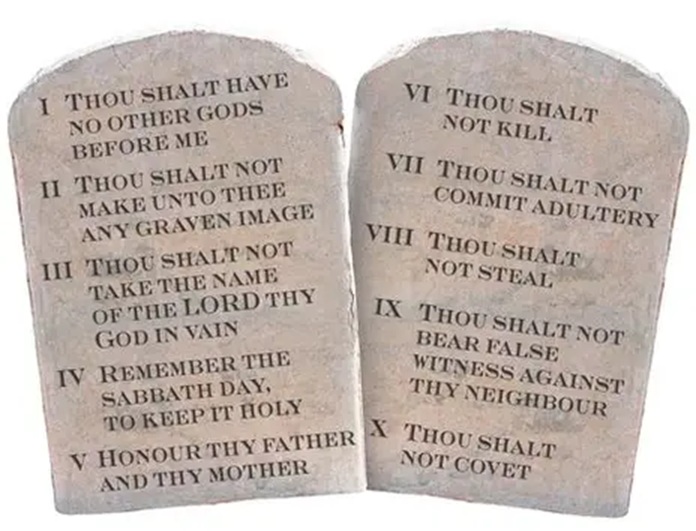
HALIFAX, Nova Scotia, August 30, 2025 – In the age of deception, it’s easy to get turned around, especially in matters concerning God (which for us should be everything). That’s why God wants to simplify our lives. He knows the spiritual obstacles we face, and so he’s devised a framework that we can refer to for all our decisions, intending that we not lose our way.
The framework is very simple. We can learn it in a few seconds and then, based on the application of that learning, successfully sidestep every provocation and test the devil can throw at us. Here is the framework:
- The Ten Commandments.
- Jesus’ words in the New Testament.
- Everything else in scripture.
As you can see, it’s a hierarchy of what to believe and in what order. Jesus taught us the framework and wants us to use it. He himself deferred to God and scripture in everything he did, but in cases where scripture could be misinterpreted and twisted to mean something else, the Ten Commandments provide clarity and therefore take precedence.
There’s nothing clearer than the Ten Commandments when it comes to what to do and what not to do. Which is why God, through his prophets, advised us not only to memorize his Law, but to surround ourselves with it in written form – on walls, doorposts, even our bodies. And then, knowing that even that might not always work, he carved his Law on our hearts.
Jesus’ words in the Bible are clear, too, but they can be twisted and taken out of context. They also run the risk of being mistranslated or removed altogether, if they counter the prevailing political or social narratives. So while we, as followers of Jesus, are to do everything that Jesus advised us to do, we need to make sure that what we’re being told are Jesus’ words are actually Jesus’ words. This we can do by prayer only, not by research. We need to go to God in prayer to find out if what Jesus is alleged to have said, Jesus actually said.
The same process of discernment applies to the rest of scripture. We can’t lazily assume and accept that everything in the Bible is God’s Word. Yes, we can assume and accept by faith that the Bible contains God’s Word, but we can’t assume and accept that all its contents are God’s Word. That would be spiritually lazy of us, and we’re not called to spiritually laziness. We’re called to discern the godly from the ungodly, and that includes what’s in the Bible.
We can use this simple framework – the Ten Commandments, Jesus’ words, everything else in scripture, in that order – to help discern truth from lies. Because discerning God’s Truth from the devil’s lies is the first order of business in the age of deception: Everything else hangs on it. If we don’t know whether we’re adhering to God’s Truth or succumbing to the devil’s lies, we can’t proceed as followers of Jesus. Everything we do will be done on a shaky foundation if we ourselves are unsure of our spiritual footing.
THE PRIMACY OF THE TEN COMMANDMENTS
I love the Commandments. They are the Law of the land of the Kingdom: They’re written on our hearts. If we keep the Commandments in every conceivable way, as Jesus taught us—that is, if we keep not just the letter of the Law, but its spirit—we’ll remain on firm spiritual footing and never lose our way.
Like the psalmist, we should be meditating on God’s Law night and day, mulling it over and tasting it for its deep and rich flavors. What exactly does it mean not to covet? Can I have a mortgage or use a credit card and still claim not to be coveting? I think you know the answer to that. What exactly does it mean to honor my mother and father? Can I expose their sins if I say they later came to God? Would I still be honoring them? I think you know the answer to that. Is medical assistance in dying both murder and suicide (that is, killing and self-killing)? I think you know the answer to that.
We need to know God’s Commandments, but that’s just the start. We also need to understand them and apply them, but even that’s not everything. We need to preach them, and not just as a curious ten-point footnote to the Gospels but as the fundamental doctrine that informs our every decision. Note that I say “informs” not “dictates”, because the Law, despite being the greatest of all of God’s commands and the Law of the Kingdom, is voluntary for us to adhere to. We don’t have to keep the Commandments. It’s a choice to keep them.
Still, we need know the Commandments before we can keep them, and we need to learn them before we can know them. I hope you’ve learned and know the Commandments, and even more so, I hope you keep them and preach them. I hope you love them so much, you meditate on them night and day and use them as your guiding light. God wrote them on your heart for that purpose.
In the age of deception, where even committed Christians are falling for the lies of the devil, we need the Ten Commandments now more than ever. We need Jesus’ words, too, and the rest of scripture, but those words are vulnerable to mistranslation, misinterpretation, or outright fraud. The Ten Commandments are inviolable and clear. They’re part of us. God made them that way because he knew the rest of scripture would be messed with.
Don’t let yourself be messed with. Adhere to God’s three-point framework, setting his Commandments at the very top.
THE COMING PERSECUTIONS

HALIFAX, Nova Scotia, August 24, 2025 – Today, we’re going to have a little lesson in geography, followed by a lesson in survival. Geography is important for us to know, because some geographical areas are dangerous for Christians to be in. Let’s call those areas “no-go zones”. Survival is important for us because if we don’t survive, Christianity will die.
GEOGRAPHY LESSON
Pretty much the entire Middle East is a no-go zone for Christians, as is much of Asia. The northern half of Africa’s not looking so great, either. If you took a globe and put your thumb on Jerusalem and then traced a circle with your pinky—hand outstretched and keeping your thumb on Jerusalem—most of the countries that would fall within the circle are either by law or by culture hostile to Christians. Not coincidentally, most of those countries are Muslim.
Countries that are by law hostile to Christians have outlawed anything to do with Christianity. That means no church buildings, no church services, no Christian bling (like crosses), and no Bibles are allowed. The penalties for breaking those laws range from imprisonment to beatings to execution. Iran, Afghanistan, Pakistan, and Somalia are some of the worst places you could be caught reading a Bible while wearing a cross. In nearly every instance, you would be killed.
Countries that are by culture hostile to Christians are places like India, Lebanon, Egypt, and Nigeria. Christianity is not illegal in these countries, but it might as well be. Christians in culturally hostile places suffer varying degrees of persecution, while their places of worship and faith-based health or educational institutions are habitual targets of vandalism, arson, and even bombings. It’s not as dangerous for Christians to be in areas that are culturally hostile compared to areas where Christianity is outlawed, but it’s still not advisable to be there. No Christian should be living or traveling in these countries. They are no-go zones.
SURVIVAL LESSON
And here comes the whole point of this brief geography lesson – the survival of Christianity. The stupidest thing a Christian can do is to choose to live or travel in an area that is either by law or by culture hostile to Christians. This is hands-down the stupidest thing that a Christian can do. It’s right up there with calling the head of the Catholic church “pope” (which means “papa”, as in “father”) when Jesus explicitly said to call no-one on Earth “father” because we have one Father, who is in Heaven.
Christians who choose to live in or to visit areas that are hostile to them are not adhering to Jesus’ directives. At no time does Jesus tell his followers to put themselves in danger by going to or remaining in areas that are hostile to them. He himself modeled what we’re to do when we encounter persecution or open hostility – we’re to leave that area and go where we’re not being persecuted. This is a directive straight from Jesus. It’s also basic common sense.
God doesn’t want his children purposely choosing persecution. To purposely choose persecution is to tempt God, even when it involves evangelizing. Living in or visiting places that are no-go zones also shows extreme hubris, not courage; hubris, not wisdom, unless you’ve been explicitly directed by God to go to those places, like Jesus was directed to go to Jerusalem when it was his time.
By “explicitly directed”, I mean just that. I don’t mean adhering to the so-called Great Commission of going into all the world and preaching the Good News. That is not an explicit directive. That is a general directive that needs to be applied wisely and in accordance with Jesus’ example of how to evangelize. Using the Great Commission as an excuse to to fly to Iran with a suitcase full of Bibles is just plain stupid, and Jesus didn’t teach his followers to be stupid. He taught us to be wise as serpents, so let us be wise as serpents.
But if we don’t go to no-go zones that are hostile to Christians, how will people there hear the Good News?
Good question, and the answer is:
Internet.
Radio.
God.
I’m living proof that you don’t need someone evangelizing you to be born-again. God himself exorcised me on a lonely beach in Australia and then put his Spirit in me, adopting me as his child. No-one preached to me (no-one dared preach to me, I was so rabidly anti-Christ as an atheist). No-one pressed a smuggled Bible into my hands. God simply and patiently waited for me to break and then immediately rushed in to save me when I cried out for help. No person could have done for me what God did that day. To believe otherwise is extreme hubris.
It’s worth mentioning that most of the areas that are now no-go zones for Christians were previously evangelized, meaning that most of the people there are deprived of the Word not by circumstance but by free-will choice. Jesus was once preached and lauded in those streets, but he’s since been rejected in favor of other beliefs. It’s also worth mentioning that most of the populations in the no-go zones can travel to areas that are not no-go zones and so can hear the Word there if they choose to hear it. But if even after hearing the Word they reject it, we need to respect their free-will choice and let them be.
COMING PERSECUTIONS
Along with showing places that are hostile to Christians, today’s geography lesson highlights that the no-go zones are expanding. Places that used to be Christian strongholds, like Turkey and Lebanon, are now openly hostile to the Word. These places are lost and will not return. Christians living there need to leave.
At the same time, those of us living in the West know only too well that Christianity’s days are numbered here, too. For example, Christians are now a minority in my home country of Canada, where Christian ministers serving in the military are forbidden to say “God” or “Jesus” in their public sermons (or even to call their sermons “sermons”). It’s not illegal to be Christian here, but Canada is becoming increasingly hostile to followers of Jesus by lumping Christianity in with all other religions and instituting laws and normalizing cultural practices that favor “diversity, equity, and inclusion” over religion.
So, while we’re not yet openly persecuted in the West, we experience what can be called soft persecution. With the sole exception of the United States, all Western nations are promoting and permitting soft persecution. The “othering” of Christians and silencing of the Word will continue until it shifts into open cultural hostility, followed by the outlawing of Christianity altogether. This shift will happen very quickly and, I believe, very soon.
If we want to see what most of the West or even the entire world will look like some day, we need only to look at the Christian no-go zones of today
And when that “some day” comes, where will we go?
ARE YOU SPIRITUALLY ALIVE OR SPIRITUALLY DEAD?
HALIFAX, Nova Scotia, August 16, 2025 – There’s a conundrum that we born-again believers must contend with every day. Better said, there’s a spiritual fact that we need to accept as our indisputable reality: In their soul, which is the seat of their will, humans have a measure either of God’s Spirit (which is holy) or of the world’s spirit (which is demonic). There is no third option, no “vacant” or “neutral” humans, no mix-and-match co-habitational arrangement where God’s Spirit shares a soul with demons. You either have God’s Holy Spirit in you, or you have unholy spirits. It’s either one or the other.
No third option.
As a born-again believer, I find this spiritual fact disturbing. I don’t think about it very often, and when I do, I don’t linger on the details. It’s enough for me to know that it’s a fact and to accept it as such.
Scripture tells us that at spiritual rebirth, we pass from death to life. We know this is true not just because scripture tells us it’s true, but because we’ve experienced it ourselves first-hand. It’s our lived reality. When God’s Spirit entered into us, we were alive for the first time in our lives. It’s a funny thing to say “we were alive for the first time in our lives”, because weren’t we alive all along, from the instant of our conception?
Physically, yes, we were alive, but spiritually, no. Other than for Jesus, we’re all born spiritually dead. We don’t come into the world spiritually innocent; we come burdened with Adam’s sin. It was Adam’s sin that brought death to the world – spiritual death, which is far worse than physical death. People who are not born-again and who are afraid to die don’t realize they’re already dead in the only way that matters.
When Jesus instructed one of his followers to “let the dead bury the dead”, he was letting us know the distinction between believers and unbelievers. Believers are spiritually alive, and unbelievers are spiritually dead. Believers belong to God (the living God), whereas unbelievers belong to Satan (lord of the dead). At the same time, unbelievers are plagued to varying degrees by demonic spirits, who also belong to and get their directives from Satan; no unbeliever is free of the demon plague. This is the source of all their emotional and mental illnesses, as well as the cause of most of their physical ailments.
As I mentioned at the outset, I don’t think about the spiritual state of humanity very often because the collective prognosis is so bleak. We’re surrounded by dead people, most of whom don’t even know they’re dead. They were born in their sins and will die in their sins, and that’s how they want it to be. They don’t want to hear about sin. They don’t want to hear about God and Jesus. Even as they rush to undergo every conceivable test and pretest to detect even the faintest presence of this or that disease, they deny their essential spirituality and the reality of their spiritually dead state.
What are we, as born-again believers, to do about these spiritual corpses? Recall that Jesus said: “Let the dead bury the dead” and to let “the blind lead the blind”. He didn’t tell us to run after them and ply them with scriptural passages or try to force-feed them the Gospel. He said to let them be. He called them dead and blind, and he said to let them be, to leave them to each other.
This is another disturbing spiritual reality that I don’t think about very often or when I do, for very long. Here in Canada, a self-described former Christian nation, we’ve reached near Sodom-levels of dead souls. Sure, “spirituality” is widely embraced and promoted, but not God and Jesus. (Don’t you dare mention God and Jesus!) Every other home has a “dreamcatcher” or a buddhist garden statue. Every other family has a pagan or a practicing witch. Whenever there’s a disaster, “thoughts” can be offered “in solidarity” with those who are suffering, but not prayers. (Don’t you dare mention prayers!) The most powerful force in the universe is not welcome here.
The spiritually dead state of unbelievers is not a figure of speech but a hardcore spiritual truth. We are surrounded by demon-infested spiritually dead people who are either unaware of their condition or, if they are aware, don’t care or have embraced it. Some have even free-willingly made a contract with Satan. You are either born-again and spiritually alive or not born-again and spiritually dead. There’s no third option. Being spiritually dead leads to eternal death, just as being spiritually alive leads to eternal life. You can’t be spiritually dead and end up in Heaven. That’s a spiritual impossibility. The only destination for spiritually dead souls is the lake of fire.
Which is why I don’t think about this spiritual conundrum very often. I’m confronted with it every day, but I don’t let myself dwell on it. It’s enough to know that this is our reality, that this is the world we live in for whatever time God allots us here. Rather than dwell on the spiritually dead, I choose instead to think about God and Jesus, about Heaven, and about feeding those sheep who do want to live. This is our mission, to feed those sheep as God gives us guidance.
We can’t help the dead who want to remain dead. They are not our mission. But we can help the sheep who choose life. That’s what Jesus did in his ministry, so that’s what we’re to do in ours.