
Home » Posts tagged 'Born-again Christian' (Page 15)
Tag Archives: Born-again Christian
SUPERNATURAL FORGETFULNESS

CHARLO, New Brunswick, February 21, 2024 – As we know, God is watching us all the time. And he’s not only watching us, he’s listening to us and reading our thoughts. He knows everything about us, inside and out, down to the smallest detail and nanoparticle. In fact, he knows everything about us even before we know, because he knows our past and our future as well as our present. That’s his privilege for being God.
But even as he’s watching us, listening to us, and reading our thoughts, God’s made it so that we don’t think about his omnipresence and omniscience all the time. He’s made it impossible (or better said, he’s supernaturally suspended our ability) to think about his omnipresence and omniscience all the time because if we did think about those things all the time, we’d alter our behavior, the way that people act differently when they know someone is looking at them or a camera or microphone is pointed their way: They act like they’re on stage playing to an audience. God doesn’t want us acting differently just to please him. He wants to see us and hear us and read our thoughts as we are, not as we think he wants us to be.
I also think we’d go a little crazy if we couldn’t take a break from knowing that someone was always watching us. On the occasions when it does come to mind (like now), I don’t mind that God is always here with me because I love God and I trust him and I know that he loves me. I know that his omnipresence and omniscience are for my benefit. I know that everything he does is for my benefit. Still, if I were constantly aware, without a break, that I had no privacy at all – even in my thoughts – it might make me a bit coo-coo. That, I think, would be the natural human response (to go a bit coo-coo), which is why God has suspended our ability to be constantly aware of his constant presence.
I was thinking about this today when I remembered that not even Jesus or the holy angels know the date for the end of the world. Jesus said that no-one knows the end date except God. Then I thought about God’s reasoning for preventing us from knowing the end date and I saw a parallel between not knowing the end date and not always being aware of God’s presence. I think both of these “absences” are supernaturally imposed on us to prevent us from acting differently from who we are.
And to prevent us from going coo-coo.
Scripture tells of a time when “hearts will fail” for fear of what’s coming on the world. Imagine what will happen when everyone knows the end is no longer nigh but now! Unbelievers will lose whatever’s left of their sanity and hell will empty out, which means that every fallen entity in existence will be roaming the earth looking for a host and torturing people. Jesus describes this time as the worst in history. It’s safe to say that people will radically change their behavior under these horrendous conditions. Even believers (if any are still here) won’t act like themselves but will measure everything they do and say in relation to the ticking clock.
In movies about the end of days, there are always shots of people streaming into churches and packing pews, motivated not by their love of God but by their fear of what’s coming on them. I always think, when I see them, it’s too late, it’s too late, you left it too late. The time to turn back to God is long gone. I guess it’s prudent to point out that when the last day does come, there won’t be any church buildings to stream into, anyway. Those will also be long gone.
What I’m saying here is that we don’t know certain things – or certain things are not always on our mind – because God supernaturally made us not to know them, at least not yet. Whoever’s left on Earth on that last day, however, will very much know it’s the last day; God won’t hold that knowledge back from anyone anymore (which explains the scripture about failing hearts). I pray to God that I won’t be here when that time comes, and you should pray that for yourself, too. As bad as things are now, it’s nothing compared to the day when God pours out his final wrath and the devil has free reign. Earth will literally become hell, with every fallen being roaming with no restraints and Satan lording over them all.
I’m happy to know what God lets me know and to leave the rest be. I had to learn to turn off certain types of curiosity as a born-again believer. God made us to be curious, but not about everything. Look what happened to Adam and Eve. Look what happened to Solomon.
Some things are best left unknown.
**********
And now, dear reader, I leave you with a challenge: See how long you can be conscious of God’s presence before you forget about it. You won’t be aware that you’ve forgotten until you remember again. Me, I usually don’t last more than a minute before God draws my attention elsewhere with a shiny bauble of a thought. I know he does this for my benefit, and it makes me laugh. It makes him laugh, too.
But you – you see how long you can think about God’s presence before you forget he’s there. See if you can beat my one-minute record (lol).
And then try not to laugh when you remember again about God’s presence and realize how quickly you forgot about it.
That’s supernatural forgetfulness.
It comes from God, and it’s for our benefit.
SUPERCHARGE YOUR WITNESS

CHARLO, New Brunswick, February 20, 2024 – There’s a saying that evil thrives when good men do nothing, implying that “good men” need to do something to drive the evil away. But what should they do? Take up arms? Enact more laws? Organize a protest? Strengthen borders? Certainly, we can do all those things or demand they be done, but none of them will entirely stop the evil that is the due reward for back-slidden former Christian nations.
Decades ago, when we had a critical number of genuine believers who lived according to God’s Word, life was undeniably better. Our high-trust nations functioned well because there was a high level of trust. This came courtesy of believers who, through their witness, brought God’s blessings on the cities and towns where they lived. Christian nations were the best in the world not because of their wealth or military strength, but because of their believers and the blessings that flowed through them from God. But as each believer moved on to his or her eternal reward, fewer and fewer rose to take their place, and the result has been a massive erosion in trust and a drastic reduction in wealth, military strength, and overall quality of life.
While we can’t stop the inevitable destruction of former Christian nations – the destruction will come just as assuredly as it came to all other nations that turned from God – we can slow the downward spiral by supercharging our witness. This, in turn, will supercharge the blessings poured out on us and on those around us. We can become those fabled “good men” who are stopping evil from thriving. That ability is in our hands. More importantly, we not only have the ability but the responsibility to do this, as we’ve been called to live not for ourselves but for others, to minister rather than to be ministered to.
So what does supercharging our witness look like in the real world today? It looks the same as it’s always looked, which means it doesn’t involve any weapons or protesting or lobbying of governments for change. We can supercharge our witness simply by doing what Jesus taught us to do, which is to love our neighbours and enemies alike and pray for those who hate us. We do this by being kind to the unkind, polite to the rude, patient with the impatient; we do this by holding the door open with a smile, letting someone behind us go ahead of us in line, or by leaving a bigger tip than what was earned. We can take the few extra seconds to put our shopping cart back where it belongs and put an abandoned cart back, too (without grumbling). We can send a thank-you card in the mail – not an email that will disappear with a click, but a physical card that can be held in the hand and mulled over. We are tangible and tactile beings, not virtual ones, and we crave the tangible and tactile. Our witness likewise needs to be tangible and tactile.
As Paul reminded us, if there’s any good in anyone, think on that. Highlight that. Roll with that. We’re not here to judge but to show the way. Remember how kind Jesus was even to Judas. From the start, Jesus knew who Judas was and what his role was in the plan of salvation, but Jesus treated him no differently than his other disciples.
And most importantly, start nothing without God’s prompting and guidance, doing everything with thanks in the name of Jesus.
Supercharging your witness doesn’t require grand gestures, just small, targeted, personal ones that are premised on serving others rather than serving yourself. God is always looking for people who are willing to make those humble gestures, as a kind word at the right moment can turn a life around.
Preaching the Word doesn’t necessarily involve preaching the Word. Incognito, God’s holy angels interact with us much more frequently than we realize and God himself hides behind “coincidence”, “luck”, “fate”, and “serendipity”. We don’t have to thump a Bible to give our witness; we just have to treat others as we would want to be treated. Do that, and God will pour out his blessings over you and over all those around you. This is how you put the brakes on evil. This is how you slow the coming destruction.
A nation isn’t blessed because of its wealth or its military; a nation is blessed because of its believers.
JOSEPH AND HIS AMAZING WEALTH-TRANSFER DREAM SCHEME
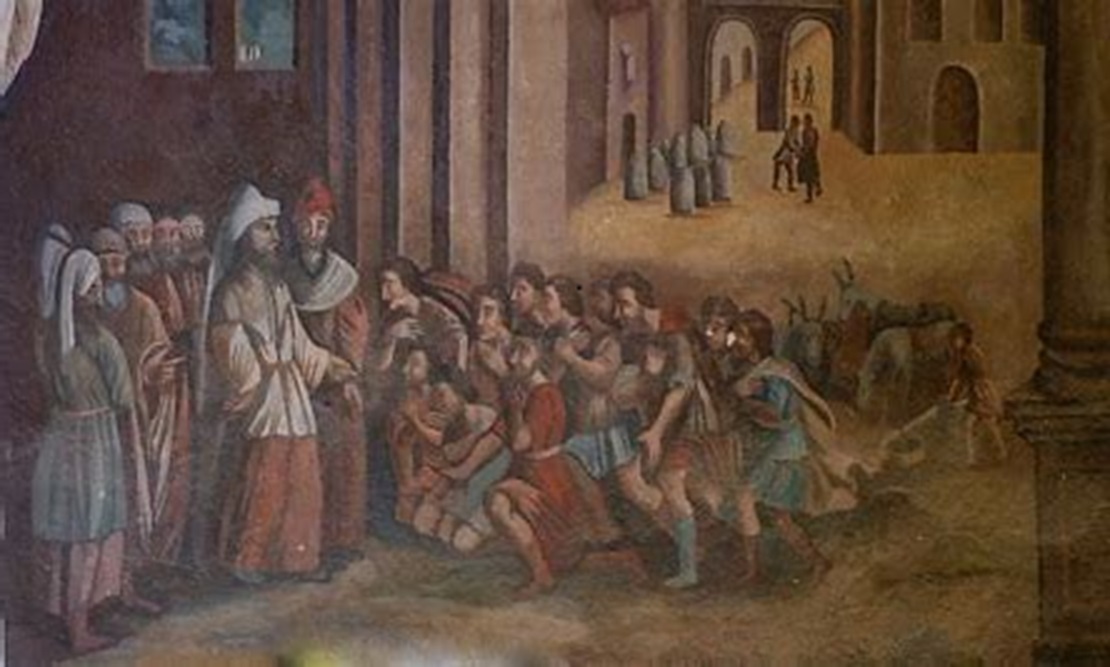
CHARLO, New Brunswick, February 19, 2024 – Christian preppers often point to the story of Joseph and the 7-year famine in Egypt to justify their stockpiling of food and supplies. They also tend to simplify the story by saying, “Look, Joseph knew a famine was coming and prepared for it, saving his family and the Egyptians from starvation.” But that’s the rosy picture of Joseph and his allegedly heroic feat of prepping. If you look a bit deeper into the details, a darker picture emerges.
In the years leading up to the famine as well as during and after it, Joseph was second only to Pharaoh in power and authority. But how did he get there? How did a young foreigner imprisoned in a dungeon on rape charges rise in rank overnight to become Pharaoh’s right-hand man?
Scripture tells us that Pharaoh had put Joseph in charge of preparing the kingdom for the famine based on Joseph’s interpretation of Pharaoh’s dreams. But what we have to read between the lines to learn is that Joseph’s suggested plan on how to deal with (or better said, how to profit from) the prophesied dearth stood to make Pharaoh the richest and most powerful man in the world. As soon as Pharaoh heard about Joseph’s dream scheme, he eagerly agreed to it and immediately rewarded Joseph with his exalted position. So Joseph not only became the second-most powerful man in Egypt virtually overnight, he also became incredibly wealthy, catapulting instantaneously into the upper ranks of the 1% or ruling “elite” class. This detail is important.
Once appointed, Joseph quickly set his plan in place. But the plan wasn’t a noble scheme prompted by his compassion to feed the starving masses during the coming famine. No, not at all. Joseph’s plan was much more shall we say “comprehensive” and involved the greatest wealth transfer in Egyptian history.
Fortunately or unfortunately (depending on your perspective), the wealth transfer was from the poor to the rich – from the people to the state – and started already when food was still being grown. Joseph instituted a nation-wide policy that required all farmers and other food producers to give the state 20% of whatever they grew or made each year. They could not opt out of this initiative (it was essentially a tax on their labour or an income tax). What Joseph was doing was taking the surplus food out of the market and storing it as property of the state, food that otherwise could have been stocked away as preps by the individual producers or consumers or even sold for a profit. So when the famine hit, the people had nothing in their own storerooms for themselves and very little by way of savings, as they’d had to give 20% of their product to the state and whatever was left over they had to live on.
The famine was long and widespread, which meant that the Egyptian people could not simply go to neighouring countries to grow or buy their food. They had to rely on the Egyptian state to feed them. After having centralized the entire food supply and in so doing creating a monopoly, Joseph then proceeded to sell the food taken from the Egyptians back to them. At first, he charged them money for the food. But when they had no more money (because they couldn’t produce or sell anything due to the ongoing famine), Joseph accepted their livestock as payment. Then when they ran out of livestock, Joseph accepted their land and their labour as payment. Under this “dream scheme”, the former independent subsistence producers and small landowners in Egypt became destitute serfs within only a few short years, thanks to Joseph’s prepping.
By the time the famine ended, Pharoah owned all the land in Egypt and the Egyptians were not only forced to labour for him, they were also forced to give him 20% of the fruits of their forced labour.
This is the view of Joseph and the famine that doesn’t get much airplay in Christian prepping circles, but the 1% have certainly taken note of it over the years. Joseph’s wealth-transfer and labour-taxation dream scheme has been repackaged and rebranded at various times in history and we’re fortunately/unfortunately (again, depending on your perspective) living in one of those times. We know the scheme today as “The Great Reset”, popularized by the heartwarming phrase: “You’ll own nothing and be happy”.
Yet it is worth remembering that Joseph did what he did with God’s approval and blessings. In fact, God instigated both the dreams and the dream scheme, just as he’s instigating the wealth transfer now. We can only assume that, like the ancient Egyptians, we have it coming.
RECYCLED SOULS? ON DEATH, DEMONS, AND SOUL MIGRATION

CHARLO, New Brunswick, February 18, 2024 – I came across the comment below a few days ago on a “conspiracy” website. I’m reposting it here because the topic is important and also touches on erroneous beliefs that some Christians hold – beliefs that are demonic in origin and need to be cleared up. The person who posted the comment was discussing the death of a famous member of a so-called elite family, speculating that the soul of the deceased had likely migrated to another human body and from there would continue his reign of economic and social engineering terror:
Pretty sure he hopped into a ‘donor’ body. These creatures never die; they hop from one donor body to the next. Most likely it would be his son, grandson, or something like that. This is how these entities continue to wreak havoc, this is why they never actually ‘die’; its because they are terrified of dying. Once they actually die (without hopping into a donor body), they will be punished for all of eternity, with most never being able to incarnate again. Before the actual ‘death’, a soul transfer is performed, switching the soul from the dying shell to the new host. [This is] similar to memory transfer into the clones they keep making. These old guys in power are older than history; they keep bouncing from one body to the next, with never actually dying, their soul just keeps transferring. ALL memories all memories, ideas, plans, etc., stay with them and they get up and continue on doing what they were doing before the transfer.
As informed as the author considers himself to be, his speculations are baseless. Souls don’t transfer from body to body; demons do. All human souls get one chance on Earth in a human body, whether they choose to serve God or choose to serve the devil. When they die, they don’t reincarnate into another human body (or animal body or insect body, etc.); their mortal body remains here (unless it undergoes the pre-ascension glorification process while still on Earth, like with Jesus) and their soul proceeds either to the realm of death or to Heaven. Satan lies to people about being able to transfer their soul to another human body when theirs dies; this lie is one of the chief tricks Satan uses to get them to sign on with him. It’s wishful thinking on the part of his prey, to believe they can body-hop, but it’s still a lie. We all, every one of us – without exception – get only one time around this racetrack, and that’s it.
Demons, however, with God’s permission, are able to migrate from body to body until the end of time, and demons are well able to pretend they’re this or that person’s soul transferred to another being. (Fallen entities are not called “intelligences” for nothing.) The lie of soul migration is how people have come to believe in and promote inter-body soul transfer and reincarnation. Demons also masquerade as dead people who are trapped on Earth in spirit form, causing “hauntings” and “visitations”. Demons tell a lot of lies and are quite good at deceiving humans. Whole religions and doctrines of superstitions have developed over the millennia based on nothing but demon-inspired lies.
Our discussion here today needs to include a reminder on where souls go when their human body dies. Scripture teaches us that there are four possible soul destinations: Heaven, hell, death, and the lake of fire. Heaven is the final destination of souls whose names are written in the book of life; hell is an interim holding pen for fallen entities who are not roaming the earth; death is an interim holding pen for human souls; and the lake of fire is the final destination (post-hell and post-death) for souls that don’t make it to Heaven. After the Judgement, all souls will either be in Heaven or in the lake of fire.
I had a very talkative cab driver a few weeks ago who regaled me with stories of his near-death experiences, claiming to have died at least three times over the past 20 years. But far from being frightened by his NDEs or finding that they gave him a new lease on life, he was enthusiastically anticipating his actual death. According to him, the only time he’s ever felt at peace was when he was dead. He described each of his NDEs as being in a dark place where he was free of pain.
As I’ve written here before, I also had an NDE (just before my rebirth) and experienced exactly what this man did – darkness and no pain. At the time, I interpreted the absence of pain as peace. It was in this pitch-blackness that God came to me with his offer. I accepted it and came back to life reborn. The so-called peace I’d felt in the darkness was nothing compared to the real peace I then experienced as a born-again believer. The peace of death is an absence of sensation, whereas the peace in a believer’s soul comes from the abiding presence of God’s Holy Spirit.
I mentioned to the cab driver that the peace he’d felt was an interim phase only (death) and that something much worse would follow for unbelievers, but he didn’t want to hear about it. He insisted (or better said, he ranted) that he hated life and longed for death. Needless to say, I was glad when that cab ride was over.
There are only four destinations for human souls when their body dies, and being recycled back to Earth is not one of them. Despite what the devil says to convince you otherwise, there’s no such thing as soul migration; there are only demons masquerading as human souls, pretending they’ve been reincarnated or transferred. Don’t fall for their lies. We’ve been granted by God to live once and once only on Earth, and then comes the Judgement. Before your time is up, set your sights on Heaven and hold them there steady ’til the end.
CHRISTIAN IN A BUNKER

CHARLO, New Brunswick, February 17, 2024 – You’re in your bunker. You’ve got enough food to last at least 10 years. Ditto, water (your bunker is on a gravity-fed well). Your power is run by by a bank of batteries that you recharge on a bike. Your air filtration and security cameras are camouflaged in tree trunks. You’ve stockpiled iodine pills, First Aid supplies, vitamins, supplements, and everything you think you’ll need to keep yourself occupied, grounded, and centered in an SHTF scenario. Your guns and ammo are high and dry, your back-up bows have plenty of arrows, and all your comms are masked and hardened. You’ve prepped to remain underground for as long as it takes, and as far as you know, no-one knows where you are.
But there’s just one thing you may have forgotten – God knows where you are, and so does the devil. And if God and the devil know where you are, you’re going to have company sooner or later. It could come in the form of surveillance or attack drones, or it may be some desperately hungry or injured people, sent by God or the devil to test how you’ll respond. As a Christian, what do you do? Do you give your position away and emerge to assist them, or do you hunker down, stay silent, and wait for them to move on? What if more refugees start showing up, even more desperate than the first ones? How long can you remain underground and silent, hoping everyone will just go away? Or should you pick and choose who to help and who to ignore?
Being a Christian makes you obligated to help whoever God prompts you to help, whether friend or foe. This obligation is non-negotiable for Christians, even in an SHTF scenario. If you choose not to help someone God has specifically prompted you to help, you’ll get the due rewards for that, which means you’ll pay the price in suffering.
Even so, helping strangers will compromise your hide-out location and put a dent in your supplies. This is the dilemma that all preppers face, Christian or not, and also the reason why they stockpile weapons and ammo. Defending your fortress at all costs may be priority #1 for most preppers, but it can’t be for Christians. Priority #1 for you as a Christian must be to help whoever God prompts you to help. You should be prepared to walk away from your bunker, if staying means you have to spill another’s blood to defend it.
Jesus’ warned us that the time would come when we’d be treated like outlaws by mainstream society, and when that time does come, we should get a weapon at all costs, even if we have to sell the shirt off our back to get one. But Jesus never said that we should use the weapon to hurt people. We should get a weapon, yes, but we should use it for deterrence purposes only. The person staring down the other end of our barrel, bow, or blade won’t know our true intentions and will likely be scared off by our menacing posture. That’s the idea, anyway, and should suffice.
Better not to have a bunker at all, if it only ends up bringing you tests and temptations.
We need to have this conversation around weapons and their use. Far too many people who call themselves Christians believe it is their God-given right to kill in self-defence or in defence of a loved one or property. Some even consider it their duty to kill in defence of God’s honor and for Christianity itself (Crusaders and “God’s Army”, I’m talking to you). This belief is false. Jesus was clear in his warning that those who live by the sword die by the sword. When Peter rushed to defend Jesus at his arrest, Jesus rebuked him for hurting the soldier and then healed the soldier’s wound. This crystalizes Jesus’ teaching on weapon usage for his followers. Yes, he told us to get a weapon, but he meant that we should carry it for deterrence purposes only. I cannot repeat that enough. We’re not to use our weapons to hurt or kill people. God will protect us from our enemies and deal with them as only he knows how.
So if you do get to that point (I pray you never do) where you’re hunkered down somewhere to ride out an SHTF storm and God sends you someone to help, to test you, you help that person, even if it compromises your hide-out and supplies. Unlike the children of the world, we’re not here for survival; we’re here to help: We’re here in service to others.
And by all means, have a weapon on hand and brandish it in fine style if the situation calls for it. Jesus told us to get a weapon. Just don’t hurt anyone with it. Only shoot (if shoot you must) to put the fear of God in your attacker. Learn how to handle and care for a weapon, but think of it as a prop only, not a killing or maiming tool. This scripture-based teaching for Christians comes straight from Jesus, who himself got it straight from God. So if you have any problem with it, take it up with them.
FEAR AND TREMBLING

CHARLO, February 16, 2024 – I was born-again from atheism nearly 25 years ago. I learned about God and Jesus from God and Jesus, first by my rebirth experience itself, and then by reading scripture and deepening my relationship with God and Jesus day by day. I attended Catholic mass for the first few years of my rebirth, but it was more an exercise in attendance and calisthenics (stand up, sit down, kneel down, sit down, bow your head, cross yourself, stand up, etc.) than an education in God. I guess what I’m saying in my usual roundabout way is that my knowledge of God and Jesus comes from the source itself – God and Jesus, and their words recorded in scripture.
Having been taught about God and Jesus by God and Jesus, I find it odd when theologians and pastors argue over what God and Jesus meant when they said this or that. God is Truth and we receive God’s Spirit of Truth at rebirth, which means those who are born-again are speaking God’s language of Truth by default. I don’t argue in support of this or that point of theology or school of thought, like a sports fan raucously backing a team for no other reason than that it is his team. As a born-again believer, I support Truth and Truth only, which is neither a school of thought nor a point of theology, because Truth, as scripture assures us, is God.
I mention this as a preamble of sorts to the topic of salvation. There are several different theological points of view and schools of thought on whether or not salvation (that is, eternity in Heaven) is guaranteed for all those who believe in Jesus. But how can there be opposing points of view on Truth? The fact that there are even differing arguments on this pivotal topic is itself a giveaway to the spiritual credentials of those doing the arguing.
Truth, being God, doesn’t need to be argued. Truth only needs to be presented, and those who love Truth will recognize it and receive it as such. This process of recognizing and receiving Truth when it’s presented is one of the abiding gifts of God’s Holy Spirit in a reborn soul. Those who are not reborn don’t have that gift and so can easily be deceived.
When I heard about “once saved, always saved”, I immediately dismissed it as a lie. It’s not only non-scriptural, it’s a repackaged version of the same old nose-stretcher told to the children of Abraham back in the day. Jesus had it out quite a few times with the scribes and Pharisees, etc., about their presumption that they were indisputably Heaven-bound solely because of their genetics. He tried to correct them by presenting the Truth, but being children of the devil, they would not receive correction.
I know that when you, as a born-again believer, read these words, you’ll recognize God’s Truth in them and receive them as such. I know that you’re well aware that we’re on spiritual probation and will remain on spiritual probation right up until the end of our time here. Our salvation is not guaranteed by our rebirth. Our rebirth, being conditional, guarantees nothing; it did, however, enable us to receive God’s Holy Spirit and through the Spirit to develop a close relationship with God and Jesus and to enter into God’s Kingdom on Earth.
But our rebirth does not guarantee our salvation, any more than the state of grace we entered into at our rebirth guarantees our salvation or being in God’s Kingdom guarantees our salvation. Jesus’ sacrifice on the cross paid the sin price that enabled our reconciliation with God, but our reconciliation doesn’t in and of itself guarantee our salvation. Jesus’ sacrifice doesn’t guarantee salvation to someone simply for stating: “I believe”. If that were the case, even demons would be Heaven-bound, as James rightly pointed out, because demons know only too well that Jesus is the Christ.
Spiritual rebirth enables us to have a one-on-one relationship with God and Jesus. Through this relationship, we have their protection and guidance, which is worth more than all the world’s wealth combined. But even having this priceless constant protection and guidance still does not guarantee our salvation. We still have free will while we’re in the state of grace, which means we can still choose against God and Jesus.
We can still sin.
And we can still fall.
We don’t stop being tempted and tested just because we’re born-again and the apple of God’s eye. Yes, God loves us, but rules are rules and standards are standards, and we’re held to the highest of standards as God’s children. He expects the most from us, and rightly so, because he’s blessed us with so much. Jesus warned us that everything we do, every word we speak, and every thought we entertain will be judged. The devil’s taking copious notes on each of us and is planning to throw them in our face at the Judgement, pulling all stops to have us condemned. Jesus will present our defense, of course, but it will be much more than just “they believed in me”. He will have to prove by our actions, words, and thoughts that we lived our belief to the best of our ability, and that we did so to our last mortal breath. The proof, as they say, is in the pudding, not in the recipe.
You, as a born-again believer, know this already. You know that you have to work out your salvation with fear and trembling, not with presumption, boasting, and false assurances. You know that you’re on probation and will remain on probation until the end of your time here. You know that grace is a state of being that you entered into at rebirth, courtesy of Jesus’ sacrifice. You didn’t earn grace; it was given to you. God has no interest in taking his gift back, but you still have the capacity to trash it and dump it of your own free will.
God promises he’ll never leave us or forsake us, but we can certainly leave and forsake him. God will not stop us, if we choose to go. We still have the capacity to stop following Jesus and start following Satan, like Judas did. May we never do that.
I learned about God, Jesus, and scripture from God, Jesus, and scripture, not from theologians and pastors. Being reborn and in a state of grace, I have God’s Holy Spirit of Truth in me, so I know a lie when I hear it. “Once saved, always saved” is a lie and a very dangerous one at that. It makes people spiritually lazy and proud, which is why the devil told this lie to the children of Abraham all those years ago and why he’s telling it to Christians today.
But as born-again believers, we know that as long as we have free will, we have no assurance of salvation, which means we can still sin the unforgivable sin and fall from grace. Being conscious of our vulnerability makes us careful in how we choose our words, thoughts, and actions. The more careful we are, the less ammo we give the devil for Judgement Day.
10

DISCLAIMER FOR UNBELIEVERS
It has been my intention from the very start of this blog to reach out to born-again believers, not unbelievers or people who identify as Christian but are not born-again. This is not an evangelizing blog. If you’re not born-again and you’re reading this, please be advised that it’s not written for you. I wouldn’t go so far as to say you’re not welcome here, but I will warn you that you won’t find anything of interest here and it will likely offend you. At the very least, it will not make much sense to you, as it’s not written in your tongue.
BLOG FOR BELIEVERS
My sole intention here is to reach out to other born-again believers. More specifically, I started this blog to be a virtual “safe space” for born-again believers, a place we can feel at home in the vast wasteland of the internet. In the early days of the Church, believers would find safe spaces in the homes of other believers, but those places were few and far between (because believers were few and far between), and outside their walls danger lurked everywhere. The same is true in the Church today regarding the fewness of true believers, but instead of street addresses, we have web addresses to take refuge. Even so, danger still surrounds us.
The world is not our friend. You can’t fully trust people who are not born-again because they don’t believe they’re answerable to God. Dealing with people who don’t consider themselves answerable to God means you’re always dealing with some degree of risk. Cultural norms and the laws of the land only extend so far in reining in people’s desires to do as they please. If this weren’t true, we wouldn’t need cultural norms and laws.
Paul advised us to be at peace with everyone as much as is possible, which means that even in our risky dealings with people of the world (all dealings with people of the world are risky) we should be kind. This can be challenging, yet Jesus was kind even to Judas Iscariot, both during his ministry years and at his arrest. Jesus knew from the outset who and what Judas was, but he treated him the same as he treated all the other disciples. This is the model we should follow in our dealings with the world. We should be kind but never compromise who we are and what we believe just to “keep the peace”. Kindness is not weakness.
If people are offended by who and what we are, the problem is with them, not us.
Jesus said that if we make it Home, we’ll be like the angels in Heaven. My understanding of heavenly angels is that God sends them on missions to protect, rescue, warn, advise, and inform people, whether believers or not. He also uses his heavenly angels to deliver some of his punishing rewards. In a sense, our time here on Earth is a form of training to prepare us to take our place among God’s angels in Heaven and to go on the same missions they do. Being kind to the unkind, especially under challenging circumstances, is a major part of that training, which is why Jesus taught us to love our enemies.
We live and move among God’s enemies. If they’re God’s enemies, they’re our enemies. Most if not all of our in-person dealings are with unbelievers. This makes the world an incredibly hostile place for us. We tend to forget how spiritually hostile the world is because we’ve adapted to it over time and so don’t always notice it. God also works hard to keep us from focusing on the omnipresent dangers around us and to protect us from them. Without God’s diversion and protection strategy, we wouldn’t last a minute.
I write this today as a reminder of how we’re separate from the world. We’re not physically separate; we’re spiritually separate. We’re spiritually marked as God’s people, and the spiritual realm acknowledges this distinction. It then plays out in our interactions with the world. Jesus said that for his namesake we would be hated without cause, and so we are. We get under people’s skin simply for existing. And the minute we speak up in defence of God and Jesus, the hellhounds are released. I’ve seen it time and time again. Their barks are startling and their growls can be menacing, but they can’t bite us, the hellhounds, not on God’s watch: Not until it’s our time.
I’m now entering the 10th year of keeping this blog. Whether I’ll be keeping it for another 10 is up to God, but if I have a say in the matter, I’d rather go Home. Like Jesus, I want to get done whatever needs to get done and get outta here. I know what Heaven is; God’s shown me “sneak-peeks” of what he has waiting for me, and I’m getting more and more impatient to be there.
The world can only grow worse and worse even as we need to grow better and better. For whatever time we have left here, we need to rise above the decay and degeneracy and continue to grow what God has planted in us. We must never stop tending what God has planted. We must never say: “Well, I’ve done my part. I’ve done enough” and slide into complacency.
We are God’s Church: every born-again believer is in God’s Church and is God’s Church. There is only one Church and has only ever been one Church – the one Jesus established nearly 2000 years ago. There are no denominations within God’s Church. There’s just us. We should be humbled by this knowledge. We should never boast that we’re born-again believers or crow that we’re children of God. We should never be proud that we’re God’s Church. We should be humbled and grateful and honored and full of the fear of the Lord, like Jesus was, and oh, so careful to remain in God’s Church, because it’s not a given that we’ll remain here, any more than Heaven is a given.
We work out our salvation with fear and trembling, as Paul warned us; we don’t work it out with boasting and cockiness. We don’t work it out with complacency and compromise. We don’t work it out with demands on God to do this or to do that: We work out our salvation with fear and trembling and with gratitude for everything God does, whether we understand it or not, whether we see its benefits or not. Every day and in every circumstance, we submit ourselves humbly and entirely to God and let him take it from there.
YOUR CROSS

CHARLO, New Brunswick, February 8, 2024 – When Jesus advised us to pick up our cross daily, he didn’t mean what most people today think he meant. The cross Jesus was talking about isn’t what most of us envision when we think of a cross. During the heyday of the Roman Empire, a cross was simply the crossbar that was used in crucifixions; it was a large and heavy piece of wood that was affixed crossways to a tree or pole, which is why it was called a cross. The cross was separate from the tree or pole and was fastened to either one or the other during a crucifixion and then removed after the prisoner was dead. The cross would then be reused for the next crucifixion, as would the tree or pole. The cross was mobile; the tree and pole weren’t.
So when Jesus told us we should pick up our cross daily, he was referring to that large and heavy mobile straight piece of wood that was intended to be carried by the condemned to the execution site, where it would then be affixed to a tree or pole and the prisoner hung on it with cords or nails until he or she died.
The structure that was temporarily formed from these two separate pieces of wood was not called a cross in Jesus’ day; only the crossbar was called a cross. At some point, the entire structure took on the name of the cross and became symbolic of Jesus and Christianity. I’m not sure this has been to our benefit, for the following reason.
If you’ll recall, along with picking up and carrying our cross daily, Jesus also invited us to take his yoke upon us. What he meant was that we should yoke ourselves to him, like cattle are yoked together, two by two, in a team. He said that the burden of his yoke would be easy and light. Like the cross reference, the yoke reference would have been readily understood by his contemporary audience. These references aren’t quite as well understood today, mainly because we don’t often see cattle yoked together and working in a field anymore, but also because of the confusion caused by what was meant by a cross in Jesus’ day and what is meant by a cross today.
I don’t know about you, but the yoke reference made a lot more sense to me after I found out what a cross was in ancient Roman times. I could envision the two different pieces of wood being used interchangeably as a metaphor, and I think that’s what Jesus was aiming for when he talked about the cross and the yoke. In both cases, whether we’re labouring under a crossbar or a yoke, we’re labouring side-by-side with Jesus, we’re following along next to him in his footsteps and he’s helping us carry our burden. He’s gently showing us what to do next and how to do it, and he’s quietly encouraging us every step of the way. As followers and disciples of Jesus, we’re working in tandem with him; we’re not working with other people: We’re working with Jesus.
Sometimes we’re plowing. Sometimes we’re harvesting. And sometimes we’re being driven to the slaughterhouse or to a place of sacrifice. But regardless of the type of task, test, or temptation we’ve been given, Jesus is always right there next to us, carrying the lion’s share of the load. We can be absolutely sure of this because he told us he would be doing just that.
And I don’t know about you, but I can’t think of anyone I would rather be yoked together with in my labours daily than Jesus.
GOD’S BABIES

For since the beginning of the world men have not heard nor perceived by the ear, neither hath the eye seen… what he hath prepared for him that waiteth for him.
Isaiah 64:4
CAMPBELLTON, New Brunswick, February 4, 2024 – Forget the Museum of Natural History. Don’t waste your time watching Jurassic Park. Why pore over old bones locked up in dusty display cases or sit in the dark staring at CGI dinosaurs when you can live the real thing, up close and personal, in Heaven?
Every creature that once roamed the Earth has a forever home in the celestial realm, and they’re all tame and friendly and surprisingly quite talkative. That’s right – if you make it to Heaven, you’ll not only see the dinosaurs, along with every furry, scaly, feathery, and leathery creature that’s ever existed, you’ll be able to talk with them as easily and as naturally as Adam once talked with the animals in Eden. You’ll be able to hang out with them and go on adventures with them. And the best thing (for me, anyway) is that glorified creatures don’t bite, sting, scratch, or poop, not in Heaven. Nothing bites, stings, scratches, or poops in Heaven.
I mention this about God’s glorified creatures because as lovely as Earth is and as blessed as we are to be here and to have Earth as our temporary address, it doesn’t hold a candle to Home. It just doesn’t. On a scale of 1 to a million in wonderfulness, with “1” being occasionally wonderful and “a million” being mind-blowing, Heaven soars beyond countability while Earth barely hangs on to “1”.
Not to denigrate Earth. I would never do that. I’m grateful to be here and I love what God’s done with the place. But God doesn’t want us to get too attached to our earthly lives or to his time-and-space-bound imperfect creation. He wants us to enjoy everything, certainly (he specifically made it for our use and pleasure), but he doesn’t want us to get too attached. Earth is like a glossy brochure, a 30-second ad, a sneak-peek preview of what’s waiting for us at Home. And not surprisingly, the dinosaurs are as much of a draw in Heaven as they are on Earth.
Of all the sights that await us in Paradise, the plants and animals will probably overwhelm us the most (that is, after we recuperate from our first glimpse of God!). And we’ll see all of God’s creatures in Heaven, not just the ones we’re familiar with. We’ll see plants and animals that are long extinct and for which no bones or fossilized remains have been found, and we’ll see plants and animals that were never on Earth. Quoting Isaiah, Paul reminds us that what God has prepared for us in Heaven is beyond our comprehension. In other words, we, as humans, not only have no point of reference on Earth, we simply don’t have the capacity to comprehend what’s waiting for us. A big part of that unimaginability is the glorified plants and animals in every conceivable (and inconceivable) size, shape, color, texture, and personality.
All of our beloved pets make it Home, too. The ones that are no longer here are there. (There’s no third option for them: they’re either here or there). So you can imagine how big Heaven must be, if every creature that ever lived on Earth is now in Heaven! I find this to be a great comfort as well as an ongoing source of amazement. When I think about my pets being perfected and permanently safe and happy in their real forever home, I can’t thank God enough and I want to be there with them as soon as I can. Knowing they’re in Heaven massively motivates me to get my butt Home.
Theologians and preachers don’t talk much about plants and animals, but they should, since God’s creatures are all over his Word, from Genesis to Revelation. Plants and animals play a huge part in God’s plan of redemption and also feature prominently in scriptural visions of Paradise. My little piece of Heaven that God shows me is full of my favourite plants and animals, all perfected and waiting for me. God has done this, showing the depth of his love for me, just as he’s done the same for you, showing the depth of his love for you. God loves his creatures so much, he’s even surrounded his throne with them. They’re always in his presence. (They’re his pets!) We’ll get to meet God’s pets, too, some day, if and when we make it Home.
And in the midst of the throne, and round about the throne, were four beasts full of eyes before and behind. And the first beast was like a lion, and the second beast like a calf, and the third beast had a face as a man, and the fourth beast was like a flying eagle. And the four beasts had six wings… and they were full of eyes… and they rest not day and night, saying, Holy, holy, holy, Lord God almighty….
Revelation 4:6-8
Eye hath not seen, nor ear heard, neither have entered into the heart of man, the things which God hath prepared for them that love him. But God hath revealed them unto us by his Spirit….
Corinthians 2:9
I thank thee, O Father, Lord of heaven and earth, because thou hast hid these things from the wise and prudent, and hast revealed them unto babes.
Matthew 11:25
HOW THE DEVIL EMASCULATES GOD’S WORD

They have filled the land with violence and have returned to provoke me with anger…. Therefore will I also deal in fury: mine eyes shall not spare, neither will I have pity: and though they cry in mine ears with a loud voice, I will not hear them….
I will recompense their way upon their head.
CHARLO, New Brunswick, January 22, 2024 – The quote above is from Ezekiel (8:17-18/9:10), where God explains what he is about to do to his own people, and why. As with everywhere else in the Bible, God does not mince his words. He is not afraid to offend Ezekiel’s sensibilities: He simply says what he means.
Most Christians no longer say what God means. They’ve been trained by the devil to sugar-coat and even compromise God’s Word so as not to offend or hurt people’s feelings. For example, Christians are now watering down what love means to include sinful acts, again for the sake of not hurting people’s feelings or risking “alienating” anyone.
But we as born-again believers are not in the business of being nice or popular; we are not trained by the devil. Prophets of God should never sugar-coat God’s Word so as not to hurt people’s sensibilities. Our job is to represent God and to speak his Truth as he reveals it to us, no compromise.
And God’s Truth is at time intensely hurtful. It’s meant to be. God uses emotional and physical pain as a way to get people’s attention – to snap them out of their sinful delusions. He also uses pain as a reward for ungodly behavior (as evidenced in the opening quote) and as a test. Allowing people to experience pain is part and parcel of who God is. We can’t expect to go through this life, whether as a sinner or a saint, and not experience some level of emotional or physical pain.
In other words, God doesn’t shy from doing what needs to be done. His justice, like everything else about him, is perfect, and sometimes his justice requires the swift, mass, and fatal infliction of pain even in his own people as their due reward. You cannot sugar-coat this reality or you risk offending God. Yet as we see in the watering down of the meaning of “love”, many Christians have no problem offending God as long as people still like them.
I have zero problems offending Christians if the choice is between speaking God’s Truth and not hurting someone’s feelings. In fact, my consistent choice to offend Christians by speaking God’s Truth has become my calling card. Most pastors caution that we should be speaking God’s Word in “love” and “grace”, again with an eye not to offend or alienate, but I don’t see any attempt by God, in Ezekiel or elsewhere, to water down the description of what he intends to do to his people. The unadulterated Truth of God is that pain is part of love and that pain is part of grace. To deny that reality is to speak the lies of the devil rather than God’s Truth.
The devil scores points when we bend and twist God’s Word so as not to offend. He’s taught even God’s people to do this and continuously whispers in our ear to act “in love”, after having redefined love as meaning “good feels” rather than evidence of God’s presence. But when you reduce God to good feels and restrict his prophets to not hurting anyone’s feelings, you emasculate them. Misrepresenting God and his Word is not acting in love; it’s supporting and promoting sin.
We cannot, as born-again believers, tolerate the misrepresentation of God and his Word, any more than we tolerate any other sin. We call it sin and refuse to participate in it. Our job is not to mollify people’s sensibilities but to speak God’s Truth boldly and as he gives us permission and instruction to speak it. It is the greatest of all privileges to be a prophet and child of God, to be called his people, but it’s not a free ride: there are equally great responsibilities in being such. I’m not saying you should set up a soapbox in the middle of a pride parade and start railing against sin – no. That is not the time or place to speak God’s Truth. But if someone in a space designated as God’s House demands that sin be tolerated, you have an obligation to speak God’s Truth, and that obligation is to God.
God has no problem obliterating even his own people if his justice calls for it. That is who God is. As his prophets speaking his Word in Truth, we need to remind “those who have ears to hear” that God is revealed as much in Ezekiel 8 and 9 as he is in John 3:16, and that the same God of John 3:16 will not hesitate to Ezekiel 8 and 9 you, if you have it coming.
I tell you all this because the devil certainly won’t, and the devil has infiltrated all denominational churches, emasculating the pastors and their congregations by watering down God’s Word. This is not what Jesus had in mind when he said we should become eunuchs for the Kingdom of Heaven’s sake. Jesus modeled what it is to be a child of God, and if you’ll recall, he was his boldest and hardest hitting when speaking God’s Truth to those who should have known better. There was zero compromise and zero sugar-coating in his confrontations. Jesus had no trouble revealing that side of himself or that side of God when circumstances called for it.
Neither should we.
 A BORN-AGAIN BELIEVER