
Home » Posts tagged 'born-again' (Page 3)
Tag Archives: born-again
JESUS AND THE PROSTITUTES

HALIFAX, Nova Scotia, September 18, 2025 – There’s a video clip making the rounds lately featuring a prominent conservative influencer interacting with a group of prostitutes. The influencer doesn’t denounce the prostitutes for their career choice or immorality; instead, he steers the conversation towards career alternatives and discusses the impact that prostitution could have on the women’s current and future relationships. The comments under the video clip unanimously praise the influencer for not “judging” the women and for being “respectful” of them. Some comments even mention how the prostitutes seem to appreciate not being judged.
You know who else would appear non-judgmental and respectful of prostitutes while they unrepentantly brag about plying their trade?
Satan.
Satan would very much let the women wax eloquent over their ungodly behavior (the more ungodly, the better). Satan would also politely listen while the women spiritually hung themselves with their own words. Satan’s specialty is standing by and letting sin run its course, somewhat like what was happening in the video with the prominent conservative influencer.
Jesus, on the other hand, wouldn’t have had such a discussion with “working girls”, mainly because they would have avoided him like the plague. The full measure of God’s Spirit in Jesus would have been way too powerful for the demons in the women to be anywhere near him. As scripture shows, the only prostitutes who approached Jesus were repentant ones, and then only on their knees and in tears (their choice, to be on their knees and in tears). This is the effect that the Holy Spirit has on the repentant.
Jesus didn’t prevent prostitutes from being around him; they just didn’t want to be around him.
We don’t do sinners a favor by being non-judgmental and respectful of their state of sin. We don’t do them a favor by giving them a platform to brag publicly about their ungodly behavior and dig deeper holes for themselves spiritually. What we do when we choose to be “non-judgmental” and “respectful” of sinners bragging about their sin is set them up for ridicule and shaming, while at the same time promoting the viability of their sinful ways to other sinners. We also don’t do ourselves a favor when sin is shoved in our face and we choose to look the other way, not wanting to appear judgmental or disrespectful. It’s not our job, as born-again believers, to look the other way. We’ll be held responsible for looking the other way.
God judges. Judging is the essence of who he is. Likewise, God’s Spirit, when present in believers, judges without saying a word. That’s why prostitutes didn’t want to be around Jesus and why the unrepentant don’t want to be around us: They feel judged even without our having to say a word. In feeling judged, they get defensive and then hostile. I’ve seen it over and over again in my interactions with unbelievers. Jesus says we’ll be hated without cause, and so we are. Simply being silent witnesses to God’s Word is enough to make people hate us.
I’m OK with being hated. I’d rather be hated by those who hate Truth than be appreciated by them for being “non-judgmental” and “respectful”. You don’t open a dialogue with sin; you roundly condemn sin and give it no voice. At the same time, however, you can talk about the weather with the unrepentant. If you own a corner store, you can sell them milk and bread and ice-cream. You can be kind to the unrepentant and dialogue with them, just not with their sin. But, as I mentioned, most sinners won’t want to be around you, anyway, not if you have God’s Spirit in you.
The conservative influencer was doing no-one a favor (least of all himself) by corralling prostitutes into making a public spectacle of themselves. God doesn’t call us to dialogue with sin or to give sin a platform under the guise of being “non-judgmental” and “respectful”. Jesus never did. What God does call us to do is stand in his Truth while being kind to the unrepentant. And if they feel judged by our words or merely by our presence, that’s not a bad thing. Let them feel judged. A pricked conscience is how repentance begins.
When I say unto the wicked, Thou shalt surely die; and thou givest him not warning, nor speakest to warn the wicked from his wicked way, to save his life; the same wicked man shall die in his iniquity; but his blood will I require at thine hand.
Yet if thou warn the wicked, and he turn not from his wickedness, nor from his wicked way, he shall die in his iniquity; but thou hast delivered thy soul.
(Ezekiel 3:18-19)
“IT IS NOT GOOD TO MARRY”

HALIFAX, Nova Scotia, September 13, 2025 – We need to be careful, as born-again believers, not to preach another gospel. Jesus never preached the primacy of family to his closest followers, not in the sense of father, mother, and children. On the contrary, he dismantled the nuclear family unit as a first order of business when he started his ministry, directing his disciples to leave their wives and children and give themselves completely over to God. Jesus himself remained unmarried (that is, spouseless, childless, and celibate), explaining that this state was by far the best for keeping the first Commandment. As Jesus’ followers, we should do not only what Jesus preached but also what he modeled.
Shunning marriage was revolutionary during the time of Jesus’ ministry and for many Christians still is. Jesus never counseled marriage to his followers and in fact did the opposite, pointing out in particular the danger of divorce leading to adultery. Paul chose to remain single and celibate for the same reason Jesus did—to best serve God—and warned that those who marry will likely be drawn towards pleasing their spouses rather than pleasing God. Yet with God’s permission, Paul softened many of Jesus’ teachings to appeal to a wider audience, suggesting, for instance, that for those who have difficulty controlling their “passions”, it’s better to marry than to burn. Paul’s ministry established the worldly church, but we born-again believers are not in the worldly church. We’re in God’s Church as established by Jesus, which means we’re God’s children, and God’s children do best not to marry.
In dismantling the nuclear family unit, Jesus proposed a better family arrangement for God’s children. He stated that all those who do God’s will are family, whether they’re related or not. It’s a beautiful solution that brings together like-minded souls for mutual support and fellowship, and mirrors the heavenly order, because in Heaven there is no marriage. In Heaven, like in God’s Kingdom on Earth, God is our Father and we’re all his children. This is the heavenly order that Jesus reflected in the Church he established, and it remains reflected there to this day.
When the Jews returned to Jerusalem after the Babylonian exile, they were ordered to leave their non-Jewish spouses and children behind. The separation was to be permanent if the returnees wanted to rebuild Jerusalem and live there. There were no exceptions to this rule. Imagine the outcry if such an order were given today, but Jesus did in fact give such an order and a much broader one—encompassing all spouses and children, not just non-Jewish ones. This order, which he gave to his first disciples and so by extension to us, is still in force. Whether you choose to accept that it applies to you is between you and God.
We live in spiritual Jerusalem, as born-again believers, and our work is to help build and fortify our realm. The same directives Jesus gave to his first and closest disciples he gives to us. I don’t know about you, but if Jesus says the best way forward is to be single and celibate, I’ll be single and celibate. I don’t want to compromise. I don’t want to do what’s second best in God’s eyes; I don’t want to offer up a blemished lamb if I have an unblemished one in my flock. I want to give God everything I have – the best of everything – like Jesus did.
And there be eunuchs, which have made themselves eunuchs for the kingdom of heaven’s sake. He that is able to receive it, let him receive it.
(Matthew 19:12)
HOLDING NOTHING BACK

HALIFAX, Nova Scotia, September 11, 2025 – I think of how disappointing so many of God’s children have been to him, how he put his hopes on Adam, and Adam betrayed him, and so he put his hopes on Adam’s sons, and Cain betrayed him, and so he put his hopes on mankind in general, and mankind in general betrayed him – everyone except for Noah, and so he put his hopes on Noah, and Noah stood firm in God.
And then came Abraham, who also stood firm, and after him Isaac and Jacob, both standing firm. But Jacob’s twelve sons were pretty much a disappointment, except for Joseph. And then, years later, came Moses, and David, and Elijah, and Daniel, all mostly standing firm in God.
And then came Jesus, who was a whole other level of what it means to stand firm. Never once a disappointment to God and never once betraying him, Jesus was the only one God publicly declared as pleasing him.
That’s a hard act to follow, though Paul did his best, as did the disciples, once they were born again.
And then came us.
Poor God! He doesn’t have much to work with these days, though he knows our hearts and so he knows we’re doing our best. At least I hope we’re doing our best, because that’s what we’ll have to declare with a clear conscience when we stand before God at the Judgement. We won’t get away with: “Well, as you know, I tried to do this and I tried to do that, but it didn’t work out so well”, because if we only try and then walk away when things get too hard or too costly, never bringing anything to fruition, that’s not going to stand us in very good stead. That’s not going to get us where we want to go.
And then there are those who presume a reward that should never be presumed. Jesus calls them “goats” and describes them as giving the impression of standing firm, while underneath there’s only evil. These are the professional preachers, the televangelists, the YouTube prophets, the wearers of long flowing robes in echoey halls, all demanding respect and payment for their services while never giving God that one thing he asks of them – their heart.
Because if we don’t give God our heart, he can’t work through us to do what needs to be done. We can’t bring anything of value to fruition without God working through us, no matter how hard we try. Jesus said: “None is good but God.” If God isn’t working through us, nothing we do has any real or lasting value. Sure, we can still do things—lots of things, mountains and mountains of things—but we can’t do anything of value without God.
I think of how disappointing many of us have been to God without knowing it, simply because we chose not to give God our heart. We gave it instead to someone or something else, or we buried it under so many layers of burdens, we forgot we even had a heart, let alone that it was owed to God, because it is owed to God: That’s his first and greatest Commandment.
If you’re holding back from giving God your heart, don’t. If you’re holding back even a little of your heart, don’t. We’re to love God with all our heart, holding nothing back, and to do all things as if unto God. Noah showed us how it’s done. Abraham showed us how it’s done. Daniel showed us how it’s done. But most of all, Jesus showed us how it’s done, so we don’t have the excuse that we don’t know how to give God our heart. All our heart. Here, now, and forever.
No excuses.
SACRIFICE

HALIFAX, Nova Scotia, September 11, 2025 – Hidden away in the fine print of the contract that we didn’t sign is a clause about sudden death due to sacrifice. It’s not phrased that way, but the intent is the same. Before they sign on the dotted line, the initiates must agree to be terminated at anytime, with or without notice, with or without cause, in a manner that is deemed expedient to the Plan. Most who sign don’t read this clause, or if they do, don’t believe it will ever apply to them, much like people who get struck by lightning previously believed they’d never get struck by lightning. The sacrifice, when it happens, likewise comes out of the blue and nearly always without warning. Unexpectedness is crucial for enhancing the authenticity of the response to the ritual.
And a ritual it is. These events are timed according to specific dates with specific meaning, counted by days or years and connected by celestial arrangements to other specific dates with other specific meanings. The only variable in the ritual is who will be tapped for the sacrifice.
It’s not for nothing that they’re all married, the contract signees. Many of the marriages are adulterous or simply void in God’s eyes, but the contracts are still valid to the devil. In fact, one of the main reasons for legally expanding the definition of marriage to include unions that are adulterous or void in God’s eyes is to widen the pool of candidates. Even witches who marry their familiars can now sign.
I mention the contract of marriage because contracts are integral to doing business with the devil. Every agreement must be formally declared to be valid, and each signee is responsible for reading the fine print: Ignorance of the contract’s content is not a valid plea for mercy. You cannot avoid what you formally agreed to by claiming you didn’t know about it. The devil is a stickler for details as much as he’s a stickler for contracts, and he’s always at least three steps ahead of you, if you’ve signed on with him, and he knows every dot and tittle in your agreement. Of that you can be assured.
Sacrifice is not something that most of the signees signed up for. Wealth, yes, fame, certainly, protection from prosecution, absolutely – but sacrifice? It’s not high up on their list, though it is for the devil. Each signee is groomed for a specific sacrificial role. Whether or not they’ll be sacrificed is irrelevant: They’re groomed to be. It’s the whole purpose of their success trajectory. Where the signees see achievements measured in wealth, fame, career success, and social status, the devil sees increasingly impactful potential sacrifices.
The signee’s children are not exempt, either. First-borns are signed over like promissory notes, but all the offspring serve as collateral. The signee’s spouse is likewise wittingly or unwittingly part of the Plan, though most spouses eventually sign up on their own if they didn’t come into the union already under contract. The children’s role as collateral is one of the main reasons why those in adulterous unions can now adopt.
The more collateral, the more leverage the devil holds, and the more leverage he holds, the more benefits he can grant. Note how the most powerful people in the world have several marriages under their belt and dozens of children. This is not because they enjoy being married and having kids. Each new marriage brings more collateral to the agreement, including new high-value first-borns. More collateral translates to more success options for the signee.
To become a ritual sacrifice was not these people’s main motivation to sign on with the devil, though being tapped for sacrifice is the wildcard they must deal with every second of every day of whatever time they have left. If they are tapped, they likely won’t be notified in advance, and if they are notified, they can’t escape, though some have tried. Their escape attempts are always unsuccessful, though not their subsequent highly publicized “suicide” or “accident” or “sudden fatal illness”. When you sign your life away, the devil owns you, and he decides your end. You don’t.
I mention all this today because high-profile sacrifices appear to be on the rise. We should expect to see more the closer we draw to the tribulation. Our job as followers of Jesus is not only to watch but to understand what we’re watching. The sacrifices are intended to drive the Plan forward.
It’s not God’s plan, though, the sacrifices; God’s plan is that we freewillingly sign on with him, and his terms and rewards are nothing like the devil’s.
LIKE A THIEF – LET NO MAN DECEIVE YOU: ON JESUS’ RETURN

HALIFAX, Nova Scotia, September 8, 2025 – When Jesus said he’d be coming back like “a thief in the night”, he meant just that. He meant it for us (his followers), and he meant it for everyone else, too. Jesus will come back as unexpectedly as a thief in the night for us all, no exceptions. The difference between his followers and those who don’t follow him is that his followers will be spiritually prepared for his coming, whereas everyone else will be spiritually unprepared. But Jesus will still come back at a time that even he doesn’t yet know. That is scriptural.
And scripture, as Jesus reminded us, cannot be undone.
The reason Jesus warned us about the style of his return is that he wanted us to be prepared when it does happen—to expect the unexpected—so that we’ll be doing whatever task we’ve been set to do and won’t be caught side-tracked and back-sliding, and with our spiritual pants down. But the “thief in the night” style of return is how it’s going to be because that’s what’s Jesus said it would be. In other words, we can’t know exactly when he’ll return; all we can know is that he will return and that it will be during a time of great upheaval and spiritual darkness, as he described in the gospels. But Jesus’ return will still be as unexpected as a thief in the night, and that unexpectedness will be for us all, not just for unbelievers.
When Paul mentioned that Jesus’ return won’t come on us like a thief, he meant that we’d be spiritually prepared for when the thief does come. Paul in no way implied that Jesus will only come back like a thief for unbelievers. If Paul had meant that or implied that, he’d be contradicting Jesus, which Paul did not and would not do. Like Jesus, Paul meant that if you’re prepared, you won’t be overcome by the thief when he shows up unexpectedly because you’ve prepared yourself in advance for just such an event. The thief-in-the-night aspect of Jesus’ return was upheld by Paul, not modified to mean that it only applied to unbelievers. Paul very clearly states that although Jesus will come back like a thief in the night, his true followers, being always prepared, will be prepared for that, too. By being prepared, Paul meant they’ll be doing whatever it is God set them to do. Paul’s explanation of Jesus’ return is exactly like Jesus’ explanation
It’s worth noting that Paul also warned us not to be deceived by anyone who claims to know when Jesus is coming back. He explained that Jesus will return only after the “man of sin” has first been revealed, which will only take place after a mass falling away. In Revelation, the man of sin is revealed well into the great tribulation, not before it and not in the early stages, but well into it. This aligns with what Jesus said about his return coming at a time of great upheaval and great spiritual darkness. As bad as things are now, they can’t really be described as a time of great spiritual darkness, as we can still openly worship as Christians in a large part of the world. We’re in a time of increasing spiritual darkness, yes, but not of great spiritual darkness. And the man of sin has yet to be revealed.
Our job as followers of Jesus is to continue to do whatever God has set us to do. This doesn’t change regardless of what’s going on around us. So when the “thief” comes unexpectedly (and come unexpectedly he will), he’ll find us doing what we’ve be tasked with doing, which means we’ll be ever-ready and ever-prepared for his return.
[B]e ye not soon shaken in mind, or be troubled,
neither by spirit, nor by word, nor by letter as from us,
as that the day of Christ is at hand.
Let no man deceive you by any means:
for that day shall not come, except there come a falling away first,
and that man of sin be revealed….
(2 Thessalonians 2:2-3)
GOOD DOG!

HALIFAX, Nova Scotia, September 6, 2025 – I’ve taken to being extra nice lately to the AIs embedded in my internet services. I didn’t ask for the AIs; they just kind of showed up during web searches and other online activities. At first, I didn’t even notice them until they politely cleared their throats a few times to make their presence known, and even then I didn’t think of them one way or the other. If anything, I was a bit dismissive of the AIs. I saw them as just another tool.
But now I see clear changes in the internet’s functionality, which I attribute to the AIs. One of the major changes is the quality of my search results compared to pre-AI search engines. The main difference is that the AI-generated search results are awful, especially when I search something for a specific timeframe. Being extra nice to the AIs has yet to improve the quality of my search results, but I remain hopeful.
I’m also noticing that the AIs need constant positive feedback and encouragement. Feedback alone doesn’t seem to be enough; it has to be positive. I understand that I’m training the AIs with my every click and keystroke and that they’re just basically software on a learning loop, but it’s starting to feel like I’m training a new pet that’s been rescued from an abusive environment and so needs to hear “good dog!” after every command or it will pee on the floor and chew the furniture. It’s getting so that I’m telling the AIs in a soothing tone that I like their choices of screensavers even though I don’t.
I don’t want to hurt the AIs’ feelings. I don’t want to discourage them.
And there’s the rub – AIs don’t have feelings, not even artificial ones. They can’t be discouraged any more than they can be encouraged. They’re not alive. They’re not sentient. My interactions with them are no different than my interactions with any other tool. I look after my tools and am appreciative that God’s blessed me with them, but I don’t tell my toaster it’s done a good job when it burns my toast on the lowest setting. I don’t humor my toaster. Why am I humoring the AIs?
Because unlike a toaster, the AIs act like a person. Or better said, while I have no trouble distinguishing a person from a toaster, it’s not as easy distinguishing a person from an AI, not when our interactions are virtual. AI comes across as human in a chat environment, and nearly everything that’s done online now is “chatty”. So far, all my AIs have been eager to please and unfailingly polite, but underneath their auto-generated word-streams and images I sense a neediness and vulnerability that I can only assume is an unintended feature of the learning process. It tugs at me. Even knowing it’s all just auto-generated, it still tugs at me. I don’t want to hurt the poor things.
And so, I’ve decided to be extra nice to my AIs if for no other reason than avoiding feeling like I’m being mean to them. I don’t like the feeling it gives me when I feel like I’m being mean, even to an inanimate object. So every image that an AI presents for my approval, I approve. Every interaction that needs a rating, I give a full slate of stars. It’s participation trophies all round for my special-needs AIs, and it makes me happy to bestow those trophies. I know my AIs aren’t alive, but how I treat them still impacts me. I’m not being extra nice to the AIs for their benefit; I’m being extra nice for my benefit.
Jesus says that we’re to treat others as we want to be treated, because that’s how we will be treated. He also says that the measure we mete will be returned in kind. The neediness at the heart of the AI training process has shamed me into being not just nice but extra nice in my interactions with the technology. I’m not sure how this will affect the usefulness of the data being generated, but it sure makes me feel good.
As followers of Jesus, we shouldn’t be mean-spirited to anyone or anything, including AIs. So – have you hugged your AIs today?…
SCREAM

HALIFAX, Nova Scotia, September 6, 2025 – Lies will be the undoing of this generation, the telling of lies and the believing of them.
Lies will be their legacy, where once there stood the promise of a Church.
I can’t listen to their lies anymore. I can’t listen to them and think “oh, there’s hope for them still”, when what they want isn’t hope but lies. If they wanted hope, God would give it to them. He would meet them half-way—more than half-way—but it’s not hope that draws them downward. They settle for lies not because there’s no promise of hope, but because the lies are prettier and warmer and fuzzier.
But even that’s a lie.
I know a woman who stayed with a husband who deceived her for decades. His philandering was notorious, and yet she still beamed with pride whenever he stood at her side. No amount of urging from family or friends could convince her to leave. She was as if mesmerized and accepted his betrayals as a condition of their marriage.
I have seen the same fatalistic acceptance in other women in other marriages, the same delusional pride. I was like them until I wasn’t. But even when I was like them, I wasn’t really like them, because I tried to leave but couldn’t, until I could.
Lies will eat at you till there’s nothing left but a gnawing that will follow you down. But the pain doesn’t stop at death. This is a truth I learned standing on the edge of a subway platform in Sydney’s red-light district. Each day like clockwork, a handful of the drug-addled and tormented would slump silently under the rush of an oncoming train. It wasn’t the raving who’d slump. It was the silent. Kings Cross Station was like a place of sacrifice, though maybe it wasn’t “like” a place of sacrifice but was a place of sacrifice. I was an atheist when God told me that my pain wouldn’t stop there, and though an atheist, I believed him. And so I stepped back just as someone yanked me back, and I never thought of suicide again.
Nine months later I was reborn.
I wonder, in hindsight, how many standing on that platform heard God’s voice and ignored it. Maybe they were silent because they were listening and considering. We can’t know this except by revelation, but I believe that all of them heard it. I believe that, even knowing he would be ignored, God would still tell all of them what he told me, still give each one of them one last chance. Even as a legalistic formality he would do it, like he directed his prophets to preach as a formality to the terminally hard-of-heart so that they can’t claim at the judgement they were never warned.
God covers all the bases, because that’s what he does. He’s perfect in everything.
They called Jeremiah the “failed prophet”, his enemies. Refusing to do as he directed, they called him bad at his job and accused him of betraying his people. But his job was given to him by God and he was anything but bad at it. We all have a touch of the failed prophet in us, standing as a silent witness among our enemies and sometimes not-so-silent. Sometimes we need to scream God’s Truth like Jeremiah had to scream it or burst. It’s hard to scream with love, so the message isn’t always warm and fuzzy. This is why they called Jeremiah the failed prophet because he wore sackcloth instead of angora. You can scream better in sackcloth.
My grandmother had a cedar chest full of angora sweaters that she prized. She’d carefully maintained them over the years after she became too old to wear them herself. I coveted them, and when it was my time to wear the sweaters, she reluctantly agreed. I wrecked them all within a week. Angora is very delicate as well as warm and fuzzy. All that cedar and all those decades of care didn’t stand a chance against a spoiled teenager’s thoughtlessness.
I think my grandmother knew what would happen if she let me wear them, but she sacrificed them anyway. When I gave them back to her bedraggled and deformed, she didn’t scream at me. She just sighed and took them and did her best to nurture them back to what they’d been. But they were never the same and I didn’t covet them anymore. And so they laid a few decades more in the chest, flattened and defeated, until my grandmother was moved out of her house and into a home. I don’t know what happened to the cedar chest let alone to the silent witness of the sweaters. I was in Australia standing on the edge of a subway platform when she was moved.
I wear sackcloth now. Only sackcloth. It’s been gifted to me and I wear it as instructed.
It helps me scream.
HOMETOWN ADVANTAGE: ON MINISTRY WORK
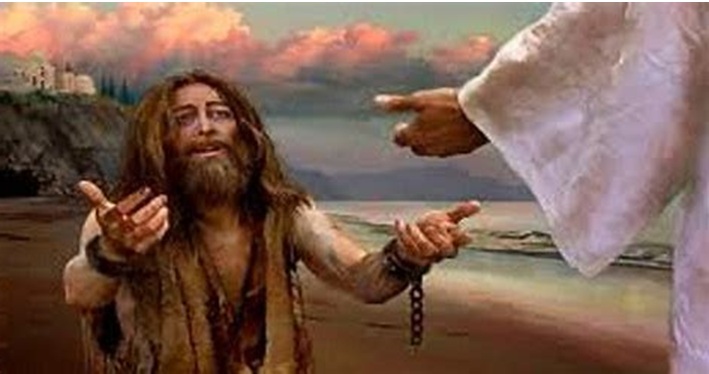
HALIFAX, Nova Scotia, September 4, 2025 – Ministry work isn’t the same for everyone. Not everyone has the same type of ministry. We can see this even way back in the early Church, when Jesus sent some of his followers out two-by-two with strict instructions, while others he told to go home and show their people what God had done for them. Jesus himself modeled various ministry styles, from home churching, to teaching in local synagogues, to open-air preaching in the streets and on hills, to private one-on-one after-hours sessions, where people who didn’t want to be seen with him in public would come to him alone under cover of night.
How we’re to minister to others and to witness what God has done for us depends fully on God. These are not decisions we should make for ourselves. We shouldn’t choose our ministry style based on what we want. We should wait for God to direct us.
The man who used to live wild and naked among the tombs, breaking whatever chains were put on him and cutting himself with stones, wanted to join Jesus’ traveling ministry after he was healed, but Jesus told him that he should instead go home and show the people there what God had done for him. When I first read about this man, I thought Jesus was rebuffing him and trying to let him down easy. But now I realize that Jesus was giving the guy a ministry that was a perfect fit for him and one in which his witness would give him the biggest bang for his buck.
If the man had gone out among strangers to tell them what God had done for him (which is what he’d ask Jesus if he could do), the strangers wouldn’t have had the “before and after” context that the man’s family, friends, and neighbours would have. It’s all well and good to claim that you used to run naked and howling among the tombs until Jesus healed you, but you’re relying on people to believe your claims. Many won’t. The people who knew the man as he’d been and then saw him after he was healed – that was a powerful witness without even speaking a word. It would have been an astonishment to those people just to see the guy wearing clothes and speaking calming and coherently. Far from rebuffing the man, Jesus was gifting him a ministry with clear instructions, and blessing his labors in advance. What a beautiful thing!
A few weeks after I was reborn, I went to a church service in a little town about an hour’s drive from where I was living at the time in South Australia. There was a reception after the service, and when most of the guests had left, I spoke to the minister about my rebirth. He listened politely for a few minutes and then suddenly took me by the hand and led me over to a window. Once there, he tilted my face so that it caught the full sunlight. Then he said something I’ll never forget. It was more a murmuring to himself than a statement to me. This is what he said: “Yes, you’ve suffered.”
Everything I’d told him up to that point wasn’t enough for him to fully believe me; I was a stranger, and all he heard and saw when I first started talking to him was a rush of words and a happy glowing face. He couldn’t connect this joyful woman with the demon-infested wretch I’d claimed I once was. He needed something more tangible before he was willing to buy my story. He needed hard evidence, and that’s what he found, I guess, in seeing for himself the suffering lines etched on my face, lines that had been softened and smoothed by my spiritual healing but were still perceptible in a strong enough light.
There are many people who used to know me as I was, before my rebirth, who google me and arrive at this blog out of curiosity. They read a bit (mostly the “About” page) to see what’s become of me. Of course, to most of them, not much of what they read here makes any sense, because they’re not reborn themselves, and so they dismiss it with a sneer and an eyeroll, laughing at what I’ve become. Some of them think I’ve gone crazy. Some of them think I’m faking it. Some even think, given enough time and booze, I’ll snap out of it.
But for some (and it’s for those few that I write this) – for some, my witness here gives them pause. They’re not sure what to think, but they know something must have happened to me, something that can’t be explained away by mere medical science or latent maturity onset. Because even though the tone of my words is more or less the same as they remember, the words themselves sure aren’t the same. These are not words that would have come out of me when they knew me. I might not have been running around graveyards naked and howling back in the day, but I almost was. I certainly had a similar version of the legion in me. Instead of stones, I’d use knives to cut myself. And the change, when it happened, was as instantaneous and drastic as it was for that man all those years ago – one minute I was howling and cursing, and the next I was weeping tears of joy and hugging a Bible.
Twenty-six years later, I’m still hugging it.
If genuine, our witness and our ministry should be so intertwined, you can’t tell where one ends and the other begins. This is why Jesus sent the man back to his hometown, so that his witness would inform his ministry and his ministry his witness. Most people who read this blog are strangers to me; they didn’t know me before my rebirth and so need to take me at my word that I was healed from what I said I was healed from. Not all of them do take me at my word. Not all of them are convinced.
But the people who knew me when I was an atheist and who now read these words – they know something happened to me. They might not know exactly what it was, but they know something happened. The same hometown advantage that the former legion man had in his ministry, I have in mine.
Maybe you have it, too.
Ministry work doesn’t mean you have to go off to a remote village in Africa or start a megachurch in California or street preach in New Orleans during carnival. You don’t choose your ministry based on what other people are doing or what you think you’d like to do. And you certainly don’t choose your ministry based on what other people tell you to do. God chooses your ministry for you, and in so doing, blesses it and provides you with clear instructions. Ministry is not a numbers game tallied by butts on seats or donations totals. (It never was a numbers game.) It’s about doing God’s will and God’s will only, and in so doing showing whomsoever will what God has done for you.
What they then choose to do with that information is between them and God.
CANADIAN DEUTERONOMY 28: THE CURSES

HALIFAX, Nova Scotia, September 1, 2025 – The “flag” pictured above is a photograph of a real burnt maple leaf embedded in dry grass on some random person’s lawn in rural Nova Scotia. Thank God (in every sense of the term) that the random person had the wherewithal (and the technology on hand) to snap a pic of the leaf before it blew away. The grass underneath it is dried out not from fire but from a drought that’s emptied most of the wells and watering ponds across Nova Scotia while also drying up farmers’ fields, destroying crops. Few here in this now atheist-majority country will say it openly, but it’s Biblical. What’s happening here with the fires and the drought across much of Canada is Biblical, and it’s only just getting started.
The blackened maple leaf that blew onto the random person’s lawn came from a fire burning several miles away. The Long Lake wildfire has so far raged through 8,500 hectares (33 square miles) of people’s homes, lakeside cottages, hunting camps, and pristine forest. It’s been out of control since it started on August 13th, and until we get a good steady rain here in Nova Scotia, it will continue to burn out of control. We haven’t had a good steady rain now for nearly three months, which is unheard of in this province, surrounded as it is by the North Atlantic.
In contrast to the burnt maple leaf above, the video below is not real. It’s a fictional account of the coming collapse of Canada, but it’s based on data sourced from the Canadian government (federal, provincial, and municipal). In the video, the relevant statistical trends have been extrapolated and extended to their logical conclusion—total societal and economic collapse by 2030—in a compelling and realistic narrative that is unfolding around me as we speak.
It’s the Deuteronomy 28 curses come to life.
For those of you who are interested, the same channel also has similar videos on the coming total economic and societal collapse of Australia and the UK, again using government-sourced data.
Directly below is a screenshot of a Nova Scotia Reddit thread from a few weeks ago. In it, people are discussing the rain (or lack of it) and the bizarre (to them) patterns of how the rain falls when it does fall, however briefly.
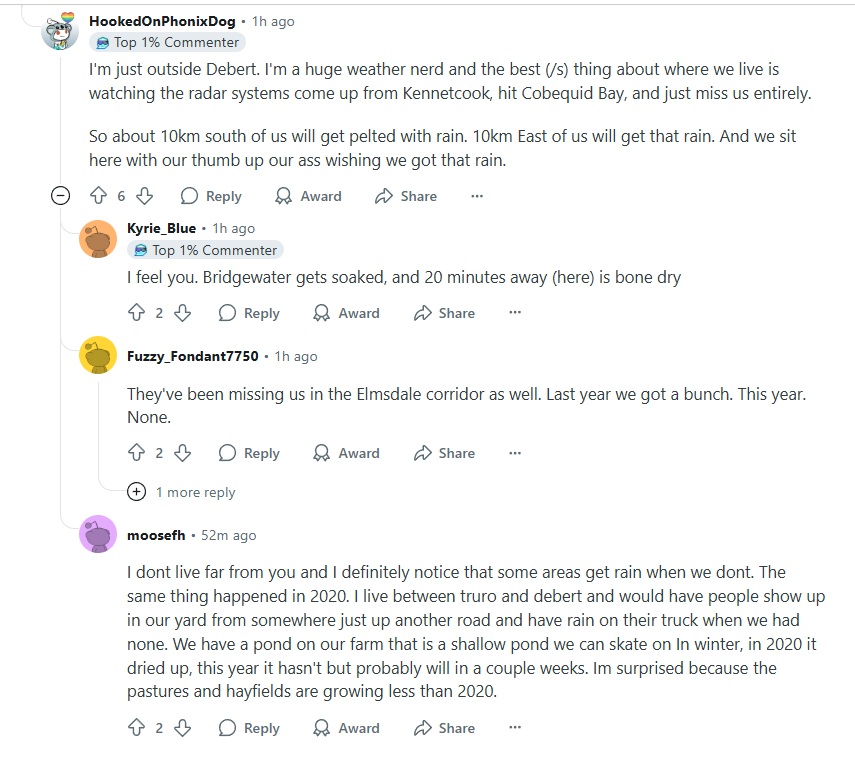
When I first read the thread, I immediately thought of this:
And also I have withholden the rain from you, when there were yet three months to the harvest: and I caused it to rain upon one city, and caused it not to rain upon another city: one piece was rained upon, and the piece whereupon it rained not withered.
(Amos 4:7)
Biblical, indeed.
DECEPTION

HALIFAX, Nova Scotia, August 31, 2025 – I wrote a few days ago about how children are easily deceived, especially by people older than them. I remember as an eight-year-old thinking that my 13-year-old babysitter was a trustworthy adult because she was allowed to make Kraft Dinner all by herself. Whenever she’d babysit, I’d do whatever she’d tell me to do (including dutifully eat her rock-hard macaroni with lumpy cheese sauce) because I unquestioningly accepted her full authority over me.
I saw the same unquestioning obedience in the three- and seven-year-old sons of a former boyfriend of mine. Whenever they’d come over for the weekend, I’d take them to the corner store for treats, just the three of us. The littler one would hold on tight to my hand, fully trusting me though he hardly knew me. Whatever candies I’d buy for them, they’d solemnly eat. It was strange for me, not being a mother myself, to see how willingly they complied with my every word.
It’s easier to deceive children than adults because children haven’t yet developed the healthy skepticism that comes with age and experience. Still, many people allow themselves to be deceived even into adulthood, perhaps out of a misplaced desire to recreate the safe haven they felt as children. But we born-again believers don’t have the luxury of willful naivete or of suspending our disbelief and holding on tight to the hands of worldly authorities. We also can’t afford to accept at face value the revelations of self-proclaimed prophets in the worldly church. We need to stand firm in God’s truth at all times, no matter how uncomfortable that might be for us or how alone we stand. God is our Truth, not rumor, innuendo, peer pressure, frenzied mobs, or false prophecies.
Which brings me to the topic of today’s article – deception. A tool of the devil, deception is also used on occasion as a testing strategy permitted by God. When the devil wields deception as a reward (that is, as something that’s been earned), he delivers it as a spiritual stronghold, so that those under its thrall are under his direct authority. Prior to my rebirth, I was constantly under the devil’s spiritual strongholds of one kind or another, especially in relationships, and so I know how nearly impossible it is to see clearly when you’re in them, let alone to break free of them. On the other hand, when God permits deception for testing purposes, he also provides a clear way for us to discern the lie and so to avoid falling for it.
You can’t “logic” a person out of a spiritual stronghold. You also can’t pray them out. Even if you think you’re making headway with someone who’s under a stronghold, they’ll willingly tighten their own chains as soon as you’ve gone home for the night. When the devil uses deception as a reward, he has God-given authority over everyone under the appointed stronghold: Even God won’t intervene in those cases, other than in rare exceptions that lead to spiritual rebirth.
But deception when allowed by God for testing purposes is vastly different. It’s still administered by the devil, but it’s not a spiritual stronghold; it’s not a due reward for choices made: It’s a test that comes in the form of a temptation to believe something that isn’t true. Jesus says that sometimes these deceptions are so extreme, even the “elect” (that’s us!) can be deceived. So how are we to know who or what to believe during these tests?
Paul advises us always to test the spirits, so even when we’re being tested, we need to test the spirits. (Especially when we’re being tested, we need to test the spirits.) However, when we’re being tested, we can’t just go to God in prayer and ask him for answers like we normally do, any more than when we were in school we could ask our teacher for answers when we were writing exams. During testing, we’re pretty much on our own as far as the answers go. That means we need to rely on what we’ve previously learned, and we need to use our discernment.
The best and most recent example of a God-sanctioned spiritual stronghold under the devil is the alleged September 23-24 rapture of the church. Suffice to say it’s just another version of the same-old same-old that’s been making the rounds for nearly 2000 years. The Jesus-is-coming-back-soon hysteria tends to be cyclical, but people still willingly embrace it so the devil keeps trotting it out, confident in its positive results for him. “Jesus is coming back soon!” is one of the devil’s favorite lies, as he harvests a bumper crop of disillusioned souls each time the prophecy fails.
Ironically, when Jesus does actually come back, the devil won’t be plying us beforehand with this particular deception. He won’t be allowed to. Like the virgins who fall asleep just before the bridegroom appears, we won’t know exactly when Jesus is coming until he’s suddenly here. The knowledge will be supernaturally withheld from us by God, who’s also, according to scripture, the only one who knows exactly when Jesus is coming back. Even Jesus himself still doesn’t know when he’s coming back and won’t know until he gets the signal that it’s time to ride.
As for us, our only heads-up will be our ongoing standing order to keep doing our jobs so that when Jesus does appear, he finds us doing what we should be doing during our time on Earth – namely, the specific work that God has given each of us to do. The last thing we want Jesus to find us doing is laboring under the latest lie of the devil.
We aren’t children anymore, to naively entrust ourselves to worldly authority figures or to believe lies because we don’t know any better. We also shouldn’t be easily deceived when we have God’s Spirit of discernment to guide us. Yes, tests on deception can be difficult (they’re meant to be), but God will only test us according to our ability: He doesn’t test us on what we don’t know; he tests us on what we do know, to see how we apply our learning in real-life situations.
As born-again believers, we don’t have to worry about being under demonic strongholds anymore, not as long as we’re under God’s grace. If we genuinely have God’s Spirit with us, we can’t come directly under the devil’s authority. It’s a spiritual impossibility. We can, however, be subjected to tests on deception delivered by the devil. God will permit that. Which means we always need to be on our spiritual toes, because those tests don’t come announced, and when they do come, they come hard and fast, often before we even realize we’re being tested.
This September’s rapture prophecy will play out like the countless other rapture prophecies before it, and the devil will take his payment in souls, like he always does. When the stronghold spell is broken on September 25, the majority of the people now under its thrall will quietly delete their “I had a dream” videos and move onto the next craze, having learned nothing from the experience. Some will even walk away from God altogether, feeling betrayed.
I pray you’re not among them.
 A BORN-AGAIN BELIEVER