
Home » Posts tagged 'CLOUD OF WITNESSES'
Tag Archives: CLOUD OF WITNESSES
HAVE YOU BEEN PIGEON-HOLED? SEPARATING WHO YOU WERE FROM WHO YOU ARE

NIAGARA FALLS, Ontario, December 9, 2022 – As many of you know, I was born again from atheism 23 years ago. For me, the switch from atheism to God worship was easy-peasy, because God did all the work during my conversion. All I had to do was agree to his terms (to choose to forgive), and I was an atheist no more. I didn’t have to work at being born-again; it just happened.
Since my conversion, I think and feel and speak as a born-again believer and follower of Jesus, at least in my own mind I do. But people who knew the atheist Charlotte have a hard time letting her go. You see, we get pegged as being either this or that and as having either these or those characteristics and traits. And for most people, these characteristics and traits are set in stone. They have no intention of changing their impression or opinion of you, no matter how much you actually change.
We all get pegged and pigeon-holed. Jesus was pegged and pigeon-holed in Nazareth. Even when he returned home as a renowned healer after he’d started his ministry, he was still, to the Nazarenes, the son of Joseph the carpenter. They couldn’t get past who he had been to see what he had become. He had been pegged and pigeon-holed for life, regardless of the miracles he performed or his newfound eloquence in scripture. The Nazarenes – including his family – still had him pegged and pigeon-holed as Joseph’s son, and the brother of Joses and James and the rest of Mary’s brood.
This is why Jesus ultimately left Nazareth permanently and warned us that we will never be taken for who we are by those who knew us as we were. Like everything else Jesus said, he was bang on the money. Every now and then I get contacted by people I knew before my conversion, and once they find out I’m a Jesus freak, they disappear down the communications black hole, never to be heard from again. Some of my old friends who contact me actually ask outright if I’m still a Christian, and when I say “yes, of course”, the conversation pretty much ends there. I don’t take it personally; I know how I’d feel if one of them converted and I’d remained an atheist: I wouldn’t even have bothered to contact them. I would have written them off completely and in derision.
We need to accept that we’ve been pegged as we were pre-conversion by those who knew us and who are not born-again. The sole exceptions are other converts. People who are genuinely born-again know that I’m genuinely born-again, but I know only one such person from my past, and that person is now gone. I’m not sad about her passing, because I know that if I make it Home I’ll see her again and forever. But for now, I’m just grateful that at least one person who knew the atheist Charlotte was able to make the leap to the born-again believer Charlotte, and to see me not for who I was, but for who I am. So far, it’s only been the one person who was able to do that, but it was enough. It was affirmation.
Maybe I’ll live to see a few more take the leap before I go Home.
In the meantime, I generally avoid people I used to know as much as they avoid me. I can’t pretend to be someone I’m not anymore, and it’s frustrating to see people look at me like I’m crazy simply for being a believer. It’s also frustrating when people treat me as if I’m still the cursing, drinking, “for-ny-kating”, lying, cheating bad girl I was before my conversion. That person is dead (she always was, spiritually) and gone, and she ain’t comin’ back. Jesus had the same problem of being perceived as Joseph’s son rather than God’s son, which is why he told us that, as children of God, we are prophets everywhere except among our own people. With few exceptions, we will remain to them whatever we were before our conversion (something something “first impressions…”).
It can be a temptation to turn back to who we were, if for nothing else for the companionship we used to have in the world. I don’t dislike the people I used to know before my conversion; I just don’t have anything in common with them anymore, and I make them uncomfortable. It’s like we’ve become strangers because we actually are strangers. We would not have formed a friendship in the “old days” if I’d been a convert then. It’s better just to admit that rather than to keep trying to force proverbial square pegs into round holes.
My friendships now are all in the Kingdom. Paul tells us that we’re surrounded by a cloud of witnesses, and he’s right. I can’t see my “invisible friends”, but I know they’re there. If you’re genuinely born-again, we’re friends. We may never meet or speak to each other, but we’re friends. I know you’re there and you know I’m here, and that’s enough, at least for me. And then there’s the spiritual realm of those who live permanently in God’s Kingdom in Heaven – they’re all our friends, too, which at last count was almost infinite in number.
Yes, the world has pegged and pigeon-holed us for whatever we used to be, but God and those who love him, and Jesus and those who follow him, know us for who are. That alone should suffice and sustain us for the rest of our time on Earth.
WHAT IS A CHRISTIAN?
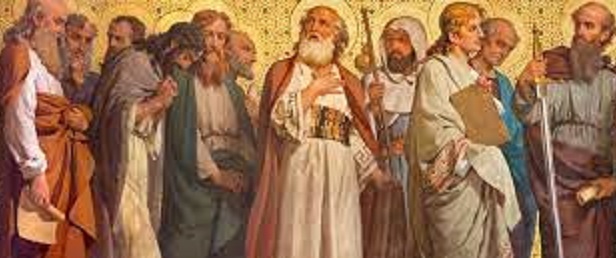
HALIFAX, Nova Scotia, August 14, 2022 – Back when the term was first coined, “Christian” was synonymous with “death sentence”, which is why anyone who identified as Christian in those days lived undercover and on the run. Jesus warned his followers that they’d be considered outlaws, and so they were. Most were killed for the sole reason that they were Christians, but they willingly chose death rather than renounce their faith and lose their place in God’s Kingdom. This shows how highly valued being a Christian once was to those who were Christians.
Nowadays, the standard definition of “Christian” has significantly changed from the original incarnation. A Christian in today’s post-modern world is someone who attends church on Sundays, follows the Commandments (more or less), gives to charity, lives a comfortable if somewhat bland life, but is otherwise indistinguishable from non-Christians. Post-modern Christians easily blend in with the same world that once persecuted and killed them. They marry, they divorce, they have careers, they have children, they have mortgages, they have pensions, they have investments, they retire, until finally they go to their eternal reward never really understanding or even wanting to know what it means to be born-again or to follow Jesus. This is a standard-issue Christian in the 21st century.
So what happened? How did Christians go from being #1 enemies of the state to being dismissed as inconsequential?
We could say “the devil happened”. Without a doubt, the worldly church has been infiltrated by the devil to the point that it is now more the congregation of Satan than of God, but that’s only part of the equation. The devil can influence, tempt, coerce and threaten, but he can’t force people to do anything against their will. He can’t force people to stop being Christians in the original meaning of the term (that is, he can’t stop them from being born-again followers of Jesus). He can’t force people to water down their faith or adjust their lifestyle to where it is indistinguishable from that of unbelievers or even outright Satanists. Only individual Christians themselves can choose to do that.
Which brings us back to the question: What is a Christian?
Christians were persecuted and killed because their beliefs were considered a threat to the status quo of the powers-that-be, who were then (as now) under the authority of Satan. Jesus, whose most violent act was to overturn a few tables, was considered such a major threat that he had to be eliminated, on the assumption that eliminating him would also kill the movement he’d started. Ironically, eliminating Jesus in the mortal realm only succeeded in unleashing him in the spiritual one, where his influence was exponentially stronger. You can’t kill God’s Spirit; get rid of one genuine believer, and others will stand up in his place.
Knowing that he was not going to succeed at eliminating Christians, the devil focussed instead on compromising them to the point where they would no longer be a threat to him. He did this through infiltrating the worldly church with anti-Christ doctrine and splitting into denominational factions what was originally the same church at different locations. He also did this by making Christianity the official religion of many countries and regions, which was accomplished by blending Christian traditions and beliefs with pagan traditions and beliefs, so that the “NEW & IMPROVED!” Christianity would be more easily accepted by the non-Christian masses.
Somewhere along the line, being born-again and following Jesus were dropped from the definition of being a Christian. Those prerequisites were still in scripture, but they weren’t in the state-created, state-sanctioned, mainstream church. Instead, you were a Christian if you lived in a certain country or region, or you were a born a Christian if your mother was a Christian. Genuine spiritual rebirth was no longer needed, because allegedly you were automatically reborn at baptism (a few weeks after birth) or at confirmation (around age 12 or 13). As for following Jesus, the Gospel was essentially replaced by creeds that differed from denomination to denomination, but were the same in that they introduced lies that denominational adherents were forced to recite, memorize, and regurgitate. Some of the creeds even stated that if you didn’t believe them, you were eternally damned.
Again, the devil can seduce and bully you, but he can’t force you to do something you don’t want to do. Sometimes the consequence of not doing the devil’s bidding is torture and death at the hands of the state or other worldly authority, but that’s how it is. Jesus warned us it would be that way, so we shouldn’t be surprised when it is. He also taught us that the world is under the authority of Satan, so we shouldn’t be surprised when we find that to be the case. The Catholic organization’s nearly 1000-year reign of terror against genuine Christians, called the Inquisition, was dressed up to look like a holy war, with the papacy and its adherents heralded as the good guys and genuine Christians framed as the bad guys. The torture inflicted by the so-called good guys on the so-called bad was so heinous, I refuse to describe it here. Let’s just say it involved demon-level atrocities that only demon-infested people could have devised and carried out. And yet the people promoting the torture and those carrying it out considered themselves to be Christians doing God’s will.
I have a love-hate relationship with the word “Christian”. Jesus never used the word, but the early born-again believers claimed it. So the love part of my love-hate relationship is using “Christian” the way the early believers used it – to identify genuine born-again followers of Jesus who were so committed to serving God in Jesus’ name, they would rather be killed than renounce their faith. These were true believers who were worthy of being called followers of Jesus, and of calling God their Father and Jesus their friend.
On the other hand, the “hate” part of my relationship with the word “Christian” flows from how watered down to the point of meaningless the term has become today. What value is there in identifying as a Christian if the word is synonymous with someone who is, at best, well-meaning but impotent or, at worst, a hypocrite or con artist?
So what is a Christian? Is it time to reclaim the term, to bring it back to its roots and original meaning, or is it too late for that? Has too much damage been done, too much water flowed under the bridge for the notion of Christian ever again to mean what it did 2000 years ago? The devil has been busy over the millennia, knowing that while he can’t prevent conversions and rebirths, he can muddy the waters and poison the wells so that the converted and reborn have a hard go of it and nominal Christians just spin their wheels, getting nowhere.
If you ask me, as a born-again believer, what a Christian is, I’ll tell you this: It means, first and foremost, to be genuinely reborn through a genuine rebirth experience. Being genuinely reborn, Christians then have God’s Spirit with them 24/7, to varying degrees (never as much as Jesus had, but still enough to guide them in the Truth along the Way and to enable them to communicate with God and Jesus constantly and directly, through prayer). Being reborn and having God’s Spirit with them 24/7, Christians can then take their place in the Kingdom of God, surrounded by their brothers and sisters in Spirit in the cloud of witnesses mentioned by Paul and described by John. They can also either prepare to teach and preach the Word, or actually teach and preach it. They should be doing one or the other: preparing to teach and preach, and then, when emboldened by the Spirit, actually doing it.
Born-again Spirit-filled Christians who live in the Kingdom and who are either preparing to teach and preach or are actually doing it also take their cue entirely from Jesus on how to act in and interact with the world (e.g., follow the Commandments, love their enemies, treat others as they’d want to be treated, etc.). Christians, in the truest sense of the term, don’t make choices based on how they feel or what the world says is OK to do – they look to Jesus to see what he did when he was on Earth in a human body. Jesus is their sole example of how to live their lives. In the Gospels, Jesus first taught them theoretically what they should do, and then he walked it out practically for them to see the theory in action. He told them, and then he showed them; he told them, and then he showed them. This is the hallmark of a great teacher and preacher.
Finally, Christians always have their eyes on the prize, which is Heaven. Living their lives day by day, as Jesus showed them to do, the only long-range plan they make is getting to Heaven. Making it to Heaven is the overarching goal and guiding light that draws them ever forward and upward, no matter how bad things get on Earth.
This, then, is what a Christian is – one who is a born-again, Spirit-filled believer who lives in the Kingdom and is always consciously in the presence of God and Jesus, who either teaches and preaches the Word or is preparing to do so, who follows in Jesus’ footsteps according to his example of how to live in the world, and who is aiming for Heaven and therefore only does and says those things that are worthy of someone aiming for Heaven. This, to me, is a Christian, and I base my definition on scripture.
Even so, I also know that the term “Christian” will never again mean to the world what it meant at its inception, and that lamenting how cheapened the worldly definition of Christian has become will not change worldly Christians into authentic ones. Only they can choose, on an individual basis, to want that change to happen, and only God can make it happen. So while I distance myself from using the word “Christian” to describe myself to the world, I still use it with God and Jesus; I still stand among my Christian brothers and sisters in the cloud of witnesses as one of countless Christians who have stood before God throughout the ages, following Jesus’ example of how to live in the world and being guided and emboldened by God’s Spirit as I make my way carefully, carefully, and with fear and trembling, Home.
WORKING FOR GOD
HALIFAX, Nova Scotia, May 22, 2022 – Work, to Jesus, was not something you did 9 to 5. It was also not something you did full-time, part-time, seasonally, in shifts, or three weeks on, one week off. It was not contractual, in the sense that you had to agree to do and say certain things “on the job” that you may or may not do or say in your “off” hours.
It was not something you did for money.
Work, to Jesus, was not like that.
To Jesus, work was who he was. He was his work. He made no distinction between the work he did for God and who he was as a person.
We who live in the Kingdom and follow Jesus should also strive to be our work, as Jesus was his.
*****
Today is my Sabbath. I’ve written before about how much I love the Sabbath. The Sabbath, of course, is our God-sanctioned day off from work. We need it and use it to rest from our labours. Keeping the Sabbath is also a Commandment. That means, not keeping the Sabbath is not an option. In keeping the Sabbath, we’re also to keep it holy, which means we’re not to devote our Sabbath day to profane (worldly) pursuits, including doing work for mammon.
I don’t always keep my Sabbath on the same day that most people keep theirs. Sometimes, I’m led by God to keep it on a different day, but the content of my Sabbath – regardless of the day I keep it – is still the same. Jesus says that the Sabbath was made for man, not man for the Sabbath, and I take him at his word. I keep the Sabbath when God guides me to keep it, and I keep it holy, as he instructed in his Commandment.
Jesus, however, was infamous for breaking the Sabbath, or so his detractors accused. Because he made no distinction between the work he did and who he was, Jesus worked on the Sabbath without breaking the Sabbath. Like priests, Jesus was actually obligated and expected to work on the Sabbath, as he frequently pointed out to his detractors.
We again see Jesus’ take on work reflected in the famous interchange between him and Martha, when Martha asks Jesus to get Mary to help her with her chores. In asking Jesus to intervene, Martha likely assumed this tactic would shame Mary into helping her. So imagine her shock when Jesus instead sides with Mary and reminds Martha that, in sitting at Jesus’ feet and learning about the Kingdom, Mary has chosen the better job.
*****
During the time they were with Jesus on Earth, the disciples did the same mundane daily chores that the rest of us generally do, such as shopping, food prep, and so on. However, shortly after they’d received the baptism of the Holy Spirit, they allocated the mundane daily chores to others and spent all their time doing the work of the Kingdom. Like Jesus, they had finally become their work.
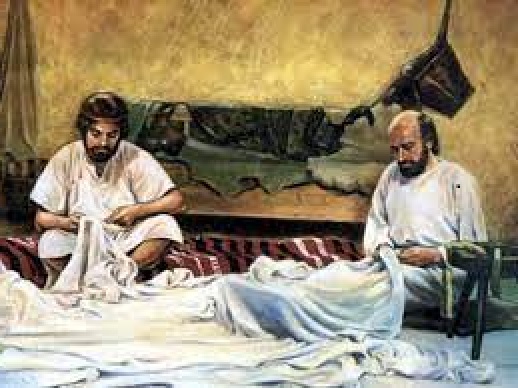
It took Paul some time to get there. Even while he was traveling and preaching and writing his letters, he still made tents for his daily bread. He also encouraged others to earn their way through the world rather than to rely on hand-outs. The six-day designated work-week was important to Paul, as it should be to us. Working six days a week is part of the same Commandment as keeping the Sabbath holy.
*****
So where does all this information leave us? If you’re like me, you’re both working in the Kingdom and working in the world, as Paul was for most of his ministry. I don’t know if I’ll ever get to the point where I’m working only in the Kingdom, like Jesus, but I hope so. I’m on God’s time, not mine.
In the meantime, I’ve been blessed to have work that I can do anywhere in the world and where I’m my own boss. The work I do for the world (freelance writing and editing) also feeds the work I do for the Kingdom, which is a profound blessing. Even better, God is my agent. And being perfect at everything he does, God is a perfect agent, which means he only gets me work that suits me, that I have time for, and that satisfies my needs. I am never without.
How much longer I’ll be doing my worldly work is up to God: again, I’m on his time, not mine. When I do my God-sanctioned and God-given worldly work, I keep in mind that I’m always to do it (as scripture tells us) as if unto God, as if I were doing it for God: as if God were my client. So even in doing worldly work, I’m still doing Kingdom work if I do it unto God, which means if I do it to the best of my ability.
In doing both worldly work and Kingdom work, I see myself along with others doing the same. We’re in a vision given to John, which he recorded in the book of Revelation:
After this I beheld, and, lo, a great multitude, which no man could number, of all nations, and kindreds, and people, and tongues, stood before the throne, and before the Lamb, clothed with white robes, and palms in their hands;
And cried with a loud voice, saying, Salvation to our God which sitteth upon the throne, and unto the Lamb.
And all the angels stood round about the throne, and about the elders and the four beasts, and fell before the throne on their faces, and worshipped God,
Saying, Amen: Blessing, and glory, and wisdom, and thanksgiving, and honour, and power, and might, be unto our God for ever and ever. Amen.
And one of the elders answered, saying unto me, What are these which are arrayed in white robes? and whence came they?
And I said unto him, Sir, thou knowest. And he said to me, These are they which came out of great tribulation, and have washed their robes, and made them white in the blood of the Lamb.
Therefore are they before the throne of God, and serve him day and night in his temple: and he that sitteth on the throne shall dwell among them.
They shall hunger no more, neither thirst any more; neither shall the sun light on them, nor any heat.
For the Lamb which is in the midst of the throne shall feed them, and shall lead them unto living fountains of waters: and God shall wipe away all tears from their eyes.
Revelation 7:9-17
There we are, having come through our own personal Tribulation and washed our robes in the sanctifying blood of Jesus, making them white. That is spiritual rebirth. Protected, guided, provided for, and comforted, we spend the rest of our time on Earth in what Paul called a “cloud” of witnesses – spiritually before the throne of God, rejoicing in God, and serving God only. If you’re genuinely born-again, you’re in John’s vision. Your work and everything you do is now a testimony to Jesus. Stick your face close enough to the words of that passage, and you’ll see yourself waving at you. I’m waving at you, too. Go ahead and wave back.
*****
For Jesus, working and doing God’s will were one and the same, and he did them night and day. For us born-again believers who are doing both worldly work and Kingdom work, we’re not that far off from how Jesus worked if we do everything we do as if unto God.
Even so, if God guides us to do it, we shouldn’t be ashamed to make tents. It’s always better to work than to beg; God never wants his children to beg. If we show the willingness to do whatever’s asked of us, God will bring us the resources we need in the world to continue our work in the Kingdom. That’s a guarantee.
Scripture tells us so.
 A BORN-AGAIN BELIEVER