
Home » Posts tagged 'God’s Spirit' (Page 14)
Tag Archives: God’s Spirit
BY THEIR FRUIT

CAMPBELLTON, New Brunswick, May 1, 2023 – As the cost of living soars and the quality of life plummets for most people in former Christian nations, few of the affected people are willing to identify the real source of these phenomena. They instead blame high prices on ‘greedy oligarchs’, ‘greedy landlords’, ‘greedy baby boomers’, etc., while pointing the rest of their fingers of blame at the flood of “gimmegrants” and refugees from third-world countries. At the same time, they bemoan government inaction on all these fronts, dismissing politicians as ‘stupid’, ‘incompetent’, and unable to foresee the damage their policies are causing.
Very few know that their afflictions were described in detail by Moses over 3000 years ago, and that the oligarchs, landlords, baby boomers, immigrants, etc., are not the cause of their problems, but the fruit of it. In other words, something else other than those factors is causing the consequence of soaring cost of living and plummeting quality of life.
That something else is described in detail in Deuteronomy 28.
As I’ve mentioned here before, I’m a big fan of Deuteronomy 28. I think it perfectly describes our time, just as it perfectly described the time of the children of Israel before the destruction of their nation in 586 B.C., just as it perfectly described the time of the Israelites and Judeans before the destruction of their nation in 70 A.D.
And now it’s our turn.
Our churches have been given over to idols and desecration, as were the synagogues during the pre-destruction times of our spiritual forefathers. Our so-called Christian belief system has been so compromised, that even practicing witches incorporate portions of it into their belief system. But again, this is the fruit – not the cause – of our current situation.
Jesus was very clear that the measure we mete is the measure we get in return. At no time does he indicate we’re punished for something we didn’t do (he’s the only one who was punished for that). If our cost of living is soaring and our quality of life is plummeting, it’s because we’ve brought it on ourselves. If our streets, schools, malls, churches, grocery stores, and public transit systems are rife with random violence, it’s because we’ve brought it on ourselves. If greed is the defining characteristic of our people, from the top to the bottom of the socioeconomic scale, it’s because we’ve brought it on ourselves. If foreigners rule over us, it’s because we’ve brought it on ourselves.
See a pattern there?
Reread Jeremiah and the other books in the Old Testament that describe the years leading up to the fall of Jerusalem and the destruction of Solomon’s temple. The corruption of the powers-that-be was off the charts. But here again, the corruption wasn’t a cause of the bad times, but the fruit of it. All the chronicled kings who did what was “evil in the eyes of God”, including colluding with pagan rulers, were the reward earned by the people they ruled over. The children of Israel, by their evil ways, had earned their evil kings, just as their spiritual descendants — Christians – have earned their corrupt leaders and fast deteriorating quality of life.
The same situation occurred during the time of Jesus’ ministry, shortly before the destruction of the second temple and Judaism’s final deathblow in 70 A.D. Israel and Judea were under Roman occupation, and the religious powers-that-be were willingly colluding with Rome. The Gospels leave no doubt as to how those powers-that-be, including the kings, treated their Messiah. They were so blinded and deafened as a result of their evil choices, they not only couldn’t see Jesus for who and what he was, they demanded his execution.
Fast-forward to today and the deep state that rules over all nations from behind the scenes. Ours is a world under Satan, as Jesus taught us. The only thing limiting Satan’s worldly power is godly people, that is, people who live according to God’s Ten Commandments and Jesus’ gospel teachings. “Spiritual warfare” prayers do not limit Satan’s power; the careful placement of so-called holy relics do not limit Satan’s power; removing politicians who do the bidding of the deep state does not limit Satan’s power. The only thing that limits Satan’s power is people making godly choices and living godly lives. The fruit of godliness is a better home, a better neighbourhood, a better community, a better city, a better nation, and a better world.
Jesus doesn’t want his followers to live sequestered in monasteries or nunneries. He wants us to live in the world, showing the way to those who are lost but are open to being found. Living in the world, we can’t help but see the worst of it. We know how bad things are because we experience it up close and personal every day. We see how the Ten Commandments are mocked and ignored and how Jesus and his teachings are mocked and ignored, and we see the fruit of the mockery and ignorance. That is, we see broken people, broken homes, broken communities, broken lives. We see band-aid solutions like rent control, welfare and EBT only making things worse. We see people openly worshiping rainbow demons in our neighbourhood churches. We see all mention of Jesus and God removed from public spaces, and people who defy their removal being arrested and imprisoned.
I personally was removed from a chapel at Toronto’s Pearson Airport a few months ago and threatened with arrest if I didn’t leave. I’d only been in the chapel for about 20 minutes and was reading the Bible and praying when the two police officers arrived to remove me. They said I was trespassing. For those who don’t know, the chapel at Pearson Airport’s Terminal 1 is open to the public, as is the airport, which means you don’t need a plane ticket either to enter the chapel or to enter the airport, and there is no limit to how long you can stay in either place. The chapel was consecrated many decades ago, upon its opening, which means it was set apart from the world and from worldly authorities.
When I took this up with God, asking him if I should pursue my removal from the chapel from a legal standpoint, he told me the chapel was deconsecrated years ago when it was changed to a “worship room” and welcomed people of all faiths to worship there. Because it was deconsecrated, the chapel was no longer his jurisdiction. In other words, the world and its worldly authorities now had jurisdiction over the chapel, as they have over most if not all chapels and churches in the world, and so the worldly authorities were in their right to handle me as they saw fit, including removing me. I was hounded out of the chapel in the same way Jesus was hounded out of the synagogue in Nazareth, where God by that point no longer had jurisdiction (“See, your house is left to you desolate”).
It’s a real eye-opener when you realize that houses ostensibly set aside for the worship of God are no longer under his jurisdiction. Jesus told us that the time would come (and in fact had already come during his ministry years) when we would no longer worship God in specific places set aside for that purpose, with set rituals and timeframes, but would instead worship God in spirit and in truth, and that God craved such worshipers.
That means we can worship God wherever we are and at any given time and without external paraphernalia, the way Jesus worshiped him.
That means that while there are no longer any designated worship places under God’s jurisdiction (as the world is under Satan), we born-again Spirit-filled believers are ourselves the perambulating church, as Jesus was. Where we are – and only where we are – is holy ground.
STRANGE HAPPINESS

CAMPBELLTON, New Brunswick, May 1, 2023 – I had a dream last night about a green sky. Everyone around me was ignoring it as if it weren’t there, but I knew it meant something bad was coming, so I ran to take shelter underground. I tried to convince others to follow me, but they either laughed at me or ignored me, just as they’d ignored the green sky.
I entered the shelter alone.
That’s when the dream ended, and I woke up in a sweat.
*****
I am an alien among my own people. I hear them talking, but their concerns are not my concerns, any more than their needs are mine or their desires are mine. Being a believer in an unbelieving world can put you at odds with nearly everyone around you. It can take a toll on you, living as an outsider, but if Jesus could do it, so can we. With God and his Word as our comfort and refuge, no matter what happens to our body, our soul is safe in God’s hands.
The dream of the green sky is my everyday reality. Look, I tell people around me, look at what’s coming! But they carry on with whatever is obsessing them for the moment, blissfully or willfully ignorant of the danger on the horizon. To them, I am the fool, the one they whisper about and talk about behind my back. I’m the one with “problems”, the failure, the one who had so much potential and threw it all away on religion. A bad investment at best and an embarrassment at worst.
I imagine Jesus heard the same whispers during his ministry years. I imagine he saw the same averted gazes or worse the blank smiling faces hiding a twisted pity tinged with loathing. To be a follower of Jesus in an unbelieving world is to know what it means to be loathed, both openly and secretly. In most cases, I’m loathed without people even knowing why they loathe me. They just do. Oh, they look to find reasons, like “she dresses funny” or “she’s too old to have long hair”, things that wouldn’t even garner a second thought in their fellow unbelievers, but in me, loathsome me, it justifies their revulsion.
I understand the revulsion. I once felt it myself as an unbeliever. I loathed believers without any grounds for loathing them. I just loathed them. I know now it was a spiritual loathing, not an emotional one. The emotions conveyed the spiritual revulsion. It was the demons in me and around me that loathed the presence of God’s Holy Spirit in the believer.
I am now on the receiving end of that undeserved revulsion, and as much as it should disturb me, it instead makes me strangely happy. I don’t hate those who loathe me. I know the reason for their ungrounded hatred and I love them. The more they loathe me, the more I love them. It’s a strange kind of happiness based on a strange kind of love that can only come from God, through his Spirit.
To love those who hate you and mock you and reject you and sideline you and overlook you and talk about you behind your back is liberating. It’s like a trained boxer coming up to you and saying “Hit me”, and you hit him hard, but he just keeps standing there inviting you to hit him again. So you hit him in the head, you hit him in the gut, you hit him in the balls, you hit him in the knees, but he just keeps standing there, waiting for you to hit him again. He takes all the hits and he keeps on standing there, smiling.
Strangely, smiling.
And never once does he curse you.
*****
Holy love is as much a spiritual phenomenon as unholy loathing. These are not human feelings, holy love and unholy loathing. They come from the spiritual realm. We humans are just the delivery vehicles. But we can only deliver what we choose. None of it is ever forced on us.
We open ourselves to it, and it flows through.
ON BEING POLITE TO DEMONS
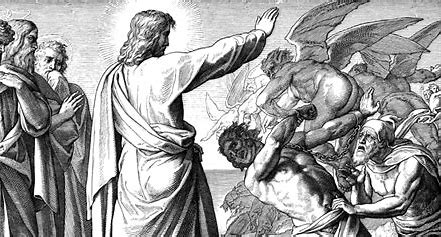
CAMPBELLTON, New Brunswick, May 1, 2023 – Jesus’ success rate with exorcising demons was, according to scriptural accounts, 100%. When he was tasked with getting rid of unholy spirits, he did the job with no fuss and no muss; just a decisive command, and out they went.
The disciples’ success rate was somewhat less than that of Jesus, but still impressive. They apparently were able to exorcise all but the ones that required the exorcist to first pray and fast. Jewish exorcists, on the other hand, failed spectacularly, according to scripture, which brings to mind today’s so-called exorcism experts from the Catholic organization. They have phenomenally poor results in dealing with demons, as they base their exorcisms on the convoluted, ritual-heavy, hierarchy-of-spirits model inherited from Jewish exorcists, not on Jesus’ straight-forward approach. Catholic exorcists even go so far as to hold conversations with the demons they’re attempting to exorcise. Polite conversations, no less.
Oy, vey!…
If Jesus spoke to the demons at all, it was solely to demand to know their name and then to use that name to loudly command them to leave the body they were inhabiting.
Which leads us to the only question that matters here: Why was Jesus so good at exorcising demons?
The answer, of course, is that Jesus exorcised demons under the power and authority of God, through God’s Holy Spirit. He did not operate under any other power or authority. All demons are entirely and without exception submissive to God through his Holy Spirit. They cannot disobey a command originating from God; it is not possible for them to do so.
But here’s the catch – not everyone can operate in the power and authority of God through his Holy Spirit. It is not something you can simply subscribe to or refer to at will. In other words, you cannot command God or his Holy Spirit to work for you. Jesus says the Spirit goes where it wills and that he cast out demons by “the finger of God”. He did not say he cast them out by his own power.
If you exorcise under the power and authority and permission of God, as Jesus did, you will have a 100% success rate. Why? Because YOU are not commanding the demons, God is commanding them through you, by his Spirit. It’s not enough to speak in Jesus’ name, whether as a believer or an unbeliever; Jewish exorcists tried that approach and failed dismally and almost comically (though there’s nothing comical in being hounded by a demon you’ve just attempted to exorcise). It’s not enough to speak Jesus’ name over demonic entities ON YOUR OWN VOLITION and expect them to comply to YOUR command. Jesus’ name has no authority when spoken for your own purposes and under your own volition. The power in the name of Jesus comes from God through his Holy Spirit, in the same way that Jesus’ power, during his time on Earth, also came from God.
True believers who speak in Jesus’ name while exorcising demons on God’s permission and under his direction will be speaking under the power of God and through his Spirit. This is the source of their authority over the demons and the reason for their success in exorcising them. Do not for one minute – no matter how fervent a believer you consider yourself to be – think that you have the power to exorcise demons on your own volition. You have no such power. It’s God working through you that performs the exorcism. You’re just the delivery vehicle, as was Jesus. Never attempt an exorcism without God first prompting you to do so, empowering you to do so, and guiding you through it.
We cannot deal politely with demons or we will fail. When God commands through us, by his Spirit, the command is delivered forcefully, in few words, and in an instant, not weakly and in several words over several days. Any exorcism model that is not based on the Holy Ghost-enabled model demonstrated by Jesus is doomed to fail not because the demon won’t leave the body it’s possessing or oppressing, but because if it does leave, it will simply enter into another one. A good example of that particular type of failure is the Jewish exorcists mentioned in Acts.
The failed exorcism is also shown in the movie The Exorcist (which, yes, I know is just a movie, but the utter failure of the word- and paraphernalia-heavy exorcism ritual was bang-on in its presentation). Also note that, in the movie, the demon only leaves the girl after the priest gives it permission to enter into him, which is not a wise thing to do on the part of the priest, even a semi-fictional one. The actual exorcism ritual involving trinkets and props and the recitation of vain repetitions is a complete failure; yes, the demon leaves the possessed girl, but it enters the priest, who is then, by the demon, thrown down a steep flight of stairs and killed. This cannot by any metric be considered a successful exorcism.
You cannot be polite to demons because you’re not the ones talking to them; God is doing the talking, through his Spirit, and God has no reason to be polite to them. Firm, yes, polite, no. Demons, like all fallen spirits, are God’s slaves. In speaking to demons, you’re just the delivery vehicle for God’s command, a position that is granted to you by virtue of your state of grace, give to you at your rebirth. As Jesus showed us, you don’t converse with unholy spirits – God commands them through you, and they have no choice but to obey those commands. Again, they’re not your commands, they’re God’s.
Exorcists who exorcise by some other power than God’s may well succeed in removing the evil spirit from the afflicted, but the spirit will simply enter into another body, not leave this realm altogether. When exorcised by God through his Holy Spirit, evil spirits are forced to leave this realm unless given stated permission to do otherwise. Recall how the demons being exorcised from the “legion man” asked Jesus if they could enter into a nearby herd of pigs, to which Jesus agreed, only to have the pigs run off the cliff and drown in the sea, forcing the demons back into the realm of the condemned. I like how this shows that Jesus, through the power of God’s Spirit, was always one step ahead of the wicked, even when playing by their rules.
Do not fool around with exorcism. It’s not a parlour game and it’s definitely not something to do for money, fame, or clicks. If God prompts and guides you to exorcise, do exactly as he says, knowing it is not by your power the spirits are commanded, but by his. Simply praying Jesus’ name over an afflicted soul is not enough to get the unholy spirit to leave. Unless God has directed you to exorcise a demon, do not attempt an exorcism. You will fail. These spirits are much, much stronger than you are, and God has put the world under the authority of Satan, which means the demons you encounter are on their own turf and playing by their own rules, as granted them by God.
When it comes to demonic spirits, do nothing that is not instigated and powered by God through his Holy Spirit. Do not even think about doing anything demon-related unless you’re instigated and powered by God through his Holy Spirit and are a genuinely reborn follower of Jesus. Remember how giddy the disciples were when they discovered they could cast out evil spirits? Jesus redirected their joy to the more important fact that their names were written in Heaven, which meant they were under the grace of God and protected by his Spirit. That is the only reason to rejoice, not in the display of power that seemingly comes from you.
Rejoice in the Lord and rejoice in your heavenly reward!
Being under God’s grace and protected by God’s Spirit gives you phenomenal abilities and privileges. Don’t abuse them and don’t ascribe them to something that’s innate in you rather than something given to you by God. As Jesus informed his arresting authorities, they only have power over him because God gave them the power temporarily. Otherwise, they have no power or authority on their own. The same holds true even for born-again believers: All our power and authority over fallen entities comes from God, through his Holy Spirit, as followers of Jesus in good standing.
“Humble yourself under the mighty hand of God, resist the devil, and he will flee”. Attempting to resist the devil without first humbling yourself under God’s mighty hand and letting his Holy Spirit take control will only lead to your failure in all spiritual matters, including exorcism. More and more unbelievers and believers are falling prey to evil spirits, but we still need to remember to wait for God’s signal before exorcising them. Jesus did not go out looking for spirits to exorcise; the possessed and oppressed were brought to him for healing or in some cases flung themselves at him in obvious need of deliverance. God will make it just as obvious to you when an exorcism is required.
When he does, remember there is no reason to be polite to the demons or to hold a conversation with them, other than to ask their name. Give them no opportunity to interact with you beyond providing their name. Do not be curious about them. Do not give them an opening to exploit. God, by his Holy Spirit working through you, will command them to leave, and they will have no choice but to leave. No other recitations, trinkets, rituals, or paraphernalia are required.
This is how Jesus exorcised and this is how we, as his followers, are to do so.
FAITH RESET

CAMPBELLTON, New Brunswick, May 1, 2023 – The church does not need a revival. It doesn’t even need a revolution.
It needs a reset back to God’s original settings.
Let me explain.
Jesus didn’t come to start a revival. He came to show us how to live our faith. Living by faith doesn’t involve listening to a sermon for an hour on Sunday and then throwing a few bucks into the collection basket, thinking we’ve done our part. It doesn’t involve living the life of the world such that our lives and those of unbelievers are indistinguishable, such that our celebrations and those of the world are the same.
No. He didn’t come to show us that.
He came to show us what living your faith means.
And in so doing, he came to reset our faith back to God’s original settings.
*****
Jesus’ reset started when he left Nazareth. He walked away from his family, his friends, his job, and his possessions, leaving everything behind that had defined him up to that point. He took nothing with him into the desert, not even food or water. He had only the breath in his lungs, the clothes on his back, and a willingness to do whatever God asked of him.
Forty days and nights later, Jesus emerged from the desert fully reset. Fasting had likely whittled him down to skin and bone, to the bare minimum required to sustain human life. All superfluity had been purged. He still had no possessions other than the clothes on his back, but he had a God-sanctioned public identity – THE SON OF MAN – and a God-sanctioned occupation: To preach and teach God’s Kingdom, and to heal all those who came to him for healing.
Tellingly, Jesus chose none of his family or friends as disciples. He’d separated himself from them for a reason. Just as tellingly, he required his disciples to do as he had done – to leave everything and everyone, and to do without. Their lives were reduced to needs, not wants. He even gave them different names to distinguish who they were from who they had been. This was the beginning of their reset back to God’s settings.
*****
One of the first things God had Adam do in the Garden of Eden was to name the creatures living there. Names are important. They’re identifiers. God renamed Abram “Abraham” and Sarai “Sarah” when he blessed them with a child in old age and promised them they would have countless children. God renamed Jacob “Israel” when he made him the same promise. Jesus made a big deal out of renaming his disciples when they first started following him. He gave them descriptive names that defined the role they would play in the Kingdom. Peter became the Rock. Saul later became Paul.
When we’re born again, we change from a creature of God to a child of God. We’re not born children of God; we become children of God through the process of rebirth, and our title in the spiritual realm changes accordingly. Scripture tells us that we all have a unique moniker that we’ll learn if and when we make it home to Heaven. Until then, we’re known as children of God. We’re also God’s prophets. A prophet is someone who speaks God’s Truth, not necessarily someone who foretells the future. Born-again believers are both children of God and prophets of God. We automatically receive these God-sanctioned identifiers upon rebirth. We do not need to petition God for them; they are given to us as gifts at our rebirth to welcome us into the Kingdom.
Conversion is nothing short of a reset, a physical turning back to God that mirrors the spiritual turning back to God. You can also go back to the pre-reset you, but you dare not go back. You dare not do anything that will plunge you back into your former spiritual deafness and blindness, as there is no way to return to a state of grace once you lose it, once you go back or even look back with longing.
After the initial euphoria of the exodus had worn off, the children of Israel began to long for the fleshpots they’d left behind in Egypt, to long for the demon worship they’d falsely attributed to providing them with those fleshpots. The reward for their longing was both physical and spiritual death. We need to be careful not to fall into the same trap of wanting the pleasures and comforts we’ve left behind when the going gets tough and rough (and it will get tough and rough). As with the children of Israel, we will also be tempted to long for our pre-reset creature comforts. But that’s all it is – a temptation. We cannot retain our grace and at the same time turn back to what we were.
When Jesus asked his disciples if they, too, will leave him, like his nominal followers had left him, Peter responded: “Where would we go?” There is nowhere else to go, once you become a genuine follower of Jesus. There is nowhere else to go once everything clicks into place and God’s Truth is revealed to you. You can go back, but you dare not go back.
The right way forward is always back to God.
*****
Unlike revivals and revolutions, resets restore what was lost. Revival simply amplifies what already exists, revolutions build something that did not exist before, but resets reclaim lost territory. In leaving his former life, Jesus threw off everything he was in order to become what he had been, what he was already spiritually, before he became the son of Joseph and Mary. Jesus then demanded that his followers do the same.
He’s still making that demand.
We can stay in the world and be nominal followers of Jesus, or we can leave the world and become genuine followers. The choice is ours. When our time comes and we stand before God, we’ll be glad we chose to become genuine followers. Nominal followers, as Jesus reminds us, have only the rewards they gather in this life, which they cannot take with them. Genuine followers, if they stay the course laid out for them by Jesus, have Heaven to look forward to as their reward.
Are you a genuine or a nominal follower? Are you like Peter, who told Jesus there is nowhere to go but to him, or are you like the nominal followers who, one by one, drifted away because they thought Jesus was asking too much of them? Nominal followers do not make it Home. There is no heavenly reward for nominal followers. Spiritual fence-sitters who say they love God, who claim to follow Jesus, and yet dismiss the call to reset as no longer being required (“it was only for the early Church”), have no place in Heaven. While on Earth, they are neither the children nor the prophets of God, and when they stand before God at Judgement, they will receive the reward of the wicked, not of the blessed. This is a spiritual fact that the devil works night and day to hide from nominal believers, to keep them asleep, to keep them believing lies, to keep them shuffling into rainbow-draped churches lorded over by the depraved.
*****
Jesus came to engender a faith reset in every genuine believer. He did not come to revive; he did not come to recreate: he came to reset us back to God’s settings.
Are you willing to become what God wills you to be, or do you only want what the world wants? Is your vision for your life God’s vision or the world’s vision? Do you follow Jesus or the worldly church?
There is no compromise in a faith reset. You either throw off the shackles of the world or you don’t, you either genuinely follow Jesus or you don’t. If you believe, you need to show that you believe. You need to LIVE YOUR BELIEF. A faith reset is not merely saying you believe but living your beliefs in real time. You cannot live the life of the world with family responsibilities, job responsibilities, debt responsibilities, etc., etc., and at the same time put God first in your life. You cannot have worldly friends and attend worldly parties and pursue worldly pleasures and ambitions and still call yourself a follower of Jesus. It’s not possible, and if you say it is, you’re lying to yourself. If it were possible, Jesus would have stayed in Nazareth among his family and friends and possessions. He would have done his ministry work in between his carpentry orders. He would have continued as he was, with his ministry work as an add-on feature of his life, not as the sole feature of it.
But Jesus not only left Nazareth, he was exiled from it. He was driven out of town. If he’d returned, he would have been killed. God permitted this situation because it was the best for Jesus. Being exiled from everything he had been was not a punishment for Jesus; it was a failsafe for his mission.
We, too, have a failsafe in the form of the promise of lost grace if we return to our own personal Nazareths. This is not a punishment, the promise of losing our grace if we go back to what we once were. This is not a threat hanging over us; it’s a warning sign of extreme danger that has been given to us by God because God loves us more than we love ourselves and knows us better than we know ourselves. To turn our back on God and reclaim the dead lives we once “lived” remains a possibility (and for some, a temptation) as long as we remain in our earthly bodies, but it would be a turning back to sure and unredeemable death. It would be grace lost and perdition gained. As Jesus would say, our end, if we did that, would be so horrific, it would better for us if we had not been born at all.
*****
The church doesn’t need a revival; it doesn’t need a revolution: it needs a reset back to God’s settings. This is done through the rebirth that Jesus emphasized in John, that Jesus insisted was required for admission not only into God’s Kingdom on Earth, but also and more importantly into his Kingdom in Heaven. Rebirth is a reset, not a revival. Rebirth is the unshackling of the prisoner, letting him go free for the first time since his imprisonment. Rebirth turns us back to God, who removes the scales from our eyes and unstops our ears, so that we can see and hear and move freely, as God intended. What you do with that freedom is up to you. You can move forward, or you can fall backward, or you can walk in circles. It’s up to you.
But moving forward is the only way to get Home.
And the only way to move forward is to continue in God’s grace and in the reset started by Jesus.
There is no other way.
ON LIVING PAIN-FREE

CAMPBELLTON, New Brunswick, May 1, 2023 – In that moment outside of time just before my rebirth and just after I’d chosen to forgive someone I thought I could never forgive, God told me that the pain I’d felt was the pain I’d earned. He hadn’t done anything to me that I first hadn’t done to someone else.
And then he healed me.
I didn’t know at the time that it was God teaching me about the nature of pain because I still didn’t believe in God. I was an atheist before I was reborn. But his statement “The pain you feel is the pain you’ve earned” was so deeply seared into my consciousness that even today – nearly 24 years later – it is more a part of me than my own name.
Most Christians don’t understand the origin or purpose of the pain they feel. Contrary to scripture, they’re taught that God permits them to suffer because he’s drawing them closer to him or strengthening them in some way. Rarely are they taught that they brought the suffering on themselves through their words, thoughts, or actions. Rarely are they taught that the pain they feel is the pain they’ve earned.
Most Christians strongly reject being told they’ve brought emotional suffering on themselves. They consider it a judgement on them in some way, and most Christians hate being judged. They prefer to be told they’re victims either of someone’s carelessness or evil intent or a target of the devil himself. The devil gets a lot of credit that he hasn’t earned in that regard. I guess it’s easier to blame the devil when things go wrong than to blame yourself.
That’s not to say that the devil doesn’t on occasion look for ways to trip you up. He does; God permitted him to do it even to Jesus. But emotional (that is, spiritual) pain is not from the devil. It’s God’s way of letting you know that you immediately need to take time out to soul-search and repent, the same way as you would immediately stop walking if you twisted your ankle. Spiritual pain is as much a red flag as physical pain, and both need your immediate attention.
Repentance is not something we should do once a year or once a month or even once a week – we should do it every day, if necessary, or whenever we feel spiritual (emotional) pain. Repentance first sheds light on the source of our pain (wrongs we’ve done to others, whether in word, deed, or thought) and then brings us back into close relationship with God and Jesus. Repentance almost always requires us to choose to forgive someone.
Running to anyone (or anything) other than to God and Jesus to complain about how we feel will not take our pain away, because running to anyone (or anything) other than to God and Jesus is not repenting. Only repentance can wash us clean the way we need to be washed clean to live pain-free and in God’s presence, because God can only clean us through our self-acknowledgement of wrongdoing. Where there is no self-acknowledgment of wrongdoing, there is no repentance, and where there is no repentance, there is no forgiveness, and where there is no forgiveness, there is no healing: The pain remains. God can only forgive us if we first choose to repent and forgive. We need to forgive others before God can forgive us. There’s no way around that. And it’s God’s forgiveness that heals us and takes our pain away. So if you want your pain gone, you first need to repent and forgive.
Are you feeling any spiritual/emotional pain? If so, when did you last take time out to soul-search and repent? When we’re hungry, we need to eat, when we’re tired, we need to sleep, and when we’re hurting, we need to repent. Repentance should be as much a part of our daily life as eating and sleeping. It shouldn’t be something special we do only on occasion, as a religious ritual, but something we do as a matter of course throughout our day. Because I can guarantee you that at some point between the time you wake up in the morning and the time you go to sleep at night, you’re going to say, think, or do something that’s going to cause you emotional/spiritual pain. And when that happens, you need to repent. You should never delay repenting; you should repent right away.
If you’re not in the habit of repenting on an as-needed basis, get into that habit. It will keep you spiritually pain-free and close to God and Jesus. Had I not, all those years ago, chosen to forgive someone I thought was unforgivable, I might not have come to understand that the pain I’d felt at the time – the pain that had grown so excruciating that it killed me – was pain I’d earned by how I’d treated others for many, many years. No-one had done anything to me that I hadn’t first done to them or to someone else. This was the most important lesson I’ve ever learned, and the second most important lesson is that I’ve learned to renew the remembrance of that most important lesson every day.
Daily repenting and forgiving keeps me close to God and Jesus and keeps me pain-free.
THE CHRISTIAN LIFE

CAMPBELLTON, New Brunswick, May 1, 2023 – No-one could ever accuse Jesus of living a glamorous life while on Earth. Even during his ministry years, when his fame grew to the point where it threatened the status quo of the powers-that-be in Jerusalem, Jesus lived a hard life characterized mainly by work, work, and more work. Sure, he spent occasional evenings at pubs or at hoity-toity dinners hosted by the local religious elite, but hanging out with people who either didn’t understand him or outright despised him and wanted him dead was hardly a night off. There was little if no room at all in Jesus’ social calendar for pleasure. And when he needed a break from work, he didn’t go out partying with the boys or head down to a Club Med; he went off by himself for a few days to a mountain to spend one-on-one time with God.
And note that he didn’t fly his private jet to the mountain. He walked.
Paul’s ministry years were much the same as those of Jesus. Paul wrote that being a Christian was like running a race to win, and he didn’t mean the 100-yard dash. After our rebirth, we run a marathon, not a sprint. And like running a marathon, our “run with God” has definitive and increasingly more difficult stages, all culminating in our final breathless collapse over the spiritual finish line, if we make it that far.
I mention the hard slogging aspect of being a born-again believer, because far too many Christians these days, influenced perhaps by prosperity preachers and feel-good ‘Christian movies’, have the impression that living the Christian life should be a cross between living la vida loca and living la dolce vita. If their life doesn’t look like that, they are (according to those preachers) missing out on all that God wants to give them while they’re here on Earth.
But the truth of the matter is that living the Christian life is a cross, full stop.
Jesus told us to pick up our cross and follow him, not pick up a 2-4 of Coors and a couple of chicks and meet him at the beach.
Christian life is hard slogging. Like running a marathon, it starts out with a burst of energy and enthusiasm. This euphoric stage is followed by a long period of ups and downs and increasingly hard work. But unlike athletes running a marathon, born-again believers running a spiritual marathon do their training while running the race (not before it), and so make all of their mistakes during the race (not during practice). As a born-again believer, you only have one shot and one race, and if you don’t finish it God’s way and in God’s time, you lose.
That’s not to say that the ups and downs and hard slogging is unpleasant. It isn’t. I’ve lived as an adult atheist and I’ve lived as an adult born-again believer, and by far my life as a born-again believer has been immeasurably more enjoyable, thanks to the constant presence of God’s Holy Spirit. I’ve never once regretted being a Christian since my rebirth 24 years ago, even when I made some major boo-boos and suffered accordingly for them, including spending time on the street. No matter how bad things got, God and Jesus were always right there with me, helping me through it. As Paul wrote, “I’ve learned to rejoice whether I’m abased or abounding”. The only way to learn to rejoice while abased is to be abased. There’s no shortcut around that one. And you don’t have to purposely try to be abased; God will arrange it for you.
I don’t write these things to discourage you or to commiserate with you; I write them because it’s the boots-on-the-ground reality of what it means to live the Christian life. I cannot imagine living any other way and I do not want to live any other way. It’s how Jesus lived his life during his ministry years and how Paul lived his life during his ministry years, so clearly it’s how the Christian life should be. Our reward is not here, in this time and space, but in the hereafter, when we’ve finished our work. This makes sense to me. We’re not here for a good time (and hopefully also not for a long time); we’re here to get our work done and then to go Home.
Nothing else should matter to us.
*****
There’s a dreaded stage in the marathon race called “hitting the wall”. That’s the point where the runner’s body has run out of its more easily obtainable energy source (glycogen) and has to start burning its fat instead. The fat-burning process takes longer than the glycogen-burning process, so the runner’s brain responds by telling him to slow down, in some cases to a crawl or even to a collapse. Once he’s hit the invisible wall, the runner’s legs (the source of his being as a runner) get torturously heavy and he feels like he’s wading through freshly poured concrete. All he wants to do is give up, quit, drop out, lay down and die – anything but keep putting one foot in front of the other.
Hitting the wall usually happens during the last quarter of the marathon. There are tactics a runner can use to mitigate it and get through it, but only sheer determination will get him to the finish line from that point onward. The negative physical and mental effects of hitting the wall stay with the runner for the rest of the race.
I am not a fan of vanity projects like running a marathon. Still, lessons can be learned from the stages most marathon runners claim to experience. I’ll detail these stages below so you can see if they resonate with your “run with God”.
The race starts with a burst of energy and euphoria that fuels the first few miles. Runners describe this stage as “effortless” and “floating”, and they claim to feel like they could run forever.
This initial stage is followed by a slow but steady decline in euphoria that lasts until around the thirteenth mile, which is the half-way point of the race (a marathon being 26.2 miles). During the come-down from the initial high, the runner stays focussed by reaffirming his pre-set goals, such as pacing, hydration, and in-race nutrition. Note that during this stage, the runner still feels relatively fresh and confident. He has no thoughts of dropping out or even of slowing down. There is only the steady rhythm of his footfalls, interspersed by occasional slacking in pace to grab a bottle of water or something to eat from the sidelines.
The confidence stage, however, is eventually followed by the beginnings of the sensation of mental and physical discomfort. This usually occurs as the runner enters the second half of the race. He may still be going strong, but it takes more of an effort to maintain his pace and stay on track with his pre-set goals. As the runner works through his increasing discomfort levels, pain points begin to be triggered. Old muscle and tendon injuries prickle and in some cases roar back. These issues aren’t enough in themselves to significantly slow the runner or cause him to drop out of the race, but they do make the prospect of running another 10 or more miles less and less appealing.
The next stage is apparently when thoughts of dropping out do start to surface in the runner’s mind. As the various triggered pain-points push past the tolerable threshold, dropping out not only starts to seem logical but also necessary for overall health. The runner has to counteract these thoughts by reminding himself of his goals and that thoughts of dropping out were anticipated during training and not to be given into.
Then, as the runner works through these increasingly laborious physical and mental challenges, somewhere between mile 18 and 22, he hits the wall. This is when the body switches from getting its energy from easily available stores in the liver to the more difficult task of converting it from fat stores. To accommodate this change-over, the brain essentially orders the body to stop moving until the switch from glycogen to fat is accomplished. Hitting the wall means the runner has to keep running against the forceful commands of his brain.
Runners describe the wall as either your legs feeling like bricks or wading through freshly poured concrete. It is quite literally will over mind over matter at this point, because your mind is screaming at your body to stop, so your will has to override your mind. Note that when most runners hit the wall, the finish line is still nowhere in sight.
The final miles of the marathon are torture for most runners. The will-over-mind-over-matter strategy is the only way they can make it to the end. The initial euphoria and confidence are long gone, and mild discomfort is but a distant rosy memory, replaced by full-body pain and exhaustion. To push through, the runner has to rely on emotional strategies rather than physical ones, like dedicating miles to his loved ones (“I’m running this mile for my son”, “I’m running this mile for my mother”, etc.). It’s no longer about the physical preparation and training, but about the force of sheer will.
Ultimately, it’s the runner’s sheer will that brings him over the finish line. But when he reaches the other side, he’s flooded with a euphoria that exceeds even the initial energy burst in the starting mile. Marathoners claim that nothing compares to those precious moments of victory at the finish line, regardless of their clocked time. At that point, it’s no longer about where they rank in the race, but only that they finished it.
All that matters is that they finished.
*****
Considering the above, we can see why Paul compared the Christian life to running a marathon. We don’t win solely by being in the race and having a strong start or a confident middle; we win by continuing to run to the very end, even when everything inside us is screaming to give up and drop out. It’s not mentioned in the polite retellings of marathon sagas, but many of the runners in their final miles are vomiting, soiling themselves, and babbling or wailing incoherently. Yet even these extreme physical phenomena (and the very public humiliation that accompanies them) don’t stop the runners from continuing to aim for the finish line.
This superhuman display of willpower and focus is something we ourselves will likely need to emulate someday, so we should pay attention to how it’s done. Just because you feel you have nothing left to give doesn’t mean that you don’t still have something to offer. Just because your brain is screaming that you’re running on empty doesn’t mean there isn’t still a drop or two left in the tank. Marathoners prove time and time again that humans can go far above and beyond even what they perceive as being as their physical and mental limits. When they hit the wall, they don’t go around it; they pick the wall up and carry it with them to the end. The wall is the runner’s cross.
We all have a cross to carry in our Christian life, no matter what the prosperity preachers claim. Our cross grows increasingly heavy as we near our own personal finish line. Our tests won’t get easier, they’ll get harder. Think of what Jesus had to endure up to his last breath in his human body. He told us that what he went through, we’ll have to go through also.
But before we get there, we’ll most likely hit a point in our Christian life that is similar to the wall hit by marathon runners. We’ll be tempted to pull back, compromise, give in. We’ll be tempted to backslide to the ways of the world rather than stay the course and follow God’s Way. But that’s all these things are – temptations. They test us to see if we want what God is offering us or what the world is offering us. If we know this in advance (and we should know it, we need to know it), we can stay the course, no matter how hard things get. We need to know that things will get hard and prepare accordingly (spiritually), the same way that marathon racers prepare their minds to reject the temptation to give up when they hit the wall.
Prosperity preachers do their flocks a grave disservice by not preparing them for the difficulties that surely lie ahead in their cross walk. It’s easy to get discouraged when you encounter troubles seemingly out of nowhere and don’t have an anchor to keep you from drifting away. Your anchor, in these situations, is the knowledge and understanding that difficulties and tests are part and parcel of the Christian life, and that if God didn’t love you and want you to come Home, he wouldn’t be refining you like gold is refined, to burn off the impurities.
Recall that the very first marathoner promptly died upon reaching Athens with the joyous news of the victory at Marathon. He was motivated not by money or fame, but by doing his job as a messenger and herald. He delivered the message that was entrusted to him, completing the task to the best of his ability. That his efforts ultimately killed him was of little consequence to him. The important thing was that he finished the task and delivered the message.
This is what it means to live the Christian life.
CONFESSIONS OF A LITTLE SISTER

CAMPBELLTON, New Brunswick, May 1, 2023 – I’m a Canadian. I’m also a little sister. These two identities are connected, so bear with me.
I have a big sister who’s also a Canadian.
Canadians have a reputation both inside and outside the country for being polite. Sometimes our politeness is misconstrued as weakness. We are, as they say, polite to a fault.
Until we’re not.
Politeness and patience tend to go hand in hand, along with tolerance and mercy. To be polite, patient, tolerant, and merciful are certainly not qualities of a weak soul. On the contrary, it takes immense strength of character to be any of those things let alone all of them, especially in the face of abuse.
I was a typical little sister when I was a kid – always trying to push boundaries but ending up pushing people’s buttons instead. I lived by my own rules (I was an atheist) and I did what I wanted. It was my way or the highway, so I spent a good deal of my teenage years hitchhiking alone along lonely roads, never really knowing where I was going, but at least believing I was going somewhere… until I ended up right back where I started, with a few more enemies under my belt.
This is where my sister comes in. My sister, as I mentioned, is Canadian, but she’s not only Canadian, she’s quintessentially Canadian – polite to a fault, patient, tolerant, etc. That is, she’s all those things until you push her too far, and then she goes all Jesus in the temple, whipping the moneychangers and overturning tables. Very few have seen my sister make the switch from polite Canadian to furious Jesus, but I have. I, her little sister, know that change well. I’ve only seen it a few times in my life, but those few times were enough for me. I learned never to push her to that point again.
We Canadians are a strange people. Even as we’re told by those paid to lead us that we’re a “post-nation” with no national culture or character, we collectively stoically accept the denunciation in a quintessentially Canadian way – we smile politely and tolerate it, though we don’t agree with it. Our silence in the face of our leaders’ mockery is likely misconstrued as weakness. Let it be so misconstrued. My sister is a Canadian and most Canadians are like my sister. They tolerate and tolerate and tolerate until they don’t. And just like Jesus in the temple – and just like God, when he’s finally had enough – the unleashing of our righteous Canadian anger will be, when it comes, Biblical.
*****
It was only as an adult that I learned about all the times my sister wheeled-and-dealed behind the scenes to persuade kids not to beat me up after school or talk smack about me in the cafeteria. My sister, you see, as well as being quintessentially politely Canadian, was also a top athlete, a straight-A student, model pretty, and a party girl in the cool crowd. This gave her street cred with all the cliques at school as well as with the teachers. So people listened to her and tolerated me for no other reason than I was her little sister.
She’s since moved on and is applying her protector skills to her own offspring, some of whom seem to have inherited the same rebellious streak as I have and so need the same wheeling-and-dealing behind the scenes. And she continues to do what needs to be done with the same gracious smile and the same persuasive politeness she displayed all those years ago, with the same good results.
God and Jesus are now my big sister. That is, God and Jesus now play the role my big sister used to play. That is, God and Jesus no longer hide behind my big sister, pretending they’re not there protecting me through her. Now they just outright protect me. They feed me their words and direct my steps. My lonely road is now their High Way, but I don’t walk alone anymore: God and Jesus are always with me.
*****
The takeaway from all this?
I’m a Canadian.
I’m also Jesus’ little sister.
You mess with me, you mess with God.
__________
But whoso shall offend one of these little ones which believe in me, it were better for him that a millstone were hanged about his neck, and that he were drowned in the depth of the sea.
Matthew 18:6
ARE YOU HOLY?

CAMPBELLTON, New Brunswick, May 1, 2023 – There are few things more misunderstood than holiness. Even some Christians have a hard time with the concept. Maybe that’s because holiness has gotten such a bad rap over the years, which is unfortunate, because the state of holiness is the state of being born-again – that is, living in the state of grace – and there’s nothing better in this world than living in God’s grace.
When you’re born-again, God’s Holy Spirit enters into you. The spirits of the world get booted out, and God’s Spirit enters in. God’s Spirit is holy, which is why it’s called the Holy Spirit. So when God’s Holy Spirit enters into you at rebirth, you become holy not because of anything you’ve done, but because of the presence of God’s Holy Spirit in you. That is the source of your holiness.
God’s Holy Spirit confers holiness on you. You are only holy because of the presence of God’s Holy Spirit. In and of yourself, you are not holy. You cannot do anything to make yourself holy. You cannot say anything to make yourself holy. You cannot stand or kneel or lay face down to make yourself holy. But if God’s Spirit is with you, you’re holy by default. You cannot NOT be holy when God’s Holy Spirit is with you. You cannot NOT be holy when you’re living in a state of grace as a born-again follower of Jesus.
Not everyone is holy to the same degree. That’s because not everyone has the same measure of God’s Holy Spirit. Jesus, scripture tells us, had the full measure of God’s Spirit while he was on Earth in human form. No-one before or since has had the full measure of God’s Spirit, so that means no-one before or since has been as holy as Jesus. That’s a spiritual fact.
If you’re genuinely born-again, you’re holy. That’s also a spiritual fact. The fact of their holiness sometimes blows people away because they think “What? Me?!!! I can’t possibly be holy!” But again, it’s important to remember that you’re not holy because of anything you do or anything you say – you’re holy solely because of the presence of God’s Spirit in you. There’s no other way to become holy.
Holiness, over the centuries, has gotten a bad rap from people trying to be holy when they’re not (or worse, pretending to be holy). Holy is not something that you can try to be; holy is something that you either are or are not. And again, you cannot be holy by your own efforts. If you try to be holy by your own efforts, you’ll end up like the “holier than thou” guy in the temple who gave himself airs because he fasted and tithed. That’s the sort of guy that gives holiness a bad rap.
The hypocritical Scribes, Pharisees, and Sadducees were also good at being fake-holy. Jesus warned us about their hypocrisy – they considered themselves holy and therefore above everyone else, but they were just blowing spiritual hot air. They might have fooled themselves and others around them, but they couldn’t fool Jesus and they didn’t fool God. God knows who’s holy and who isn’t because he knows who has his Spirit and who doesn’t.
We see the same attempt to appear holy in mainstream established churches today, with the priests and ministers adorned in elaborate costumes that designate them as holy. But wearing certain clothing can’t make a person holy any more than fasting or paying tithes can. Only God’s Holy Spirit can make a person holy, and only by God’s decision. The same principle holds true for so-called holy water and so-called holy artifacts, including so-called holy places.
There are no holy places anymore, only holy people who have been made holy by the presence of God’s Spirit in them. Jesus taught us that we won’t have to go to a specific location anymore (like the temple in Jerusalem, which housed the holy of holies) to worship God, because God will come to those who worship him in Spirit and in Truth. We don’t have to go to God; God will come to us. Those who live in God’s grace become temples by the presence of God’s Holy Spirit in them. They become walking talking holies of holies.
Again, you are holy not by anything you do or say or think or wear, or by the office you hold (priest, minister, pope, etc.), or by your location – you can only be holy by the presence of God’s Holy Spirit in you, and that through spiritual rebirth. God’s Holy Spirit is the source of all holiness.
So if you’re genuinely born-again, you’re holy.
“And they shall call them The holy people,
The redeemed of the Lord.”
Isaiah 62:12
I WANT IT ALL: ON BEING SPIRITUALLY GREEDY

CAMPBELLTON, New Brunswick, May 1, 2023 – I don’t know about you, but I want everything God wants to give me. I don’t want to be like King Ahaz who was afraid to ask God for anything even when God specifically demanded that he ask – I want everything that God wants to give me. Jesus told his disciples that they have not because they ask not. We also know that Jesus had the fulness of God’s Spirit because he was born sinless, lived sinlessly, and was willfully submissive to God, and we know that Jesus knew his reward was waiting for him in Heaven, not on Earth. That’s what I want – the best eternity God has to offer me, according to my capacity and ability. I don’t want just a little sliver of what God wants for me: I want it all.
At the same time, I don’t want to squander my eternity by asking for my reward here and now – I want to store up my treasures in Heaven. I know God will provide for me here on Earth, one way or another, if I free-willingly choose to be willfully submissive to him, like Jesus was. I know God will provide, and I know God is generous in his provision, because I live and witness God’s generosity every day. I don’t want to worry about what I have or don’t have in the here and now; my sights are on eternity. Whatever God wants for me, that’s what I want. I want it all, not just a small portion of it. I want everything that God wants to give me.
So I’m rockin’ up to the spiritual superstore with my spiritual shopping cart and my spiritual platinum VISA that’s on God’s account, and I’m going to fill my cart to overflowing, because that’s what God wants me to do. That’s what he invites me to do and urges me to do. That’s what he’s prepared for me to do, like he’s preparing the Party Of All Parties. And it’s a big cart, my spiritual shopping cart. It’s not one of those little child-sized rinky-dinky models like at the dollar store, and it’s not a basket you sling over your arm. It’s bigger than even one of those big honkin’ Costco or IKEA carts, meant to haul gigantic purchases and family-sized packs of whatever. That’s what my spiritual shopping cart looks like.
Spiritual greed is good. We know it is because Jesus told us that we have not because we ask not. And when his disciples told him they wanted to sit next to him in Heaven, he didn’t tell them they were greedy and it was the wrong thing to ask for; he just told them it wasn’t his decision to make. And he also reminded them that the higher up they aim, the more will be required of them.
The higher up we aim, the more will be required of us.
Sounds fair.
We saw how that played out with Jesus, and then we saw how that played out with Stephen and Andrew and Peter and Paul and all of Jesus’ faithful followers who looked for their reward in Heaven, not on Earth. Once we set our sights on getting everything God wants to give us, the tests and blessings and persecutions follow like night follows day. These are the terms of the agreement. You don’t want tests and blessings and persecutions, you don’t ask God for everything he wants to give you.
Simple as.
The greatest reward we can get in the here and now is a close relationship with God and Jesus. There’s nothing better. Spiritual rebirth enables that relationship, which is why Jesus says we must be reborn. In spiritual rebirth, the spirits of the fallen world are expelled and God’s Holy Spirit rushes in to fill the void. It’s the presence of God’s Spirit in a soul that enables one-on-one communication with God and Jesus. Our soul was made to be filled with God’s Holy Spirit. The spirits of the world that inhabit a pre-reborn soul are spiritual trespassers and squatters. You weren’t made for spiritual trespassers and squatters to inhabit you; you were made for God’s Holy Spirit to inhabit you. Only with God’s Holy Spirit in you are you healed and made whole.
Only with God’s Holy Spirit in you can you heal others.
CONFESSIONS OF A (FORMER) PREPPING JUNKIE

NIAGARA FALLS, Ontario, January 7, 2023 – It never ceases to amaze me that Jesus went into the wilderness for 40 days and 40 nights without any preps at all. Not even water. And yet, even after having starved for nearly 6 weeks, he still managed to outwit the devil.
How’d he do that?
People are starting to furiously prep again, like they did just before the “pandemic” was declared nearly three years ago. I overheard a woman today in the dollar store breathlessly detailing her latest prepping acquisitions to a friend she’d run into. She said she got most of her ideas from survivalist videos she saw on YouTube. Her friend was ooh-ing and ahhh-ing over her overfilled grocery cart and congratulating her on her alleged prepping acumen.
Meanwhile, in grocery stores all across Canada and the US, shelves are being emptied out of basic necessities like rice, pasta, canned vegetables, etc., causing food shortages for everyone else. That they’re causing food shortages doesn’t seem to faze the preppers one whit. They’re only interested in their own perceived needs.
Jesus, as demonstrated by his 40 days and 40 nights in the wilderness, was no prepper. In fact, he stated his position on prepping quite clearly:
“Therefore I tell you, do not be anxious about your life, what you will eat or what you will drink…. Is not life more than food?”
Jesus was notorious for having only enough supplies at any given time to get him through the day. When he needed food and none was available, he relied on God to supply it. Think of how he fed the thousands who’d come to listen to him preach the sermon on the mount. Even his disciples were at a loss to figure out how so many people could be fed in the wilderness, but Jesus just calmly held up the few fishes and loaves they had, said a silent heartfelt prayer, and God took care of the rest.
Because that’s what it’s all about – letting God do his job while we do ours. Jesus was able to go 40 days and nights in the wilderness with no food or water because God set that task to him and then supernaturally enabled him to do it.
When you prep, what you’re saying is that you don’t trust God to supply for your needs. You’re relying on your own strength and ingenuity and turning your back on God.
You’re showing zero faith in God.
Now before you start huffing and puffing, allow me to let you in on a little secret. I know that God doesn’t want us, his born-again children, to prep, because I was once a prepper myself. I still have around 10,000 pristine tea light candles in storage to prove it (lol). But then God started getting on my case a few years ago. He pointed me to various scriptures to show me that my prepping revealed I had a very low level of faith in him to provide for me in some future SHTF scenario. I got the message loud and clear, and from that point onward I stopped prepping altogether. Instead, because I move around so much and occasionally live out in the boonies, I only buy what I think I’ll need until my next shopping trip.
I know what a buzz it is to prep, because I’ve done it. It has addictive properties, in that no matter how much you buy, you still feel you don’t have enough and have to buy more. Many Christians have become prepping junkies who invest a good portion of their income on food and other supplies they may never actually need.
Imagine if they had instead invested all that money, time, and energy in the Kingdom.
If we follow Jesus, we live as Jesus lived. If he didn’t prep and he relied on God to provide for him, then so should we. I’m not talking to unbelievers here or to nominal Christians – I’m talking to born-again believers. The only prepping we should be doing is spiritual prepping, which means working on our relationship with God, treating other people as we want to be treated, and following ever closer behind Jesus. If unbelievers what to prep, let them. Don’t interfere with them. It’s not our business to tell them what to do. If nominal Christians want to prep, maybe remind them that Jesus was no prepper, and leave it at that. They may take the bait, but whether they do or not is between them and God. It’s out of our hands.
But for us born-again believers, we need to understand that prepping food and other items is not what we do. Prepping shows a lack of faith in God to provide for our needs. We are not in Old Testament times, where prepping was actively encouraged, such as in the time of Joseph, where his job was to prep in order to provide for his family. Let other people prep, if they want to, but we born-agains need to remain faithful to our calling to follow closely behind Jesus, who never prepped, not even when he knew he’d be spending 40 days and 40 nights in the wilderness.
Whatever task God sets for us, he will provide for us ONE WAY OR ANOTHER. The “one way or another” part is really important for us to take on, because, like the disciples who wondered where all the food was going to come from to feed the thousands, we won’t always know how our needs will be provided for. That’s where having faith in God comes in handy. You may not be able to see how you’ll be provided for, but trust that God sees very clearly how it will be done.
And it will be done.
I had to learn the hard way that prepping was a no-no for me, throwing out dozens of cans of expired peaches, cranberry sauce, kidney beans, etc., in the process. God doesn’t want us to prep in that way. If he did, Jesus would have been an exemplary prepper. Instead, Jesus prepped in the only way that mattered – spiritually, and for all eternity, storing up his treasures in Heaven, not on Earth.
He taught us and showed us that we should do the same.
Now, if you have a basement or a garage full of preps, don’t throw them out. Use them and share them. And then resolve within yourself not to buy any more than you’ll need until your next anticipated shopping trip.
As born-again believers, we don’t need to be prepping junkies; we need to be faith junkies.
 A BORN-AGAIN BELIEVER