
Home » Posts tagged 'JOSEPH'
Tag Archives: JOSEPH
JOSEPH AND HIS AMAZING WEALTH-TRANSFER DREAM SCHEME
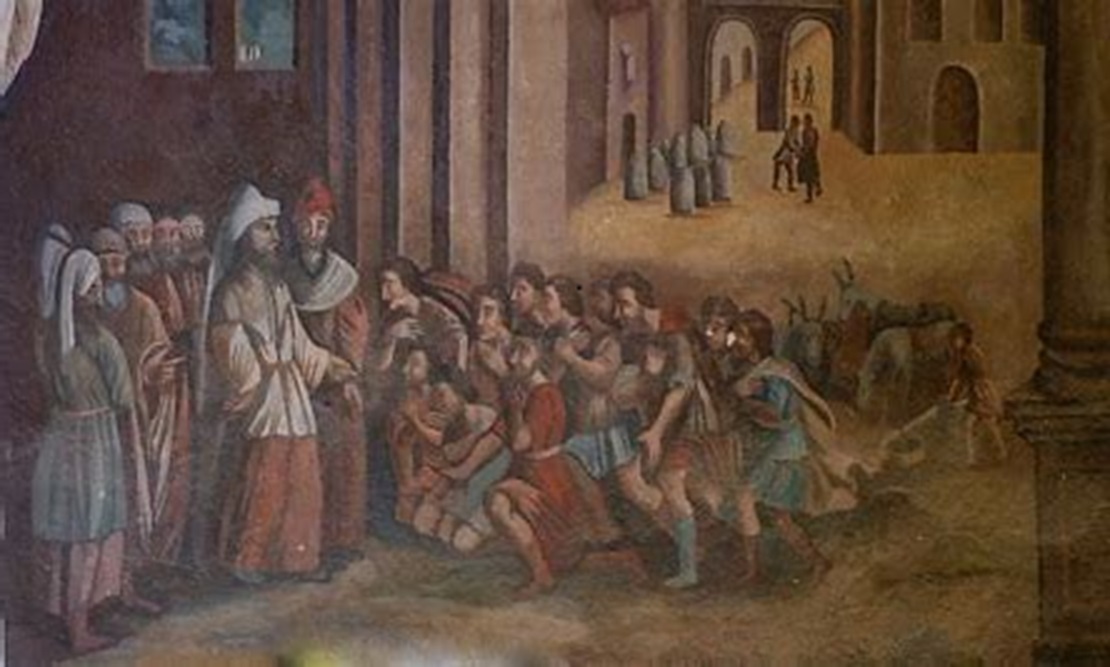
CHARLO, New Brunswick, February 19, 2024 – Christian preppers often point to the story of Joseph and the 7-year famine in Egypt to justify their stockpiling of food and supplies. They also tend to simplify the story by saying, “Look, Joseph knew a famine was coming and prepared for it, saving his family and the Egyptians from starvation.” But that’s the rosy picture of Joseph and his allegedly heroic feat of prepping. If you look a bit deeper into the details, a darker picture emerges.
In the years leading up to the famine as well as during and after it, Joseph was second only to Pharaoh in power and authority. But how did he get there? How did a young foreigner imprisoned in a dungeon on rape charges rise in rank overnight to become Pharaoh’s right-hand man?
Scripture tells us that Pharaoh had put Joseph in charge of preparing the kingdom for the famine based on Joseph’s interpretation of Pharaoh’s dreams. But what we have to read between the lines to learn is that Joseph’s suggested plan on how to deal with (or better said, how to profit from) the prophesied dearth stood to make Pharaoh the richest and most powerful man in the world. As soon as Pharaoh heard about Joseph’s dream scheme, he eagerly agreed to it and immediately rewarded Joseph with his exalted position. So Joseph not only became the second-most powerful man in Egypt virtually overnight, he also became incredibly wealthy, catapulting instantaneously into the upper ranks of the 1% or ruling “elite” class. This detail is important.
Once appointed, Joseph quickly set his plan in place. But the plan wasn’t a noble scheme prompted by his compassion to feed the starving masses during the coming famine. No, not at all. Joseph’s plan was much more shall we say “comprehensive” and involved the greatest wealth transfer in Egyptian history.
Fortunately or unfortunately (depending on your perspective), the wealth transfer was from the poor to the rich – from the people to the state – and started already when food was still being grown. Joseph instituted a nation-wide policy that required all farmers and other food producers to give the state 20% of whatever they grew or made each year. They could not opt out of this initiative (it was essentially a tax on their labour or an income tax). What Joseph was doing was taking the surplus food out of the market and storing it as property of the state, food that otherwise could have been stocked away as preps by the individual producers or consumers or even sold for a profit. So when the famine hit, the people had nothing in their own storerooms for themselves and very little by way of savings, as they’d had to give 20% of their product to the state and whatever was left over they had to live on.
The famine was long and widespread, which meant that the Egyptian people could not simply go to neighouring countries to grow or buy their food. They had to rely on the Egyptian state to feed them. After having centralized the entire food supply and in so doing creating a monopoly, Joseph then proceeded to sell the food taken from the Egyptians back to them. At first, he charged them money for the food. But when they had no more money (because they couldn’t produce or sell anything due to the ongoing famine), Joseph accepted their livestock as payment. Then when they ran out of livestock, Joseph accepted their land and their labour as payment. Under this “dream scheme”, the former independent subsistence producers and small landowners in Egypt became destitute serfs within only a few short years, thanks to Joseph’s prepping.
By the time the famine ended, Pharoah owned all the land in Egypt and the Egyptians were not only forced to labour for him, they were also forced to give him 20% of the fruits of their forced labour.
This is the view of Joseph and the famine that doesn’t get much airplay in Christian prepping circles, but the 1% have certainly taken note of it over the years. Joseph’s wealth-transfer and labour-taxation dream scheme has been repackaged and rebranded at various times in history and we’re fortunately/unfortunately (again, depending on your perspective) living in one of those times. We know the scheme today as “The Great Reset”, popularized by the heartwarming phrase: “You’ll own nothing and be happy”.
Yet it is worth remembering that Joseph did what he did with God’s approval and blessings. In fact, God instigated both the dreams and the dream scheme, just as he’s instigating the wealth transfer now. We can only assume that, like the ancient Egyptians, we have it coming.
BIBLE READ-THROUGH: DAY 2 REFLECTION (GENESIS 29-EXODUS 4:31)
“40 Days and 40 Nights of God’s Word”
DAY 2: JULY 24
GENESIS 29 – EXODUS 4:31
GREENVILLE STATION, Nova Scotia, July 24, 2021 – The primary themes of moving/leaving to survive, obedience to God, and having a personal relationship with God continue in this reading. Another theme has also blossomed here, which is the God-given right to deceive, if the deception means the godly survival of the one doing the deceiving. We saw this seed planted already in Day 1’s reading with Abraham passing off his wife Sarah as his sister to ensure their survival among the non-Hebrews, but it really takes off in the reading today. Deception abounds, though not all of it is blessed and encouraged by God.
- When learning the 10 Commandments after I was born-again, I was intrigued that God commands us not to bear false witness; he doesn’t command us not to lie, although many people misconstrue the Commandment as being not to lie. So lying, in and of itself, is not a sin if it’s used for godly purposes. God gives his children leeway to lie if lying saves their butt and furthers his plan. We’ll see more of this as the readings proceed.
- I love the story of Joseph! How he had to cheerfully endure injustice after injustice (that is, test after test) in order to end up in a position of authority that would ultimately enable him to save what would later become the 12 tribes of Israel is classic God (as in “the Lord moves in mysterious way, his wonders to perform”). It’s also a good lesson for us on how to deal with adversity (patient endurance), knowing that God is always in control and his plan is on track, even though it may not look that way while you’re in the midst of it.
- Joseph’s love for his brothers brings me to tears every time. I cry when he cries. Joseph weeping over his brothers reminds me of Jesus weeping with Martha and Mary over the death of their brother Lazarus, even though Jesus secretly knows that Lazarus will be brought back to life shortly. The depth of Joseph’s love and compassion for his brothers’ suffering is intensely moving. He knows he has to make them suffer for what they did to him, but it hurts him to do it. He isn’t punishing them out of hatred or revenge; he is just doing what has to be done, all the while loving them.
- As with many of the main Bible figures (our spiritual forefathers), most of the offspring of Jacob (Israel) were problem children. They were not like their father. In fact, in their younger years, some of them were downright nasty. Nonetheless, we can see during their interchanges with Joseph in Egypt that they had become godlier with age. But their father’s final blessing of them before his death reveals their core characters, and not all of them are admirable.
- Note in particular Israel’s blessing of Judah, Jesus’ tribe. This is one of the early messianic prophecies.
- Even so, warts and all, the twelve sons of Jacobs are the patriarchs of the twelve tribes of Israel and remain so to this day.
- I like that scripture shows the warts and weaknesses as well as the strengths. It humanizes the people being portrayed. It gives them an immediacy that overcomes the thousands of years and different cultures that separate us. These people are our spiritual kinfolk. They served the same God we now serve. They spoke with the same God we now speak with. And they love the same God we love. This makes them our spiritual brethren, and it’s good that we get to know them through scripture. If and when we make it to Heaven, we’ll get to know them in person.
- Really looking forward to getting deeper into the Exodus in tomorrow’s reading! Love the “rod of God” that became symbolic of Moses and is still used out of context today for other far less godly purposes.
- Never a dull moment in the Bible!
__________________________________________
By the way, you’re welcome to post your own reflections of the day’s reading in the comment section. If you’ve posted it elsewhere, just copy and paste it here. One of the glories of God’s Word is that we all see different things in it at different times, depending on what’s going in our own lives and what we need to learn.
What jumped out at you in this reading? What did you see this time that you hadn’t noticed before?
Feel free to let us know! Share it with us below.
________________________________________
BIBLE READ-THROUGH SCHEDULE ON PDF:
 A BORN-AGAIN BELIEVER