
Home » Uncategorized (Page 4)
Category Archives: Uncategorized
WHY WE WORSHIP GOD

CAMPBELLTON, New Brunswick, May 20, 2023 – An unbeliever asked me yesterday why God needs us to worship him, which is an excellent question. You can always count on unbelievers to ask the hardest-hitting and most uncompromising questions. The short answer I gave him is that God doesn’t need us to worship him; he doesn’t need anything from us. We need to worship him, and to do so for our own benefit, not for his.
When we worship God, we benefit.
Case in point. I had an unsettling dream last night that left me with an accusing mindset when I woke up. Still half asleep, I was mulling over the dream in my mind when I heard a choir of what I can only assume were angels singing a song of worship to God. I listened for a few seconds and then I couldn’t help but join in. It was a very simple and very catchy tune (it just went up and down the scale) with very simple lyrics, so I picked it up fast. As soon as I started singing, the accusing mindset melted away and the unsettled feeling resolved into joy.
Glory!
Glory all together!
Praise the Lord! Praise the Lord!
Glory all together! Praise the Lord!
In the name of Jesus!
Praise the Lord!
This is why we worship God. When we praise him, his joy finds an outlet through our worship, however we choose to express it. When we worship God, it opens all our spiritual doors and windows, enabling his Spirit to work powerfully through us. While it’s true that God’s Spirit is always with us born-again believers (if God’s Spirit isn’t with us, we aren’t born-again), praising and worshiping God – especially through singing – amps up the measure of the Spirit God has given each of us. It doubles, triples, quadruples our measure of God’s Spirit during the time of worship, which is why people who love God love to worship God – it just feels good!
Worshiping God is the best thing we can do for ourselves, which is why God made worshiping (loving) him the first and foremost of his Commandments. Worshiping God is also the highest form of spiritual warfare: It steers us away from thinking things we shouldn’t by resolving any enmity we might have in our heart and putting our focus squarely on God.
So the next time someone asks you why an omnipotent God needs us to worship him, tell that person God doesn’t need anything from us; we need everything from him, especially his joy, which he’s made us to receive simply by worshiping him.
Glory!
Glory all together!
Praise the Lord! Praise the Lord!
Glory all together! Praise the Lord!
In the name of Jesus!
Praise the Lord!
(* Repeat as many times as you need to!)
“COME OUT OF HER, MY PEOPLE!”: A WORD ON THE INVASION

CAMPBELLTON, New Brunswick, May 10, 2023 – Just before God delivers his judgement on a nation and a people, he sends his prophets to warn them. The closer to the point of judgement, the more powerful the prophet. And so we see Abraham intervening for Sodom, Moses pleading with Pharaoh, Jeremiah railing at the Judeans, and Jesus clashing with the temple elders.
Along with sending his prophets, God also warns his people in other ways. Some of these are listed in Ezekiel 7:21-24:
“I will give it into the hands of the strangers for a prey and to the wicked of the earth for a spoil…. My face will I turn also from them…. Wherefore I will bring the worst of the heathen and they shall possess their houses… and their holy places shall be defiled.”
Chief among these warnings is the mass invasions by “the worst of the heathen”.
No-one can deny that the spiritually worst of the worst are making their way to formerly Christian nations. As some politicians have dryly quipped, “they’re not sending their best and brightest”. But the invasion, which began as a trickle shortly after WWII and has since swelled to a tsunami, is organized, initiated, and permitted by God. It’s the collective just desserts of a fallen Christendom; in other words, former Christian nations have it coming, and there’s nothing we can do to stop it.
This is not an anti-immigrant or anti-refugee rant; this is a take-off-your-blinders-and-see-what’s-really-going-on-here exposé, aimed at God’s Church. The most important take-away is that no-one can halt the invasion, as it’s been earned by those countries being targeted by the invaders. What God put in motion, no-one can stop. It’s God’s perfect justice in action.
There was a time when God’s backslidden people could have put on sackcloth and ashes and repented their way out of this situation, like the people of Nineveh, but that time is long gone. Once the tap has been opened full throttle and the invaders are pouring over the borders in numbers too great even to count, it’s too late. The window of opportunity to appeal to God’s mercy has slammed shut and there is no other exit.
How do we, as God’s people, deal with the invasion? First, we need to see it for what it is on a spiritual level and understand what it indicates, as I’ve explained above. There’s no stopping it, and even criticizing it means you’re working against God. Don’t do that. Secondly, you need to decide whether you want to live in the midst of the invasion or separate yourself from it. Being a child of God, you have that choice.
Jeremiah tried to warn his people to turn from their sins or they would lose everything God had given them since their arrival in the promised land. Instead of heeding his warning, they doubled down on their perversions and accused Jeremiah of being a turncoat (aiding and abetting the enemy). But God had instructed Jeremiah to plead with his people to surrender, as the destruction of Jerusalem would proceed as planned, with God himself fighting against his own people. The only ones who’d survive this horror were those who did as Jeremiah instructed.
We in the Western world are now in the same position as were the children of Israel just before their defeat. The more we support the godless West and its perversions, the more we call damnation down on ourselves and end up fighting against God. The last thing that we should be doing as born-again believers is fighting against God, even in support of our home country. Yet we shouldn’t be supporting the enemies of the West, either. We should support neither side, since the worldly powers-that-be are under Satan, and we don’t want to align with Satan.
Instead, we should remove ourselves to a small, quiet, out-of-the-way place, like Jeremiah did and like Lot did, and let God enact his judgement when and where it’s due. This is why God says to “Come out of her, my people!”. He doesn’t want his children to remain in spiritual Babylon and suffer the same reward as those who brought the punishment on themselves. We not only have the choice to flee spiritual Babylon so as not to “share” in her punishments, we have the obligation to flee.
In other words, “Come out of her, my people!” is not a plea; it’s a command.
Again, this is not an anti-immigrant rant. It’s an exhortation in support of God’s justice and judgement. The current massive waves of people into the Western world are calculated not only to destroy the economy of the West, but also to destroy its cultural cohesion, quality of life, food supply, services provision, etc., and yet this destruction has God’s seal of approval. Scripture warns that the “worst of the heathen” will be living in our houses and so they are. The West chose to live a godless life, and this is what a godless life looks like: God removing his blessings from his people and giving them to the enemy.
Knowing all this, how are we to proceed?
We need to accept God’s judgement as just, not fight against it. We need to remove ourselves from the flash points and take refuge. We cannot stop what is already in motion, but we can choose to survive it and live to preach another day.
*****
The verses in Ezekiel quoted at the beginning of this article are followed by what I consider the darkest passage in scripture. I’ve written about it here. Ezekiel 9 shows God moving beyond mercy to judgement.
This shift is now underway in former Christian nations, and this is your final warning: Get out of spiritual Babylon while you still can or suffer the same fate as God’s enemies.
GOT TALENT? A TIMELY REMINDER TO USE IT, NOT BURY IT

NIAGARA FALLS, Ontario, December 15, 2022 – When I was four years old, I loved watching figure skaters on TV.
I wanted to be just like them, so my parents bought me a pair of skates and my mother would take me to the local arena. She would glide around the periphery and I would mostly just slip-slide along the boards, holding onto them and trying not to fall down.
In one of our visits to the arena, I decided I wanted to jump like the figure skaters on TV.
So I slip-slided over to the centre of the ice and I jumped.
The next thing I knew, I was lying flat on my back, howling in shock. I don’t remember exactly how I got down there, but it was nothing like the jump landings I’d seen on TV. A kindly man helped me onto my feet and brushed the snow off my back. Then my mother, alerted by my howls, skated over to me and took me home.
As the years passed, I continued to skate, but I wasn’t a talented figure skater. I took lessons and learned how to be good at the basics, but I could never jump and spin due to balance issues, and my later vision problems threw off my hand-eye coordination, so I wasn’t much of an athlete. I’m OK with that now, because I know in Heaven (if I make it) I’ll have perfect athleticism. That’s what I’m holding out for: to learn how to figure skate in Heaven.
But four-year-old me knew nothing about Heaven. All she knew was that she wanted to do something that she had no ability to do. Even then, at such a tender age, I understood that no matter how hard I trained, I would not be able to skate like the figure skaters on TV. I just didn’t have the talent for it.
God gives us all talents. We all have something we’re naturally good at. The trick is to find what that is and then work on it. I worked on figure skating and became a competent skater, but I still couldn’t jump or spin: I could only glide gracefully around and around, backwards and forwards, in circles.
Skating wasn’t a talent God gave me. It was something I worked at, but it wasn’t a talent. In the body of Christ, which is God’s Kingdom on Earth (otherwise known as the Church founded by Jesus), we all have a God-given talent that we’re good at and that we’re expected to invest in the Kingdom. That talent is something we’re completely comfortable with and doesn’t feel like work. It’s as natural to us as breathing, and no matter how long or how often we do it, we never tire of it.
Jesus found his several talents in teaching and preaching and healing and casting out demons. He’d learned how to be a carpenter, but that wasn’t his talent. He was probably pretty skilled at carpentry work, having learned it from his dad from a very young age, but being a carpenter was not what he’d been called to do. He was called to heal the sick, cast out evil, and teach and preach God’s Word. Because he was called to do these things, he was given the talent to do them, which meant that he was able to do them night and day and never tire of doing them.
That, ultimately, is what a talent is – a God-given, God-driven, and God-fueled ability to do your calling. It’s that thing you do well that you then need to put to the service of the Kingdom. Paul reminds us that there are many different parts of the body of Christ, and that each part works in tandem with the others, the way organs and systems in a body work together. We can’t all be eyes or ears or gall bladders in the body of Christ, or it would be a pretty funny-looking Church.
What’s your talent? Some of us are good at teaching. Some are good at charity work. Some are good at ministering to the poor and homeless. Some are good at witnessing. Some are good at ministering to the elderly, and some are good at ministering to children. Some are good at listening and advising. Some are good at working quietly behind the scenes. Some are good at healing. Some are good at casting out spirits, some are good at Bible research, and some are good at preaching. These are just a few of the talents within the body of Christ.
Have you found your talent yet? If so, are you investing it in the Kingdom? When I was first born-again, I thought I had to do everything – charity work, teaching, preaching, witnessing, ministering to the poor, etc. None of these things were my talents, so I kind of bombed at them. I also felt out of place doing them, which was very discouraging to me. I didn’t feel forced to do them; I just assumed I had to do them. I later realized I was wrong, and I learned first-hand that God doesn’t expect us to do what we’re not good at. Being a follower of Jesus is not a “to do” list: It’s a calling.
God doesn’t want us pursuing activities in the Kingdom that are not our talents. He doesn’t want us slip-sliding along the boards, holding onto them for dear life, or falling flat on our backs the minute we try to step out to do something we’re not equipped to do. And he also doesn’t want us to work at something for years and years just to have the ability to skate around and around in circles, going nowhere.
The talent that God’s given you is what he expects you to pursue, not the things you see others doing and so want to do yourself. A talent is also not something that you can do competently enough but just competently enough. God doesn’t want you wasting your time on those things. He’s given you at least one talent, and he expects you to use it in the service of his Kingdom, like Jesus did. If you choose to do that, God will work through you and give you success in your efforts. All he asks of you is a willingness to invest the talent he’s given you back into the Kingdom.
I hope you choose to do that. I hope you find your talent (or talents) and go for it. We need all hands on deck in the Kingdom these days. Don’t bury your talent and don’t waste whatever time you have left on Earth pursuing things that are not your talent. Let the parable (below) and my four-year-old howling self be your warning.
(And for you literalists out there, yes, I’m aware that the parable is about money, but it’s also applicable to abilities.)
__________
For the kingdom of heaven is as a man travelling into a far country, who called his own servants, and delivered unto them his goods.
And unto one he gave five talents, to another two, and to another one; to every man according to his several ability; and straightway took his journey.
Then he that had received the five talents went and traded with the same, and made them other five talents.
And likewise he that had received two, he also gained other two.
But he that had received one went and digged in the earth, and hid his lord’s money.
After a long time the lord of those servants cometh, and reckoneth with them.
And so he that had received five talents came and brought other five talents, saying, Lord, thou deliveredst unto me five talents: behold, I have gained beside them five talents more.
His lord said unto him, Well done, thou good and faithful servant: thou hast been faithful over a few things, I will make thee ruler over many things: enter thou into the joy of thy lord.
He also that had received two talents came and said, Lord, thou deliveredst unto me two talents: behold, I have gained two other talents beside them.
His lord said unto him, Well done, good and faithful servant; thou hast been faithful over a few things, I will make thee ruler over many things: enter thou into the joy of thy lord.
Then he which had received the one talent came and said, Lord, I knew thee that thou art an hard man, reaping where thou hast not sown, and gathering where thou hast not strawed: And I was afraid, and went and hid thy talent in the earth: lo, there thou hast that is thine.
His lord answered and said unto him, Thou wicked and slothful servant, thou knewest that I reap where I sowed not, and gather where I have not strawed: Thou oughtest therefore to have put my money to the exchangers, and then at my coming I should have received mine own with usury. Take therefore the talent from him, and give it unto him which hath ten talents. For unto every one that hath shall be given, and he shall have abundance: but from him that hath not shall be taken away even that which he hath.
And cast ye the unprofitable servant into outer darkness: there shall be weeping and gnashing of teeth.
Matthew 25:14-30
HAVE YOU BEEN DUPED BY A FALSE PROPHET?

NIAGARA FALLS, Ontario, October 19, 2022 – It’s easy to fool the gullible, and unfortunately most people who consider themselves Christians are highly gullible. Why is that? Because of those who consider themselves Christians, most are not actually Christian, and of those who are, many don’t know scripture and/or don’t know God.
We, as born-again believers, should be none of the above, and if we are, we need to attend to it immediately.
I do not name names here. God knows who the false prophets are; no need to name and shame them. Suffice to say if they charge you money for books or videos that (allegedly) teach you about God’s Kingdom, they’re false prophets. If they solicit donations for any type of project, they’re false prophets. If they solicit donations for their ministry, they’re false prophets. If they charge you even an honorarium to preach at your church or organization, they’re false prophets.
Many will come with grandiose stories of how they became followers of Jesus. They also come with equally grandiose stories of their sordid past, which they unhesitatingly share in gory detail. Rather than simply to say “I was a sinner”, they provide enough background information to write a novel. It’s as if they’re proud of how ‘bad’ they were. Those who genuinely reborn don’t want to talk about how they used to be. They’re ashamed of it. That part of them is dead and gone and buried. It suffices for the genuinely born-again to say “I did horrible things”, and to let the rest be.
I came across a video yesterday featuring a false prophet. As soon as he opened his mouth, I knew he wasn’t speaking on God’s authority. He claimed to be a former Satanist, and yet I had the distinct impression that he still served the dark powers. Everything he said was like a punchline rather than a revelation. He provided immense detail on his years as a Satanist. This should not be. We do not need to know any details about Satanism, and yet this man’s testimony could easily pique the interest of those who are weak in faith. His testimony was like a peephole into Satanism, whereas if he were genuinely reborn, it should be like a brick wall or a bulwark barring even the mention of the term.
It is easy to fall under the spell of someone who claims to have been saved from the clutches of the evil one. We want to rejoice with a newfound brother or sister and to welcome them into the family. We want to share our love of God and Jesus with those who likewise want to share their love with us. And yet our desire to see God’s saving grace working through people in real time makes us vulnerable to deception.
Which is why Jesus warned us that “many false prophets shall rise, and shall deceive many” and Paul advised us to test the spirits. We should never simply take someone at his or her word, no matter how successful or established the ministry or how sincere the false prophet claims to be. Jesus says that the Way is narrow and few find it, and that we’d know them by their fruit. What is the fruit of the false prophet? Nearly always mammon. Everything they do is done with the intention of gathering more adherents, as more adherents translates into more money.
Too many Christians today are bedazzled by seeming angels of light, but this is not a new phenomenon; Paul was dealing with it already 2000 years ago. Test the spirits. Take no-one at their word; compare their testimony against scripture. If something seems “off” about someone, it’s probably because it is. We live in an age of great deception, and followers of Jesus are the primary targets.
But what is the end goal of false prophets, beyond acquiring wealth and fame? Satan uses them to lure believers into accepting false teachings. He also uses them to lure believers away from reading the Bible for themselves and to focus on the false prophet rather than on God and Jesus. The mission of the deceived then becomes to serve the false prophet and the false prophet’s church or organization rather than to serve God as a follower of Jesus. Ultimately, the purpose of a false prophet is to lure souls away from God, especially born-again ones.
Are you under the spell of a false prophet? I was, years ago, as a very young born-again believer. I bought the books and the videos, I made the “love donations”, I faithfully watched all the programs on TV and attended the daily services until little by little, what I saw didn’t add up (or rather, what I saw added up to something that didn’t align with scripture or my own personal experience as a convert). That’s the thing about false prophets – they’ll always give themselves away, sooner or later. They’re a test as much as a temptation, and it’s up to us to discern them as such.
Don’t be ashamed if you’ve fallen for the wiles of a false prophet. They’re very good at what they do. Our essential human impulse is to give people the benefit of the doubt, which is why psychopaths have such an easy run. Keep in mind, too, that many false prophets sincerely believe in what they’re doing, not as believers, but as people who are (as they see it) giving hope and spreading joy, using Jesus and God as their shtick.
In the end, God can use anything to our benefit, including false prophets. My firsthand experience in falling for false prophets actually drove me to read the Old Testament for myself (rather than to rely on others to spoon-feed it to me) after I’d realized I’d been deceived. Likewise, I got to know God as my Dad only after I ran screaming from institutionalized false prophecy. It’s as if the devil was betting that he’d get me back and God was telling him to dream on, knowing that my desire for Truth would eventually override my gullibility to snake-oil salesmen. And God was right (when is he ever not?). My personal experience with false prophets became for me a cautionary tale and learning experience that God ultimately used to draw me closer to him and to warn others.
If you’re adhering to a ministry that requires you (or guilts you) at any level to fund it, you’re in the clutches of a false prophet. No genuine minister of God requires anyone to pay money to hear his Word and learn from Jesus. God doesn’t even require “free will donations”, as so many false prophets like to phrase it. If God wants you to sow financial seeds into a ministry, he’ll prompt you to do so in his time and in his way; everything else comes from the devil. It’s not a coincidence that of all the followers who could have been in charge of the money bag, it was Judas Iscariot, who also, according to scripture, stole from it.
As Jesus tells us, you cannot serve God and mammon. Every false prophet serves mammon, and they don’t hide it. Just look on their website and see what you can buy or donate. They want you to buy and/or donate – that’s the whole purpose of their ministry.
“B-b-but they do good work! Look at the orphanage they’re running in [fill in the blank]! Look at how they’re inspiring people to be better [fill in the blank]!” That’s precisely why they fit the definition of angels of light. Jesus talks about those at the judgment who are shocked not to be numbered among the saved, as they’d held and attended services and even performed miracles. Yet despite this, Jesus says he never knew them. God does not know false prophets, which means he hasn’t sent them to preach and teach. “By their fruits shall ye know them.” For false prophets, whether institutionalized or independent, it’s all about the money, and you can discern that just by checking out their website or attending a service. Somewhere, at some point, money will be requested. That is the false prophet’s calling card.
It’s not something to be ashamed of, to have been tricked into supporting a false prophet for a time. We’ve all fallen for the smooth words and soulful confessions of at least one of them. But if you know or suspect that a ministry you’re supporting is a false prophet and you continue to support it, then you’ll be answerable for it.
Better to stand alone and true to God than to sit in the congregation of the deceived.
REAL JESUS, REAL YOU

NIAGARA FALLS, Ontario, September 20, 2022 – One of the few things we know for sure about Jesus is that he never sinned during his time on Earth. He came into the world sinless and he left it sinless. Had he not be entirely sinless, he wouldn’t have been able to pay the sin debt owed by Adam. But the debt’s been paid; the kingdom’s come; and Jesus is at the right hand of God, where he belongs.
But Jesus being sinless doesn’t mean that Jesus always wanted to do what God wanted him to do. What most Christians don’t consider (and they should consider it, they really, really should) is that while Jesus was always obedient to God, he didn’t always want to be. Sometimes he dragged his heels, sometimes he jumped the gun, and sometimes he tried to negotiate his way around it.
This is important, that we acknowledge that Jesus didn’t always want to do what God was asking him to do but that he did it anyway. Because if we’re honest with ourselves, we’ll admit that we don’t always want to do what God is asking us to do. All of us occasionally try to find a way around God’s will or a justification for not doing it. All of us do this, and if you say you don’t, you’re lying to yourself.
We’re constantly being tested to see whether we want what God is offering or what the world is offering. But God is not going to permit us to be tempted when we’re all fired up after a revival meeting; no, he’s going to test us after we’ve been fasting for 40 days and nights in the wilderness. He wants to see the real us, not the one we claim to be with our Christian friends. He wants to see how we respond not when we’re at the top of our game, but when we’re scraping the bottom of the barrel; when we’re tired and cranky; when we’ve spent the past 3 weeks sleeping on the airport floor: when we’re hungry and thirsty and exhausted and lost and people are being downright nasty to us. That’s when we’ll be tested. That’s when we’ll be pressed to do God’s will against every nerve and bone in our body.
This is where many people fall. They fail the test and then decide not to get back up again. But if we understand that Jesus himself didn’t always want to do what God tasked him to do (that is, that he didn’t always want to choose to forgive, that he didn’t always want to turn the other cheek, that he didn’t always want to love his enemies, etc.), it makes it easier for us to be obedient through gritted teeth. Because you wanna bet that Jesus was gritting his teeth on many an occasion when he chose to do God’s will. He wasn’t always doing it with a smile on his face. No-one on Earth always does God’s will with a smile on their face. It’s not possible to do that.
But it is possible to be obedient to God while gritting your teeth or grumbling under your breath. God’s not asking you to give up who you are or to stop being authentically you; he’s just inviting you to choose his way rather than the world’s way. That’s what it means to be obedient to God, to do God’s will, and it can be done through gritted teeth and while grumbling.
Or you can choose not to do God’s will, and fail the test. When that happens, you need to acknowledge your failure and move on. Don’t grovel in your failure; learn from it. And you’d might as well learn from it, because you’re going to be tested again on that exact same point. You don’t get out of something by failing it, not in God’s economy: You get a re-do when you least expect it.
Case in point: Several weeks ago, I had a run-in with a woman at a bus shelter in Halifax. She was smoking, pointedly ignoring all the “NO SMOKING” signs painted around the shelter’s interior. I politely asked her to stop smoking, but she ignored me. I asked her again, she still ignored me, and that’s when things took a turn for the worse. It’s also when I should have backed off and let God deal with her, but I wasn’t in the mood to do that on that particular day. So I locked horns with the woman.
I won’t bore you with the details, but let’s just say it got nasty. Real nasty. It almost came to physical blows, but God sent us off in different directions before that could happen.
A few weeks later, the night before I left Halifax, I was on a bus, and who should get on but the woman I’d locked horns with. She sat down next to me, but she didn’t recognize me at first. She’d had a problem finding her monthly bus pass when she was boarding the bus, so I asked her if she wanted mine, as I was leaving town the next day and wouldn’t need it anymore. She thanked me and said no, she had a pass already, she just needed to find it at the bottom of her purse. She dug through her bag for a minute and triumphantly flashed her pass at me and the bus driver. Then she thanked me again for my offer and complimented me on my coat.
It was at that point that I noticed a glimmer of recognition in her eyes, but not clear recognition. I could tell that she was trying to place me from somewhere, but she wasn’t sure where. So we chatted for a few minutes about the weather turning cold and about my upcoming trip, and then she gathered her things together to get off the bus. That, I think, is when the penny dropped for her and she remembered where she knew me from. But instead of lighting into me (which she could easily have done), she instead stared me straight in the face and wished me a good night and safe travels. I returned her well wishes, and we nodded and smiled good-bye to each other as if we were old friends.
I think I can say with confidence that I passed the re-do test, as did she. God’s timing is perfect. The funny thing is, during our brief bus trip together, the woman reminded me so much of me. We had similar mannerisms and ways of expressing ourselves, and it wouldn’t surprise me if she were a Christian, though not necessarily a born-again one. I have a feeling I’ll see her again someday, and we’ll have a good laugh over our bus shelter battle. God’s sense of humor, like his timing, is always perfect.
But WE are not perfect, and neither was Jesus during his time on Earth. That means we sometimes have to do God’s will through gritted teeth and while grumbling under our breath. That means we sometimes get mad at God. He’s our Dad, after all. (Surely you’ve been angry with your earthly father!) God would rather that you be real with him than fake it, and anger is a reasonable response to being asked to do something you don’t want to do.
Choosing God’s way was something Jesus always did, though not always with a smile on his face. God doesn’t expect us to do what even Jesus couldn’t do. What he does expect us to do is to grumble and to fail on occasion; and when we do fail, to get back on the horse ASAP. Obedience to God doesn’t require a smiling face, just a grudging “yes” when we’d sometimes rather say “no”.
A simple “yes” will do it.
God will do all the rest.
GETTING THE MIRACLE YOU NEED

HALIFAX, Nova Scotia, August 18, 2022 – So many people praying for a miracle, praying for healing, praying for the cancer to go away or at least to go into remission. Praying for relationships to be healed. Praying for enough money to pay the bills or maybe a lottery win.
Praying for a miracle.
And then, when the requested miracle doesn’t come, so many people crying to God: “Why are you doing this to me? What have I done to deserve this?” and cursing him, or worse, swearing he doesn’t exist.
But God answers all prayers, including those made in the agony of the soul. You might not get the exact miracle you requested, but you will get a miracle. God will intervene, if you ask him to. Through divine intervention, he’ll give you the strength to endure whatever it is you’re going through, whatever it is you’ve brought on yourself, whatever it is you have to suffer. There’s your miracle. The miracle is in the power of your strength to endure, which you wouldn’t have had if you hadn’t prayed to God for help. Your strength to endure is God working through you. There’s your miracle.
People ask me if God works miracles in my life, and I say yes, every minute of every day. Every minute of every day God works through me. Every day I witness his intervention, because I constantly ask for it and thank God for it. Every day I see his miracles.
I may not get precisely what I ask for, but I do get what God knows I need to stay on the path Home. And sometimes he’ll throw in a little something extra, something he knows I’ll know could only have come from him, just to make me laugh. God loves it when he can make us laugh.
The night before Jesus was crucified, he prayed to God that there would be some other way for him to complete his mission without his having to be crucified. He didn’t want to be crucified. He didn’t want the agony and very public humiliation of that kind of death. But note that he qualified his prayer with “not what I want, but you want”, and he prayed the same prayer three times in succession, showing us that we need to be persistent in prayer, so that God knows we mean what we say and that it’s not just a passing fancy.
Jesus didn’t get specifically what he asked for; he was crucified. But immediately after Jesus prayed, God sent an angel to strengthen him. There was the miracle he needed – not the miracle he wanted, but the miracle he needed to get through what he had to get through in order to get Home.
Our strength to endure whatever we have to endure is not our strength; it doesn’t come from us, no matter how strong we think we are. That strength to endure comes from God. That is divine intervention. That is a miracle.
So whatever you pray for, pray like Jesus – qualify your prayers by telling God not to give you what you want, but what he wants. God loves you even more than you love yourself, so if you give God leave to give you what he wants rather than what you want, you’ll always come out ahead. Yes, Jesus had to deal with being crucified, but he was crucified while also strengthened by God to endure it. Imagine how much worse it would have been for Jesus without God’s help.
I know how bad things can get when you don’t pray for God’s help, because I lived the first 36 years of my life on Earth without praying to God, and I stumbled from one disaster to the next. I was constantly an emotional basket case, constantly flailing in pain, and constantly casting blame like an AK-47 spraying bullets.
But on that day when I finally called out for help, not even knowing who I was calling to, God heard, and he answered immediately. He offered me the option of choosing to forgive or choosing not to forgive, showing me the outcome of each choice and shining a bright light on the choice to forgive as the right one and the one that would stop all my pain. Thank God I cried out for help that day. Thank God God heard me, and thank God he answered.
God always hears our prayers and always answers them. Always. There is never a time when he doesn’t. When you give God leave to intervene, he might not do exactly what you want him to do, but he will do what’s best for you. That’s his job description as your Heavenly Father.
So pray to God like Jesus prayed – not demanding, not expecting, not threatening or negotiating, but humbly giving into God’s will for you, whatever that may be.
That’s how you pray, and that’s how you get the miracle you need.
THE CHURCH THAT JESUS BUILT

HALIFAX, Nova Scotia, June 23, 2022 – What does Jesus think of Christianity?
I asked him, and this is what he told me.
He hates what’s it’s become, the same way he hated what Judaism had become.
He’s also not surprised what Christianity has turned into. He warned us 2000 years ago already that it would morph into something unrecognizable from what he’d established.
Is a church still Christian if Jesus has left the building?
What remains is a mish-mash of soulless rituals adapted from dead belief systems, songs of praise that sound like funeral dirges, and a worldly ideological free-for-all that would make even the ancient Sodomites blush. Yes, Jesus was notorious for eating and drinking with tax collectors and prostitutes, but he didn’t invite them into the temple to drink. He made it very clear that the temple was set aside as a house of prayer.
In a house of prayer, you come before God to talk to him and hear from him. When you come before God, you don’t come loud and proud, demanding that God accept your sin as righteousness. If you’re born-again, you come before God as his child, respectful and loving. If you’re not born-again, you come before God penitent and humbled. There is no room for pride in God’s house of prayer.
There is no room for Pride in God’s house of prayer.
Those who feel compelled to express their pride can do it elsewhere; the places designated as God’s houses are places of prayer for all people, not places for acting out.
The penitent sinful are welcome in God’s house, but sin isn’t. Pride isn’t.
*****
But of course, I’m dreaming here to think that the mainstream worldly churches have the remotest grasp of these concepts now, and that even if they did, they would care to apply them. Jesus hates the current manifestation of Christianity not because of the people in it, but because of the sin in it. The one true Church that Jesus established by very definition has no sin it; sin cannot enter into God’s Kingdom: It’s a spiritual impossibility for sin to enter in. Which means the churches masquerading as his are not his.
Christian churches are not Christian.
The Church that Jesus established is the Kingdom of God on Earth. This is the one true Church and the one that born-again believers automatically become members of at their rebirth. There is no need for born-again believers to join a worldly denominational church. If you’re genuinely born again and you want to know what your Church looks like in the spiritual realm, you can see a vision of it in Revelation 7. All those white-robed people of different nations and languages standing before God’s throne day and night and waving palm fronds to witness their allegiance to Jesus as Messiah – there’s your Church. You’re among those white-robed people, if you’re genuinely born-again.
In John, Jesus prayed that his followers would be one with God as he was one with God. Jesus always got what he prayed for (as he always waited for God to direct his prayers), so we know that we, as his born-again followers, do have the same relationship with God as Jesus did during his time on Earth. God is our Father.
And having the same relationship that Jesus had with God, we are one family of believers and we all believe the same thing. There is nothing to dispute. There are no disagreements. There is no need for denominations or creeds or statements of belief. We believe what Jesus believed, not because we’re mindless zombies who parrot whatever is told us, but because Jesus believed Truth, and so do we.
We believe the Gospel. We believe God’s Word. Any deviation from that we do not believe and in fact any deviation cannot enter into God’s Church. Only Truth lives in God’s Church, and only genuine born-again believers can enter in there.
Lies, deceit, Pride, and all forms of sin cannot enter. It’s a spiritual impossibility for unrepentant sin to enter into God’s Church.
That’s how we know that the sin-laden mainstream denominational churches are not God’s Church. They are places designated for people to come before God, if they want to, they are a house of prayer for all people, but they are not God’s Church.
The Kingdom and the Kingdom only is God’s Church – the one foretold in scripture, and the one that Jesus built.
THE NUMBERS GAME

HALIFAX, Nova Scotia, June 21, 2022 – Abraham made a deal with God that if there were 10 righteous souls in Sodom, God would not destroy it.
As it were, God did destroy Sodom, so clearly there weren’t even 10 righteous souls there.
However, I’m wondering if someone had done a show-of-hands survey just prior to the destruction to see how many people in Sodom self-identified as righteous, I’m guessing a lot more than 10 people would have raised their hands.
By the same token, of the million or so souls who were of age (20 years and up) when they left Egypt in the exodus, only 2 (Caleb and Joshua) were considered by God to be sufficiently righteous to enter the Promised Land.
And of all those alive during the days of Noah, only Noah was considered sufficiently righteous to be spared the flood.
So let’s take a look at this – so far, the actual named righteous out of millions if not billions of souls who lived during those eras are 4 in total: Lot, Caleb, Joshua and Noah. (Their families were spared as chattel.)
We could also add Abraham, of course, but that only makes 5.
What about the 2 billion Christians today? How many of them do you think would raise their hands and self-identify as righteous? There were many children of Israel during the days of Jesus’ ministry who would have self-identified as righteous, too, and some of those Jesus told to their face they didn’t have a hope in Hades of getting to Heaven, not in the spiritual state they were in.
These low numbers should be very sobering to us.
Do you consider yourself to be as righteous as Lot? How about as righteous as Noah? Or maybe as righteous as Stephen, the first martyr of the church, who prayed for and forgave those who were stoning him to death while they were stoning him to death? We know that Moses made it to Heaven, too, and Elijah, because they came to visit Jesus during the so-called transfiguration on the mount. So now, along with the other named 5 souls, we’ve got a few more, but not many.
This speaks to me of how difficult it is to make it all the way Home. At the same time, it also speaks to me of how full of crap the mainstream Christian church must be to assure their adherents that Jesus did all the heavy lifting, so all they have to do is show up every Sunday and/or give money to the church, and off to Heaven they go. Or something like that.
I frankly do not consider myself righteous. I have a long way to go before I would make such a claim, if ever. And I think the point here is precisely that: We cannot judge our own righteousness or the righteousness of others. We cannot know definitively whether we’re righteous before God. Abraham thought it was a sure thing to negotiate God down to just 10 righteous souls in Sodom, thinking there must be at least 10, but he was wrong. There was only 1.
And then there was none.
*****
We read of visions of mass destruction throughout the book of Revelation and in Ezekiel 9. Mass destruction was also recorded as historical fact in the book of Jeremiah and in Genesis and elsewhere. In the visions and actual scenes of destruction, very few are spared. Jeremiah relays how mothers cooked and ate their own children during the famine when Jerusalem was under siege by the Babylonians, in fulfillment of Moses’ prophecies in Leviticus 26 and Deuteronomy 28.
It’s a nasty world out there, filled with nasty people doing nasty things. God knows that. None of what anyone does is a surprise to him. But don’t you be nasty. Don’t you eat your own children, no matter how hungry you get. Don’t you congregate around the door of your neighbour, demanding he bring out his guests so you can rape them. Don’t you strip yourself naked and dance drunk around a golden calf made from the very gold God gave you for his temple ornaments. Don’t you sell everything you have and give only half to the poor, hiding away the other half for a rainy day.
In other words, don’t be unrighteous. Be like the people of Nineveh, who repented when they were told they needed to repent. That’s how you overcome any unrighteousness you may not even know is in you.
Jesus’ message at the start of his ministry was to repent and believe the Gospel. That message doesn’t change at any point during the rest of our time on Earth. We are all in constant need of repentance and all in constant need of the Gospel, just as we’re all in constant need of being reminded how precious and elusive the reward of Heaven actually is.
It’s a numbers game. Jesus said that many are called but few are chosen; Jesus also said that the Way Home is narrow and few find it.
We need to take these words to heart and hope that in mentioning the few, Jesus was talking about us.
HAPPY ENDINGS

HALIFAX, Nova Scotia, June 4, 2022 – Most people, including born-again believers, want stories to have happy endings. They want those who deserve punishment to be punished and those who were unjustly accused to be vindicated. If there’s a romance involved, they want the lovers to marry and live happily ever after. They want the plot tied up with a bow and the loose ends pulled into festive curls. They want a happy ending almost like it’s hardwired in them to want a happy ending.
Outside of stories, real life doesn’t always end happily, if you consider death as the ending. Most people die in pain, whether from disease or violence. Some take their own life and die groggily by overdose. Very few “die peacefully in their sleep”, and of those few who do, we have to wonder how peaceful their passing actually was.
Even believers aren’t exempt from experiencing a painful death, as we see in scripture. Jesus died in excruciating agony, as did many of his disciples and followers, as did many of the prophets before them. If Jesus couldn’t arrange for a happy ending to his earthly life, what chance do we have?
The short answer is “next to none”. We have next to no chance of having a happy earthly ending. Even as we live with the joy of God’s Spirit 24/7 as born-again Spirit-filled believers, even as God provides for our needs and wipes away all our tears, we can still anticipate having a painful death someday. That’s why Jesus said that those who endure to the end will be saved. He emphasized the end, because the end, when we’ll be racked by pain, is where it will be most tempting for us to give up and betray God.
*****
The best stories build slowly and steadily to a crisis, which then quickly resolves in a happy ending that we didn’t see coming. The contrast between the crisis moment and the subsequent unforeseen and satisfying resolution is what gives the story its emotional punch. It’s the retelling, over and over again, of being stuck between a rock and a hard place (like between the advancing Egyptian army and the Red sea) and then being sprung in a way we hadn’t anticipated that makes sense to us. We not only demand our happy endings, we demand them to happen in such a way that we’re happily surprised and satisfied.
God is only too happy to deliver on our expectations. Granted, those of us who do endure to the end will have to wait a bit for our happy ending, but it will come. Our earthly exit might not be so happy, but we know that our earthly exit is not our ending. It’s the end of our time here on Earth, yes, but it’s not our ending. Our happy ending comes after the Judgement.
Jesus’ death on the cross looked like an agonizing and humiliating defeat. Don’t expect your death to look any better. And yet we know that Jesus was only paying the price that had to be paid in the way it needed to be paid according to scripture and God’s guidance, and that once the debt was paid, the happy ending would begin. And so it did for Jesus, with his resurrection into his new body and his ascension to sit at the right hand of God and be Lord of creation for ever and ever. If ever there was a happy ending, that is it.
Our ending will be just as happy for us, if we endure to the end of our time here. Jesus said we should expect persecutions while on Earth, we should expect to be outcasts, we should expect to be alienated from those we love (but who don’t love God), and we should expect to live in poverty, though not in want. We will never live in want as long as we stay true to God.
The Good Lord always provides.
*****
I anticipate my own happy ending as if the anticipation were hard-wired into me, because it is hardwired into me. God made us to want a happy ending. Our need for a happy ending is as much a part of who we are as our need for food and water and air. We know better than to look to the world for satisfaction, and we will never find our happy ending there, any more than Jesus did.
Our happy ending will only come if and when we make it Home.
WORKING FOR GOD
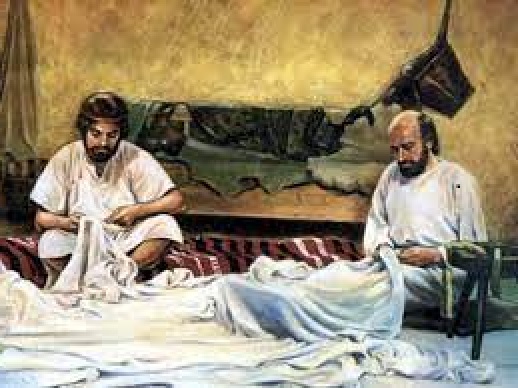
HALIFAX, Nova Scotia, May 22, 2022 – Work, to Jesus, was not something you did 9 to 5. It was also not something you did full-time, part-time, seasonally, in shifts, or three weeks on, one week off. It was not contractual, in the sense that you had to agree to do and say certain things “on the job” that you may or may not do or say in your “off” hours.
It was not something you did for money.
Work, to Jesus, was not like that.
To Jesus, work was who he was. He was his work. He made no distinction between the work he did for God and who he was as a person.
We who live in the Kingdom and follow Jesus should also strive to be our work, as Jesus was his.
*****
Today is my Sabbath. I’ve written before about how much I love the Sabbath. The Sabbath, of course, is our God-sanctioned day off from work. We need it and use it to rest from our labours. Keeping the Sabbath is also a Commandment. That means, not keeping the Sabbath is not an option. In keeping the Sabbath, we’re also to keep it holy, which means we’re not to devote our Sabbath day to profane (worldly) pursuits, including doing work for mammon.
I don’t always keep my Sabbath on the same day that most people keep theirs. Sometimes, I’m led by God to keep it on a different day, but the content of my Sabbath – regardless of the day I keep it – is still the same. Jesus says that the Sabbath was made for man, not man for the Sabbath, and I take him at his word. I keep the Sabbath when God guides me to keep it, and I keep it holy, as he instructed in his Commandment.
Jesus, however, was infamous for breaking the Sabbath, or so his detractors accused. Because he made no distinction between the work he did and who he was, Jesus worked on the Sabbath without breaking the Sabbath. Like priests, Jesus was actually obligated and expected to work on the Sabbath, as he frequently pointed out to his detractors.
We again see Jesus’ take on work reflected in the famous interchange between him and Martha, when Martha asks Jesus to get Mary to help her with her chores. In asking Jesus to intervene, Martha likely assumed this tactic would shame Mary into helping her. So imagine her shock when Jesus instead sides with Mary and reminds Martha that, in sitting at Jesus’ feet and learning about the Kingdom, Mary has chosen the better job.
*****
During the time they were with Jesus on Earth, the disciples did the same mundane daily chores that the rest of us generally do, such as shopping, food prep, and so on. However, shortly after they’d received the baptism of the Holy Spirit, they allocated the mundane daily chores to others and spent all their time doing the work of the Kingdom. Like Jesus, they had finally become their work.
It took Paul some time to get there. Even while he was traveling and preaching and writing his letters, he still made tents for his daily bread. He also encouraged others to earn their way through the world rather than to rely on hand-outs. The six-day designated work-week was important to Paul, as it should be to us. Working six days a week is part of the same Commandment as keeping the Sabbath holy.
*****
So where does all this information leave us? If you’re like me, you’re both working in the Kingdom and working in the world, as Paul was for most of his ministry. I don’t know if I’ll ever get to the point where I’m working only in the Kingdom, like Jesus, but I hope so. I’m on God’s time, not mine.
In the meantime, I’ve been blessed to have work that I can do anywhere in the world and where I’m my own boss. The work I do for the world (freelance writing and editing) also feeds the work I do for the Kingdom, which is a profound blessing. Even better, God is my agent. And being perfect at everything he does, God is a perfect agent, which means he only gets me work that suits me, that I have time for, and that satisfies my needs. I am never without.
How much longer I’ll be doing my worldly work is up to God: again, I’m on his time, not mine. When I do my God-sanctioned and God-given worldly work, I keep in mind that I’m always to do it (as scripture tells us) as if unto God, as if I were doing it for God: as if God were my client. So even in doing worldly work, I’m still doing Kingdom work if I do it unto God, which means if I do it to the best of my ability.
In doing both worldly work and Kingdom work, I see myself along with others doing the same. We’re in a vision given to John, which he recorded in the book of Revelation:
After this I beheld, and, lo, a great multitude, which no man could number, of all nations, and kindreds, and people, and tongues, stood before the throne, and before the Lamb, clothed with white robes, and palms in their hands;
And cried with a loud voice, saying, Salvation to our God which sitteth upon the throne, and unto the Lamb.
And all the angels stood round about the throne, and about the elders and the four beasts, and fell before the throne on their faces, and worshipped God,
Saying, Amen: Blessing, and glory, and wisdom, and thanksgiving, and honour, and power, and might, be unto our God for ever and ever. Amen.
And one of the elders answered, saying unto me, What are these which are arrayed in white robes? and whence came they?
And I said unto him, Sir, thou knowest. And he said to me, These are they which came out of great tribulation, and have washed their robes, and made them white in the blood of the Lamb.
Therefore are they before the throne of God, and serve him day and night in his temple: and he that sitteth on the throne shall dwell among them.
They shall hunger no more, neither thirst any more; neither shall the sun light on them, nor any heat.
For the Lamb which is in the midst of the throne shall feed them, and shall lead them unto living fountains of waters: and God shall wipe away all tears from their eyes.
Revelation 7:9-17
There we are, having come through our own personal Tribulation and washed our robes in the sanctifying blood of Jesus, making them white. That is spiritual rebirth. Protected, guided, provided for, and comforted, we spend the rest of our time on Earth in what Paul called a “cloud” of witnesses – spiritually before the throne of God, rejoicing in God, and serving God only. If you’re genuinely born-again, you’re in John’s vision. Your work and everything you do is now a testimony to Jesus. Stick your face close enough to the words of that passage, and you’ll see yourself waving at you. I’m waving at you, too. Go ahead and wave back.
*****
For Jesus, working and doing God’s will were one and the same, and he did them night and day. For us born-again believers who are doing both worldly work and Kingdom work, we’re not that far off from how Jesus worked if we do everything we do as if unto God.
Even so, if God guides us to do it, we shouldn’t be ashamed to make tents. It’s always better to work than to beg; God never wants his children to beg. If we show the willingness to do whatever’s asked of us, God will bring us the resources we need in the world to continue our work in the Kingdom. That’s a guarantee.
Scripture tells us so.
 A BORN-AGAIN BELIEVER