
WE NEED A PANDEMIC

HALIFAX, Nova Scotia, February 17, 2026 – We pray wrong. We see a drought and pray for rain. We see a broken nation and pray for healing. We see ungodly people doing ungodly things, and we pray for God to forgive them. But what we should be praying for is an outbreak of righteousness, an epidemic of doing good, a pandemic of people choosing what’s right in God’s eyes, even when it flies in the face of what the world thinks is right. At the same time, we need to pray for God to strengthen us to levels he hasn’t strengthened us before, so that we can persistently and under every circumstance model godliness, model godliness, model godliness, until it spreads like a holy contagion to everyone around us.
We need a pandemic of godliness.
You can’t change God’s justice. You can’t call for a review of God’s terms just because you don’t like them. God sent Jonah to warn the Ninevites that their city would be destroyed in 40 days. When the King of Nineveh heard Jonah, he didn’t ignore him or mock him. He didn’t try to silence him. He didn’t threaten to arrest him for hate speech or for creating a public disturbance. No, the King responded by instituting a nation-wide emergency. All Ninevites were to drop whatever they were doing and immediately sit in sackcloth and ashes, including their animals. And they were to fast until the king told them to stop. No arguments and no exceptions. They couldn’t even drink water. The King believed that if Nineveh did this, God might change his mind about destroying them.
Note that the King didn’t simply pray to God to forgive the Ninevites’ sins. Nor did he curse God for the threatened destruction. He instead took the most drastic godly action possible and used his authority to make sure that everyone else did. “But, Charlotte”, you might be thinking, “People today aren’t going to this. They’re not going to stop whatever they’re doing and go along with whatever the government or other authority tells them to do.” You might be surprised. During the last “pandemic”, whole populations stopped whatever they were doing and donned masks. Whole populations obediently stood six feet apart. Entire industries were shut down, schools and businesses were shuttered, people self-isolated at home – some welded in from the outside – until they were given permission to leave. Whole populations complied with the most drastic of decrees without question. And they did all this for months – even years – because they were afraid to catch a cold. You’d be surprised at what people can be persuaded to do under the right authority.
When God saw the Ninevites’ collective show of repentance, he called off the planned destruction. Note that God’s justice didn’t change; the Ninevites changed, and in changing their behavior, they changed their due reward.
All nations today are on the fast-track to destruction. We need a pandemic of godly behavior to stop the destruction or at the very least to delay it. Praying for God to forgive us and save us is not going to cut it this time. Like Nineveh, it’s too late and we’re too far gone. We need instead to pray for people to make godly choices – to choose what’s right in God’s eyes. And we need to pray this prayer while making godly choices ourselves, every day, all day, without exception. Our prayers will only have authority if we ourselves model what we’re praying for.
We urgently need a pandemic of godliness. It begins with localized outbreaks of making good choices.
Let’s get that pandemic started now!
So the people of Nineveh believed God, and proclaimed a fast, and put on sackcloth, from the greatest of them even to the least of them. For word came unto the king of Nineveh, and he arose from his throne, and he laid his robe from him, and covered him with sackcloth, and sat in ashes. And he caused it to be proclaimed and published through Nineveh by the decree of the king and his nobles, saying, Let neither man nor beast, herd nor flock, taste any thing: let them not feed, nor drink water: But let man and beast be covered with sackcloth, and cry mightily unto God: yea, let them turn every one from his evil way, and from the violence that is in their hands. Who can tell if God will turn and repent, and turn away from his fierce anger, that we perish not? And God saw their works, that they turned from their evil way; and God repented of the evil, that he had said that he would do unto them; and he did it not.
(Jonah 3:5-10)
GOOD BONES

By landing the quad axel, [Ilia] Malinin may have maxed out the boundaries of human performance. Most sports scientists agree that the speed and amplitude necessary for five-revolution jumps truly is impossible…. 1
HALIFAX, Nova Scotia, February 16, 2026 – I loved figure skating when I was a kid. I was no “contender” (as Marlon Brando famously put it2), but I loved skating nonetheless. I took it up again briefly a few years ago as an enthusiastic adult. Still no contender, but men would occasionally follow me around the arena and ask me to teach their kids (lol).
I finally had to give up skating altogether following an unrelated knee injury. Resigned to being sidelined at arenas for the rest of my time on Earth, I still love to watch figure skaters and to dream about when I’ll be skating again in Heaven. Really skating. Contender-level skating.
I was watching a video of Ilia Malinin a few weeks ago, marveling at his jumps (especially his trademark quadruple axel), when God told me I’ll be able to do that and more – at least ten revolutions – in Heaven. Surprised at his comment, I asked God if that’s because it’s Heaven and everything’s possible in Heaven. And he said no, there are still limits in Heaven and I’d still have to learn how to skate properly; I wouldn’t arrive in Heaven already knowing how to do jumps and spins. I’d have to learn things in Heaven just like I do on Earth. The difference is that Heaven has different “natural laws”, which means that our bodies are different, especially the bones.
“The bones?”
“Yes. Your bones in Heaven will be more like birds’ bones – hollow and light. Only unlike earthly birds’ bones, your heavenly bones will be unbreakable.” He went on to explain further that the birdlike lightness of my heavenly bones, combined with my heavenly body’s zero fat and infinitely flexible joints and strong muscles, will enable me to propel myself high up into the air, completing a dozen revolutions or more and covering a vast distance. It will almost be like flying.
“Good bones”, God repeated. “It’ll be in your good bones. You’ll see.”
Meanwhile, back on Earth, scientists report that
[a]n ideal quadruple jump spans around 0.6 seconds, wherein the skaters have to first take off, then spin four and a half times…. Studies estimate that for an ideal quintuple jump, the athlete has to have a jump duration of around 0.8 seconds…. This requires humongous heights and distances which can only be achieved by ‘pencil’ thin bodies and about 90% rotation efficiency, meaning that only 10% of the total airtime should be used for take-off and landing while also starting off with greater forces to increase angular momentum.3
And yet according to God, our jumping ability is not just in the “speed and amplitude”1 or in having a “pencil-thin” body or maxed-out angular momentum3 – it’s in the lightness of the bones. Our human bones are heavy and solid and also depend on fragile ligaments and joints that are prone to stiffness. None of these issues will be a factor in Heaven. If scientists can figure out a way to hollow out skaters’ bones (and do away with ligaments and joints), they might just make it past the current quadruple human limit.
I don’t know about you, but I can’t wait to test-run my new body on my local skating surface in Heaven. It’ll be one of the first things I do when (and if) I get Home.
So move over, Ilia (and Marlon)! There’s gonna be a new contender in town….
1 Led by Fairfax’s Ilia Malinin, figure skaters push limits of human performance | FFXnow
2 I Coulda Been a Contender – On the Waterfront (6/8) Movie CLIP (1954) HD
HOW TO GET OUT OF YOUR DEAL WITH THE DEVIL

HALIFAX, Nova Scotia, February 15, 2026 – A couple of months ago, I did an internet search to try to find an online source for how to unbecome a freemason or a member of any other oath-swearing organization that was really a cover for serving the devil. The search results were pretty slim-pickin’s. There were a few YouTube videos made by allegedly former freemasons who insisted that you just needed to stop paying your fees and then send a letter to your lodge (or whatever) informing them that you’re out. Another online source swore that renouncing your oath was all it took and that once you’d done that, you could otherwise continue your life as usual. No extra effort required.
Then there was the guy who claimed that there’s no way out at all, that you can’t unswear what you’d sworn. Now this I knew to be false, so I immediately hopped into the conversation to state that if you really want out, you can get out. About a millisecond after I hit “Send”, a notification popped up that my account had been temporarily suspended pending a review. A few seconds after that, another pop-up informed me that I’d been permanently banned from the subreddit, with no option for appeal. I was also advised to seek help from a certified mental health specialist. I hadn’t even realized that I was on a Reddit thread (let alone r/freemason, lol); I’d just responded to a statement online that I knew was false. That level of lie I could not let stand.
The auto-ban and accompanying auto-insult was meant to silence not just me but anyone who dared suggest the possibility of getting out of the oath, but Truth cannot be silenced. Truth always finds a way. And so, for whomsoever will and whosoever wants to hear it, I will now inform you how you can get out of whatever oath you swore that bound you to the devil. This includes oaths made by witches, occultists, and other devil worshipers, as well as those sworn when joining professional organizations.
- 1: Genuine desire to get out
First and foremost, the desire to get out of your oath has to be genuine and come from deep down inside you. It can’t be something that just sounds like a good idea; it has to be soul-driven and all-consuming. It has to obsess you to the point that it’s all that you want and all you can think about, so much so that you’re willing to do whatever it takes to get out of the deal. Because it will likely take everything you have, including potentially your earthly body. If you’re not willing to give it all, stop reading right here. This is not for you.
- 2: Make your request to God
Once you’ve decided that you’re willing to do whatever it takes, you need to tell it to God. You need to bypass everyone and everything and go directly to God. Go to him in prayer. Humble yourself before God and tell him what you want. If your desire is genuine, he already knows, but he needs to hear it from you. You need to form the words in your heart and give them to him. This is your formal request to get out. (Note that I’ve also heard such requests made in howls and sobs. These are acceptable to God, too.)
- 3: Endure the tests
If God accepts your request, the tests will come. Words, as we well know, are cheap. So are desires. You may want out of your oath today, but tomorrow you might change your mind. So God will test you over time to see if your request is real or just a passing whim.
The tests are not easy. They are, however, a sign that your request has been taken onboard by God and is being considered. This is the best possible outcome of your request.
You’ll know you’re being tested because the hardships are sudden and brutal. You’ll lose everything you gained from the time you started formally serving Satan. That might mean you’ll lose your job, your wealth, your social connections and status, your reputation, your degrees, and even your family. Your health might also precipitously decline, if it was being propped up by services and devices you could only access because of your oath-related connections. You’ll be subjected to what can only be described as Job-level testing. How you endure those tests will determine whether or not you successfully get out of your oath, so make up your mind to endure them. Don’t fight them. Don’t question them. Don’t complain about them. Endure them.
- 4: You’re out
If God is satisfied that your request is genuine, he’ll direct Satan to release you from your bonds. God might also direct you to submit a formal letter to whatever organization you signed on with to inform them that you denounce your oath and that you’re out. This letter is not performative; it’s a witness. It’s a statement of fact that cannot be denied. It’s also a final kiss good-bye, so make it kind. Make it charitable. Maybe even include a copy of this “How to” in case someone else in the organization wants out, too.
You (or better said, your earthly body) may or may not survive long after you send the letter, but your soul will have escaped the worst. You may end up penniless, outcast, defamed, ridiculed, disease-ridden, and not long for this world, but you won’t be serving the devil anymore, which means your eternity looks bright. This is your best possible outcome.
- 5: Stay resolved
You’ll be out, but the tests will continue in a different way. Think of it as being marooned alone on a desert island after having survived a shipwreck. You’ve proven through enduring your initial battery of tests that you genuinely wanted out of your deal with the devil; now you’ll have to prove that you won’t go back on your decision, because every day will bring temptations to return to your old life, that is, to return to serving Satan. You cannot escape being tempted, not while you’re in your earthly body, so resolve now to continue to endure, no matter the cost. That’s the only way you’ll make it through to the end: Resolve to endure.
AFTERWORD
If you genuinely want out of your oath to the devil, know that you’ll be spiritually supported in ways that you have no idea exist. The Spirit calling you out is infinitely stronger than the spirits clawing you back. If you genuinely want out, you’ll get out, as long as you accept with humility whatever God requires of you. Humble endurance is the key.
Your eternal reward will be worth it.
THE ANSWER TO MY PRAYER
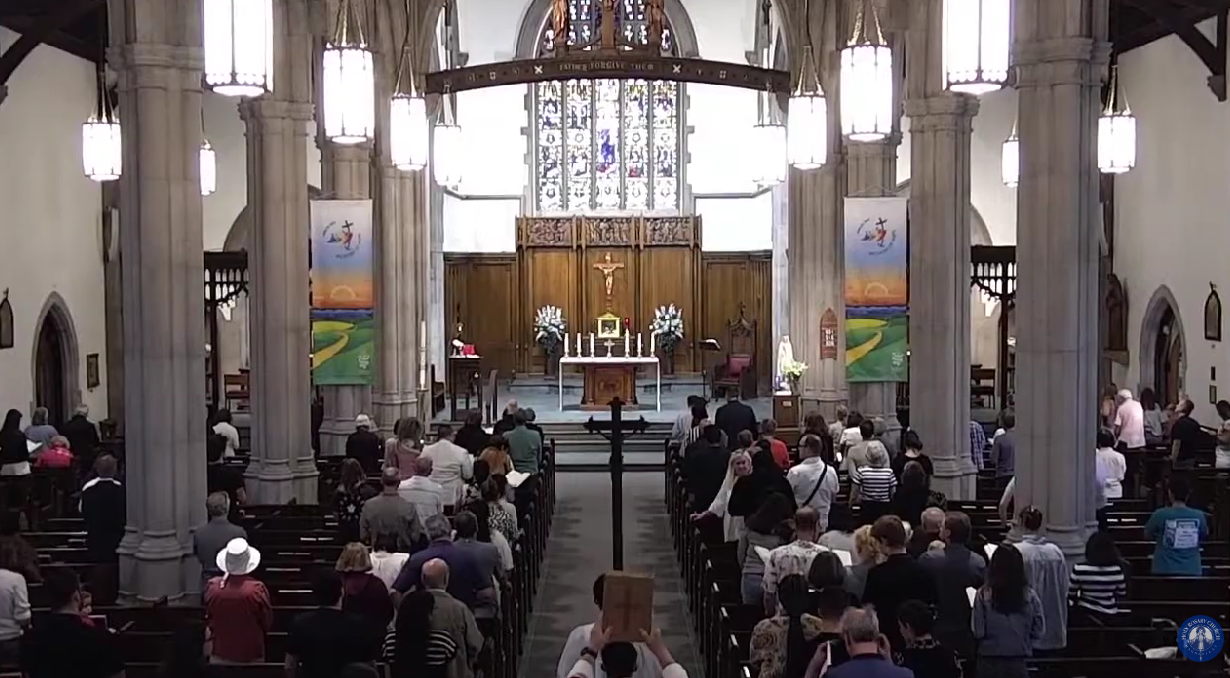
HALIFAX, Nova Scotia, February 14, 2026 – Because I came to belief as an adult rather than as a child, my faith evolved differently than most believers. Still, even as an adult, I was as docile as a child when I first believed. Having been infant-baptized into the Roman Catholic church and so believing that’s where I belonged, I started attending Catholic masses shortly after I was reborn. Sometimes I’d go twice a day (noon and five p.m.) and on Sundays I’d go three times. I couldn’t get enough of God, who (as I was told by the priests) lived in a box at the side of the altar. I’d always sit in the front pew so I could get as close to him as possible.
As I matured in my faith, I started having doubts about what the priests were telling me. I started not being able to say some of the responses during mass because I knew they were wrong. I started reading with horror about the various Inquisitions and other crimes, past and present, of the papacy. I also (and this for me was by far the worst) started to feel a distance developing between me and God. The joy that had been my constant companion in the early days and months of my rebirth began to retreat. In its place was a sense of duty (attending mass, praying the rosary, following all prayer and fasting directives issued by the pope, decorating my place with crucifixes, pictures of saints, prayer candles, etc.) that seemed to be taking me farther and farther away from God.
Three-and-a-half years into my rebirth, I was heavily involved in Catholicism. Along with attending mass daily, I sat on several committees, was appointed lector, taught a Bible class, and was even entrusted with a key to the church building, I was there so often. I also rented the church basement for my employment-related events. My life revolved around “the church”, so what happened on January 12th that year upended everything.
It was a Sunday. I was sitting in my pew after the service, reveling in my usual post-mass bliss and enjoying the smell of the just-extinguished altar candles. I loved that smell because it reminded me of birthday candles (and so birthday cake!). Other than for a few people milling around some statues of saints, lighting candles and bowing down in prayer before them, I was alone in the church’s main room. As I sat there in a haze of spiritual warm ‘n’ fuzzies, God suddenly opened my eyes. I say “opened my eyes”, but it was more like something fell from my eyes and I could see what I hadn’t seen before. And what I saw horrified me.
I was in a pagan temple. I wasn’t in a God-worshiping church, I was in a pagan temple, and the people bowing down before the statues were bowing down before effigies of demons. Even worse was the abomination of the mangled corpse that hung, larger than life, over the altar. It was a reenactment of Jesus on the cross that was supposed to represent God’s great love for us, but all I could see (and all I still see, whenever I see a crucifix) was Jesus’ tormented and humiliated body. This is not how God shows us his love.
While I sat there in shock at what was being revealed to me, the priest slipped through one of the back doors behind the altar, smiled at me, and asked me if I’d be attending the Christmas party in the church basement at noon. I managed to squeak out a “we’ll see”, to which he nodded and disappeared back through the door. Then the deacon bustled up the aisle behind me to prepare the altar for the next mass. Seeing me sitting there, he also asked me if I was attending the party, to which I managed another weak “we’ll see”. He murmured a few more pleasantries while performing his housekeeping duties and then disappeared through the same back door as the priest.
I took this as my cue to leave.
Carefully, deliberately, I stood up and put on my shoes. For three and half years, I’d removed my shoes whenever I passed the threshold of the church, believing the place to be holy ground. For me to put on my shoes while I was still at the church pew was an act of revolution. Likely no-one else noticed me putting on my shoes at the pew, but I did and God did. And then, firmly shod, I made my way to the back of the church, out the doors, and onto the street, never to return.
In showing me the truth about the church building I’d just exited, God didn’t say to leave it. He gave me no directive or command in that regard: He simply revealed to me what manner of place I was in and then left it up to me to decide what to do. But having seen what I just saw, there was no way I could stay there. And not being able to stay there (or in other places like it), I could no longer be a Catholic.
When I got back to my apartment, I immediately tore down all the crucifixes and pictures of saints adorning my walls and threw them into a box. Into a second box went my rosary beads, chaplets, prayer cards, and every other piece of Catholic paraphernalia I’d collected (at great expense) over the years, including my Catholic Bible, hymn books, and catechism. I then closed the two boxes and shoved them under a table out of sight.
I half expected to be struck by lightning through my skylight while I was doing this, but nothing happened other than that the room appeared much brighter and cleaner after the purge. Then I sat down at my kitchen table and opened a second-hand Bible I’d bought on impulse a few years earlier but hadn’t used (because it wasn’t Catholic) and started reading the Old Testament for the first time in my life. I’d been reading the New Testament every day since my rebirth, but I hadn’t yet touched the Old Testament. I’d been relying instead on the carefully selected and sanitized OT snippets that were doled out during mass. But in reading the older books for myself, I soon realized why those snippets had been so carefully selected.
The OT clearly showed that Catholicism is not Christianity. Many of the rites and rituals taught to Catholics are expressly forbidden and even outright condemned in the Old Testament. Tellingly, those verses are never included in the OT morsels spoon-fed to us during mass.
From that day forward, I removed myself entirely from the church and all its activities without telling anyone there why. God had me remain silent, as I wasn’t yet strong enough to combat their arguments. I let them draw their own conclusions as to why I’d left. Occasionally, I’d pass a congregant on the street, but they’d avert their eyes and ignore my greeting. The priest stopped me once and asked me “Charlotte, what happened?…”, but I could only mumble some vague excuse that I no longer recall and that didn’t resolve the confusion in his eyes.
The priest was a kindly man. He’d consistently supported me in everything I did at the church, appointing me as lector at noon mass and even agreeing to let me teach a Bible study, which at that time was unheard of in a Catholic church. He knew my conversion was real and that I was different from most if not all the other congregants. I could see the hurt in his eyes that day on the street, hurt and concern underlying his confusion, but God had me remain silent beyond my mumbled excuse. It wasn’t my time to explain.
The revelation God showed me on January 12th that year was an answer to a prayer I’d prayed on my face in tears on a milestone birthday nine days earlier. In that prayer, I’d begged God to take out of my life everything that was keeping me from doing his holy will, to take me back spiritually to how I was when I was first reborn. My prayer was awkward and stilted (I was repeating a phrase I’d heard from a televangelist), but my tears were real and my agony was real and my desire to reconnect with God—to be close with him again like we were at the beginning—was a cry from the heart, pure, raw, and unfeigned.
And God heard my prayer.
And he answered it.
In his time and in his way, he answered it, showing me that what was keeping me from doing his will was Catholicism and all its trappings. He didn’t tell me to leave Catholicism; he showed me what it was – first, by revealing the true nature of the place I’d been worshiping in, and second by revealing to me in scripture how Catholicism violated his commands and how I’d been replacing him with Catholicism, faith with religion. What I chose to do with that knowledge was up to me.
I know I made the right choice in walking away from the Catholic organization. Although my life was temporarily upended and I became an outcast in that community, the reward was a closer relationship with God. My prayer was answered in the best possible way. I’ve never once regretted leaving Catholicism and I have no plans to return. But in rejecting the church, I didn’t reject the people I’d met there; most of them were kind-hearted and well-meaning, just spiritually confused. It wasn’t Catholics I was rejecting, it was Catholic doctrines, Catholic creeds, Catholic paraphernalia, and the whole rotting edifice of the papacy. It’s all spiritual garbage, but it does have a worldly purpose, and so I let it be. Catholicism is not my concern.
I’m glad I experienced the worldly church firsthand, but I’m also glad it was “one and done”. I might have been infant-baptized into Roman Catholicism, but I was reborn into God’s Kingdom. I know now, as a mature bornagain believer, that my worship center is the Kingdom established by Jesus, and my fellow worshipers are bornagain believers. This is my Church. These are my people. This is where I belong. No buildings. No creeds. No recitations. No props. Faith, not religion. Just us living in constant spiritual communion with each other and with God and Jesus, through God’s Holy Spirit.
This is all I want and this is all I need until I get Home.
SOAP

HALIFAX, Nova Scotia, February 13, 2026 – In the lead-up to the Flood, Noah continued to preach, even while knowing (because God told him) that he and his family would be the only ones spared. Likewise, Moses shepherded the children of Israel through the wilderness for 40 years, all the while knowing (because God told him) that of those who were 20 years or older when they left Egypt, only Joshua and Caleb would make it to the Promised Land. And in the tribulation to come, scripture tells us that two witnesses will preach to the remnant and to a spiritually dead people, the latter who will never turn back to God.
One of the heaviest crosses we bear as bornagain believers is witnessing and ministering to those we know will never turn. In these cases, we don’t witness and minister for their sake, but because God tells us to. It’s our duty as God’s children to witness and minister, even if our efforts bear no visible fruit.
Especially if our efforts bear no visible fruit.
**********
I live in Canada. I was born here and have lived here most of my life. I was not raised as a believer but I became a believer as an adult. Since then, I’ve watched the percentage of professing believers decline to the point that Canada now is, sadly, minority Christian.
Canada was founded in 1867 as a nation with an overwhelmingly majority Christian population (around 99%). It remained majority Christian until about a decade ago. And, as we know, a nation that is minority Christian is by default majority demon. There’s no third option. There’s no “secular nation”. Secular is yet another euphemism for demonic.
So here I am, living in a majority-demon country that in less than 150 years morphed from nearly 100% Christian to far less than 50%. Most other Western nations have suffered similar fates during the same timeframe. The United States appears to be the last man standing with regard to the rate of decline of its Christian population, but it’s still declining. Just slower.
And yet even amidst this unstoppable (because prophesied) downward spiritual trajectory, we still need to preach – first and foremost to each other, but also as witnesses to unbelieving nations. And we do so knowing that our words (other than those we share among ourselves) will be rejected and cursed and twisted back onto us as a trap. I’ve seen it happen over and over again, the purposely malignant misinterpretation of God’s Word, and still I continue to preach. It’s my job, as a bornagain believer. I cannot not preach.
For the past 11 years, this blog has served as my main witness, not because it’s aimed at unbelievers (it’s very much and solely aimed at bornagain believers) but because unbelievers come here, some out of curiosity and some looking for ammo to use against me when the time is right. I give it to them freely, the ammo, only I call it Truth and God’s Word. Let them call it what they want.
Just like God sends the sun and rain on both the just and unjust, we’re to witness first and foremost to each other, and if unbelievers wander by while we’re witnessing, let them hear. Even better – hand them some soap as the Word washes over them. It may be that some of the grime will be washed from their soul, and their eternity won’t be as bad as it would have been.
We can be under no illusion that the prophesied falling away is reversible. It can be slowed but not reversed. Noah knew that only his family would make it to the ark. Moses knew that only Joshua and Caleb would make it to the Promised Land. We know that only bornagain believers (and not even all bornagain believers) will make it Home. And yet still we preach. And yet still we witness – to each other first and foremost, but also to whomsoever will for whatsoever reason.
Though the general spiritual trajectory is now downward, ours is ever upward. We’re to draw as many upward with us as we can, while there’s still time.
ON ONE WORLD RELIGION

HALIFAX, Nova Scotia, February 10, 2026 – The god of Islam is not my God. Neither is the god of post-resurrection Judaism. These cults do not worship Jesus’ Father. That we all worship the same “deity” is a lie. As a born-again believer, I worship the Father of Jesus who, since my rebirth, is my Father, too. I don’t know who or what Muslims and modern Jews worship, and frankly I don’t want to know.
I am not spiritually yoked together with anyone who isn’t a born-again believer. The Christian ecumenism being pushed by the worldly church is bad enough, but framing the “three Abrahamic religions” as spiritually equal is an abomination. The first time I went into an airport “Worship Centre” (formerly known as a chapel), I felt like I’d entered a pagan (i.e., demonic) zone. Muslim “holy books” were piled on top of Jewish “holy books” piled on top of the Holy Bible. Loosely rolled “prayer rugs” were piled in the corner. What had formerly been a sanctuary for quiet reflection—a place to calm one’s pre- or post-flight nerves—had become a pop-up exercise studio. All that was missing was driving-beat music.
While I sat there silently reading the Bible, a steady parade of men came and went. Some unrolled a rug and assumed various yoga-like positions while chanting and occasionally howling. Others sat muttering and rocking back and forth like the poor tormented souls I’d seen in videos of insane asylums. These were not my spiritual brethren, these howling, chanting, rocking humans. If this is how they worship, you cannot convince me that they and I worship the same God.
In the public realm, I gladly do business with Muslims and Jews. I treat them as I do everyone else. I do not discriminate based on any metric. But I cannot worship with them because we do not worship the same Being. There are no “three Abrahamic religions”: There is only God, the Father of Jesus, who is also the God of Abraham, the God of Isaac, the God of Jacob, and the God of born-again believers. There has only ever been one God, and Jesus is his one and only Messiah.
Anyone who tells you otherwise is lying.
FAMILY?

HALIFAX, Nova Scotia, February 10, 2026 – In the worldly church, much is made of the ideal “holy family” of Jesus, Mary, and Joseph. But the truth is that during his ministry years, Jesus didn’t get along very well with his family. They were estranged and at odds with him, refusing to believe that he was the Messiah. They even at one point tried to stop his ministry, prompting Jesus to declare publicly that his real family was “those who do the will of [his] Father in Heaven”.
Scripture says that God will take us “one of a city” and “two of a family” – not whole cities and not whole families, but only a select few (or less) from each. This, too, is at odds with worldly church propaganda, which falsely promotes the assured heavenly destination of even the shakiest of believers. What we can see from the Gospel narrative is that the holy family of Jesus, Mary, and Joseph existed for brief moments in time, not constantly throughout their years as a family unit. Mary and some of Jesus’ other blood relatives didn’t even accept Jesus was the Messiah until after his crucifixion.
I mention all this because we too, as born-again believers, likely have unbelieving families. It’s baked into scripture and therefore into our lived reality. If Jesus went through the experience of being the sole believer in his family, so will we. It’s nothing to fight and nothing to lament.
Still, living among and socializing with spiritually hostile blood relatives can be a trial in the truest sense of the word. It’s meant to be a trial and we’re expected to handle it properly. By “properly”, I mean like Jesus handled it. And how did he handle it? By limiting his interactions with his unbelieving relatives. By refusing to compromise who and what he was in God’s eyes. By putting his duty to God ahead of his duty to his blood relatives. By prioritizing doing God’s will and God’s will only.
It can be a minefield to tread among unbelieving relatives, especially when some of them are actively working against you. When Jesus said that we’ll find our worst enemies among our own kith and kin, and he wasn’t overstating or being dramatic. God will permit Satan to use these people to test us, because where more frequently do we “let our hair down” and just be ourselves than among those we grew up with? It’s in these familiar and intimate settings that God wants to see how we respond to provocations. Out in the world among strangers, we act and react self-protectively—at arm’s length—whereas within the bosom of our families we tend to do and say things without overthinking them. It’s in these raw uncalculated moments that God can best assess our spiritual development.
A case in point for me is having “pagan” witches and freemason witches as relatives. How am I, as a born-again believer, to interact with these servants of Satan? The same way my believing grandmother used to interact with me before I was born-again – with patience, with kindness, and with copious behind-the-scenes prayers. It helps for me to remember the many kindnesses these relatives did before they signed on with the devil. Paul says that if there’s anything good in a person, we should think on that, and so I do. While it’s highly unlikely that these people will ever renounce their satanic oaths, that’s not my business. My business is to pray for whoever God guides me to pray for in the way that God shows me. The rest I let be.
Even within his own immediate family, Jesus experienced the emotional minefield of interacting with spiritual enemies. Thanks to the record of the Gospels, we know how he dealt with them. We are to do the same.
THE CHURCH INDESTRUCTIBLE
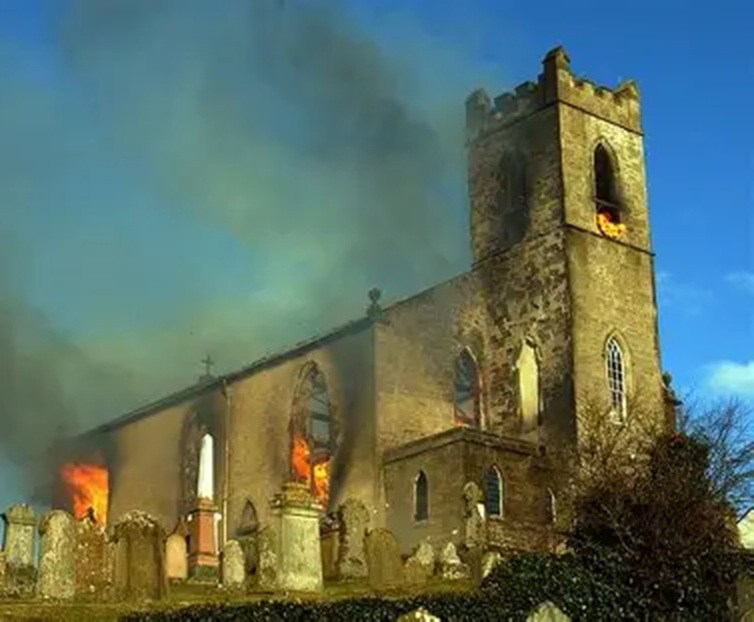
HALIFAX, Nova Scotia, February 9, 2026 – Jesus never intended for us to gather in a building to pray and worship. In fact, shortly before his crucifixion, Jesus said that going to the temple in Jerusalem and doing the things that were done there (rituals, rites, sacrifices, etc.) would soon no longer be required, that the temple of stone would be replaced with the temple of his risen body. By “temple”, he meant the Church. As born-agains, we know that the Church is the collective of Holy Spirit-filled believers that exist on Earth at any given time. Even without a building (and especially without a building), the Church will exist until Jesus comes back to take the last of his followers Home.
Paul also, in laying the foundation for the worldly church, never designated certain buildings as prayer and worship sites. When he talked about the church in this or that city or town, he meant people who identified as believers (some were born-again believers, some weren’t) who lived there. He was not referring to a building or (God forbid) a denomination. To Paul, the church was made up of those who believed that Jesus was the prophesied Messiah. Rebirth wasn’t a prerequisite in Paul’s worldly church as it was in Jesus’ Church. If you’re genuinely born-again, you know what I mean.
Then somewhere along the way, the building itself started to be called “the church”, and people rallied around the building instead of rallying around God and Jesus. So when the building a.k.a. church was emptied or demolished, the impression was that the body of believers had likewise shrivelled and died. This is the devil’s doing, to inspire a building to be called a church rather than the body of believers to be called the Church, as Jesus intended. This is the devil’s doing, and he’s been very successful at dividing the falling house of nominal believers through creeds, denominations, and deconsecrated structures.
The demolishing of buildings designated as churches, or their revamping into condos, mosques, or other worldly or spiritual uses, is mainly for optics, like a notch in the devil’s belt or a feather in his cap. Yes, the worldly church, built as it is on the shaky ground of self-identifying belief rather than God-inspired belief, is ultimately destined for destruction, but the Church whose cornerstone is Jesus cannot be destroyed. It is by very definition indestructible. Having its presence solely in the spiritual realm, the Church of genuine born-again believers is fully protected by God through his Holy Spirit and will persist until Jesus comes back in glory to take his remnant Home.
We, the Church built on Jesus, are not called to worship and “fellowship” in a building that is little more than a social club but to reach out to one another constantly in prayer, to support one another constantly in prayer, and to love one another constantly in prayer. Jesus said that’s how we’ll be known, by our love for one another – not for our love for the world, but for one another. I pray for you and you pray for me, even if we don’t know each other by name or know that the other exists. We can rest assured that the Church Indestructible does exist (if it didn’t, none of us would be here), and it is for this Church that we’re to send up our most fervent prayers.
Because as long as the Church exists, the world exists; and as long as the world exists, there is still hope for some. But when the last of us leaves – and God’s Holy Spirit leaves with us – hope will be no more.
START NOW

HALIFAX, Nova Scotia, February 9, 2026 – It’s a terrible thing to waste the time that God’s allotted you, to do the things he’s told you not to do and not to do those things he’s told you specifically to do. You’ll not be held guiltless at the Judgement for wasting your allotted time and for disobeying God. Maybe you think you’re somehow exempt, but so too did the children of Abraham, who thought that by being children of Abraham they could bypass Judgement, but Jesus told them they were wrong. You, too, are wrong if you think that by virtue of being “saved” you’re home-free, no questions asked. If you were genuinely born-again, you’d know there’s no guaranteed ticket Home. There’s the grace of God that you live by now and the mercy of God at your death. Nowhere in scripture are you guaranteed Paradise.
But still, you do play a role in getting Home, and don’t let anyone convince you otherwise. God wants to see that you want what he’s offering more than what the devil is offering, and you’ll be tested to that effect. Anyone can say they believe in God or they believe in Jesus or they want to go to Heaven, but it’s in the doing that your heart is revealed. Not in the saying but in the doing, especially your response to God’s correction and to doing what’s right when everyone around you is given the go-ahead to do what’s wrong. In that situation in particular – when the law of the land is contrary to God’s law, or when the will of the majority is set against you – God watches closely to see what you’ll do. This is a big part of how you earn your ticket home: by choosing to do what’s right in God’s eyes even when the world punishes you for it.
You cannot get to Heaven by convincing yourself that you’re going, any more than you can be born-again by convincing yourself that you’re reborn. Jesus says the Spirit goes where it wills; God determines who is reborn, not you or your pastor. God decides who is born-again and God himself performs the rebirth, which is an exorcism of demonic spirits followed by an inrushing of God’s Holy Spirit into the reborn soul. If you were genuinely born-again, you’d know that the Holy Spirit will not dwell in the same soul as demons.
It’s a terrible thing to waste the grace of time that God’s allotted you. Your sole focus should be God. Your sole ambition should be aligning your will with God’s, like Jesus did. If you’re not doing that to the best of your ability, start now.
THE GIFT
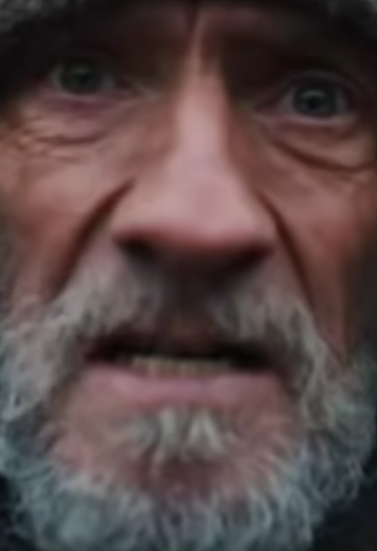
HALIFAX, Nova Scotia, February 4, 2026 – There was a guy, a few weeks before Christmas, who was slumped in an old manual wheelchair at what is probably the coldest, windiest, and busiest intersection in Halifax. That day it was also snowing. But the old man didn’t seem to notice the snow, or if he did, didn’t care. He was on a mission. He was crying over and over again “Jesus is coming!”, and he’d obviously cried it so many times by the time I’d arrived, his voice was a croak. And yet despite the cold and the wind and vocal cords strained to breaking, the man didn’t abort his mission. He continued to preach. In response, the throngs of people hurrying by didn’t so much as lift their eyes from their phones. To them, he wasn’t there.
I stopped for a minute to listen to him. He was elderly and gaunt and looked ill. He also wasn’t dressed for the cold. I thought at first he was just another panhandler like the dozens of panhandlers plying their trade along that busy strip, but I didn’t see a cup or upended hat near him. He wasn’t begging. He was giving rather than taking.
Nearly two months later, I can still see him in his wheelchair with the snow and crowds swirling around him. I can still hear his voice. He hasn’t been back to that corner since, or at least I haven’t seen him. Maybe he’s moved on to another intersection elsewhere in the city, or maybe that was the only time he’d preached. Maybe some force drove him out into the bitter cold and wind that day to cry those few words over and over, some force that he didn’t quite understand and yet obeyed. I’m glad he did.
Because even though he isn’t there, I still see him. I still hear him. His simple message still rings in my head loud and clear: “JESUS IS COMING!” And whether Jesus comes today or tomorrow or in another 2000 years, he is coming. That is a guarantee. And whether we receive his coming with joy or with shame – well, that’s the whole point of the old man’s message.
 A BORN-AGAIN BELIEVER