HALIFAX, Nova Scotia, June 9, 2025 – I understand why Jesus started his ministry work by spending 40 days and nights alone in the desert. I also understand why John the Baptist lived most of his life in the wilderness, and why so many prophets throughout the ages have chosen to live alone and in isolation, not just away from the “madding crowd” but from everyone, especially religious people. By “religious people”, I mean those who claim to believe in God but actually only hold to a belief system made up of rituals, recitations, pageantry, creeds – learned behavior, not something that emerges organically from God’s Holy Spirit living in a soul. Holding to a belief system is not genuine worship. All religions are premised on holding to a belief system, which is how you can distinguish genuine faith from religion. People who genuinely believe in and worship God aren’t religious, and their belief is not a system but evidence of the presence of God’s Holy Spirit in them.
I understand why Jesus started his ministry work in total isolation and why John the Baptist and others like him chose to live in the wilderness, not just retreat to it on occasion. The world is a hectic, frantic, and noisy place perpetually at odds with God and constantly reaching out to turn you this way and that, to lure you off the straight and narrow. But as noisy and frantic as the anti-God crowd is, the religious crowd is even more frenetic and shrill.
So many people now claim to be prophets, to be hearing from God—to have a dream or a vision or a word—but it all smacks of self-promotion. From the pope and headliner televangelists all the way down to obscure YouTubers with a handful of subscribers, they’re in it for the money, and if not for the money, for the power, and if not for the money and/or the power, then for their ego, forcing your back against the wall to get you to agree with them. Yet for all their pomp and bluster, they’re not pointing you to God and Jesus, they’re pointing you to themselves and their donations button. That’s one way to know they’re false prophets.
Not everyone’s voice needs to be heard when it comes to God and his Word. God himself is a ‘still quiet voice’, not a pushy one, not a shrill one, and not even one that demands our attention, though no-one deserves our attention more than God. Yes, God does command on occasion, but he mostly invites. He doesn’t push himself on anyone and has never once forced anyone’s back to the wall, demanding they agree with him. Nowhere in scripture do we see God pushing himself on anyone. Jesus didn’t push himself on anyone either, which set him apart from the false prophets and rabble-rousers that thronged the streets and public houses of the dying Jewish state, vying for people’s attention and money.
Yes, I understand why a genuine prophet needs to get away from the racket, because it is a racket in every sense of the term. It was a racket back in Elijah’s day and it’s a racket now. Too bad we can’t deal with the false prophets the way that Elijah did (or better said, the way God did), but that’s not what Jesus wants us to do. Taking our cue, as always, from Jesus, we know just to get away when it’s time to get away.
And how shall we do that? Shall we live like the homeless, brazenly setting up camp on a busy sidewalk or quietly tucked away at the far end of a park? Shall we roam restlessly from place to place, never spending more than a night here or there, or should we hunker down maybe at a monastery and stay long enough to bring a garden from seedling to harvest? Where can God’s children go to get away from it all? Where does God want us to go?
Jesus went to the desert, to wilderness places, to mountaintops. Sometimes he even just walked across large bodies of water, alone. I don’t think the location really mattered; it was the isolation factor that mattered, the solitary factor: the one-on-one time with God. Because that’s what the world wants to take away from you more than anything else – your God-given right to be in God’s presence and spend alone-time with him. They don’t forcibly take that from you; they try to convince you that it isn’t possible or isn’t desirable or simply isn’t for you (and here’s something much better!), but nothing’s better than alone-time with God. You cannot convince me otherwise.
Jesus couldn’t be convinced, either, which is why he was always going off by himself to pray and advising us to pray alone. It’s hard to get alone-time with God when people are hanging around, though it can be done. Jesus did it on the cross.
Moses also famously preferred alone-time with God above all else. He scaled a burning mountain not once but twice, enduring 40 days and nights without food or drink or sleep to be in God’s presence, though I’m guessing it didn’t feel to him like 40 days and nights. That’s how it is when you’re in God’s presence; you lose track of time, or better said, you lose the perception of the passage of time. And when he could no longer go up a mountain to be alone with God, Moses built a tabernacle according to God’s specifications and spent alone-time with God there.
Thanks to Jesus’ sacrifice, we no longer need to go to mountaintops or tabernacles or into designated spaces to be alone with God. We don’t have to stand with our eyes closed or our hands clasped or upraised. Jesus said there’d come a time when such formalities would no longer be required. We can be alone with God—that is, we can pray—anywhere and at anytime.
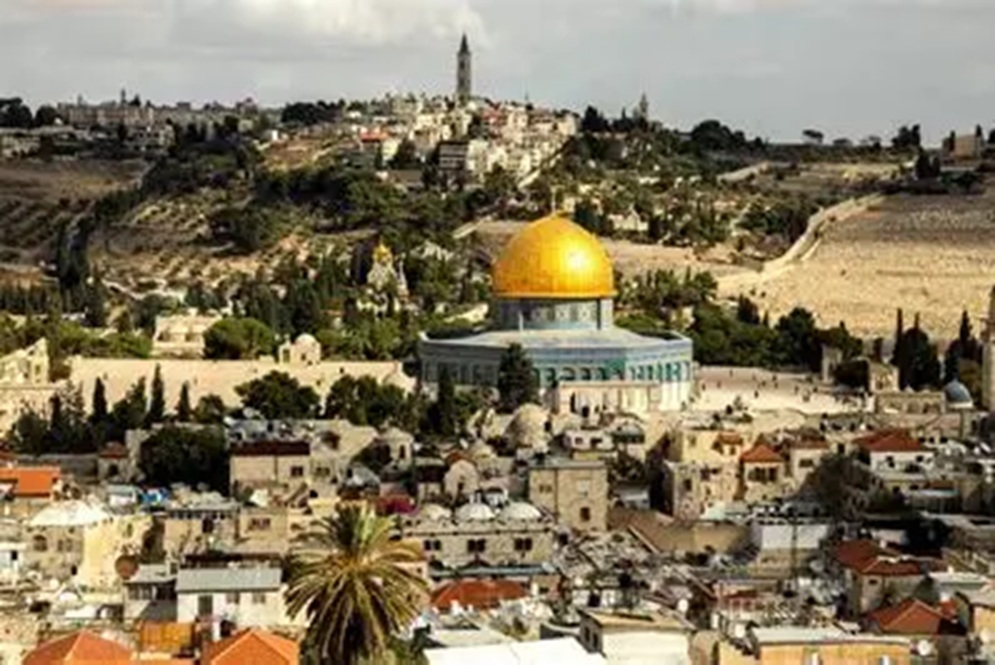
I always laugh a little bit inside when I read about the “No Praying” restrictions in certain religious sites, like at the Al Aqsa Mosque on the temple mount in Jerusalem where, by law, only Muslims are “allowed” to pray. As a born-again believer, I can pray just walking down the street or sitting on a bus or sometimes even during a conversation. I don’t appear to be praying, but I am. And because I can pray anywhere and at anytime without anyone except God and Jesus knowing I’m praying, I could surely pray at the Al Aqsa if I went there. So I laugh a little bit inside me when I hear about the “no-prayer zones” in Jerusalem and at other sites that are sacred to the world, like abortion clinics. For us, there’s no such thing as no-prayer zones. They simply don’t exist, no matter how many signs are erected or by-laws enacted or police officers assigned to enforce them. We can pray anywhere and at anytime without appearing to pray, and no-one can stop us.
Which leads me to conclude that maybe getting away from it all isn’t always necessary. Sometimes, yes, but not always, not when we can be alone with God even in Times Square on New Year’s Eve. Laws against praying don’t apply to those who follow Jesus and his advice on how to spend alone-time with God. It’s one of the many gifts, rights, and privileges God has given to his children, and the world cannot—dare not—intervene.
 A BORN-AGAIN BELIEVER